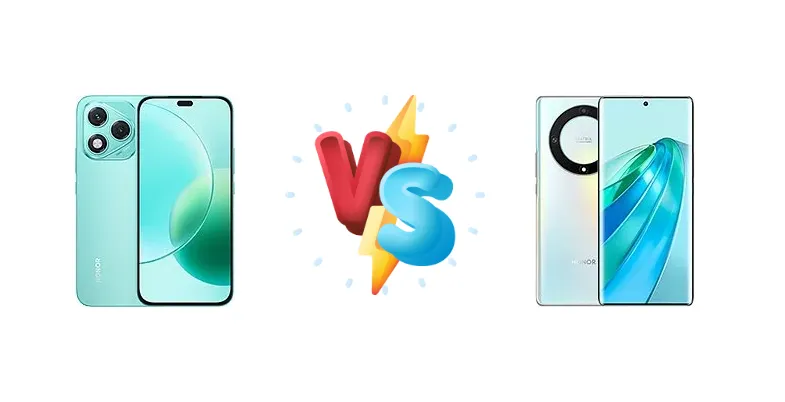
The Honor 400 Lite and X9a represent Honor's strategy in the competitive mid-range smartphone market. The 400 Lite, featuring the newer Mediatek Dimensity 7025 Ultra, aims for a balance of performance and efficiency. Meanwhile, the X9a, powered by the Qualcomm Snapdragon 695 5G, focuses on established 5G connectivity and a slightly faster charging experience. This comparison will dissect their key differences to help you choose the right device.
🏆 Quick Verdict
For the average user prioritizing sustained performance and longer battery life, the Honor 400 Lite emerges as the stronger contender. Its Dimensity 7025 Ultra chipset, coupled with impressive 48:56h endurance, offers a more robust experience than the Snapdragon 695-powered X9a, despite the latter's slightly faster 40W charging.
| Network |
|---|
| 2G bands | GSM 850 / 900 / 1800 / 1900 | GSM 850 / 900 / 1800 / 1900 |
| 3G bands | HSDPA 850 / 900 / 1900 / 2100 | HSDPA 850 / 900 / 1900 / 2100 |
| 4G bands | LTE | LTE |
| 5G bands | SA/NSA | SA/NSA |
| Speed | HSPA, LTE, 5G | HSPA, LTE, 5G |
| Technology | GSM / HSPA / LTE / 5G | GSM / HSPA / LTE / 5G |
| Launch |
|---|
| Announced | 2025, April 03 | 2023, January 04 |
| Status | Available. Released 2025, April 08 | Available. Released 2023, January 06 |
| Body |
|---|
| Dimensions | 161 x 74.6 x 7.3 mm (6.34 x 2.94 x 0.29 in) | 161.6 x 73.9 x 7.9 mm (6.36 x 2.91 x 0.31 in) |
| SIM | Nano-SIM + Nano-SIM + eSIM (max 2 at a time) | Nano-SIM + Nano-SIM |
| Weight | 171 g (6.03 oz) | 175 g (6.17 oz) |
| Display |
|---|
| Protection | Mohs level 4 | - |
| Resolution | 1080 x 2412 pixels, 20:9 ratio (~394 ppi density) | 1080 x 2400 pixels, 20:9 ratio (~395 ppi density) |
| Size | 6.7 inches, 108.0 cm2 (~89.9% screen-to-body ratio) | 6.67 inches, 107.4 cm2 (~89.9% screen-to-body ratio) |
| Type | AMOLED, 120Hz, 3840Hz PWM, 3500 nits (peak) | AMOLED, 1B colors, 120Hz, 800 nits (HBM) |
| Platform |
|---|
| CPU | Octa-core (2x2.5 GHz Cortex-A78 & 6x2.0 GHz Cortex-A55) | Octa-core (2x2.2 GHz Kryo 660 Gold & 6x1.7 GHz Kryo 660 Silver) |
| Chipset | Mediatek Dimensity 7025 Ultra (6 nm) | Qualcomm SM6375 Snapdragon 695 5G (6 nm) |
| GPU | IMG BXM-8-256 | Adreno 619 |
| OS | Android 15, up to 6 major Android upgrades, MagicOS 9 | Android 12, upgradable to Android 13, MagicOS 7 |
| Memory |
|---|
| Card slot | No | No |
| Internal | 256GB 8GB RAM, 256GB 12GB RAM | 128GB 6GB RAM, 128GB 8GB RAM, 256GB 8GB RAM |
| Main Camera |
|---|
| Dual | 108 MP, f/1.8, (wide), 1/1.67", PDAF
5 MP, f/2.2, (ultrawide) | 64 MP, f/1.8, (wide), PDAF
5 MP, f/2.2, (ultrawide)
2 MP (macro) |
| Features | LED flash, HDR, panorama | LED flash, panorama, HDR |
| Single | - | 16 MP, f/2.5, (wide) |
| Video | 1080p@30fps | 1080p@30fps |
| Selfie camera |
|---|
| Single | 16 MP, f/2.5, (wide) | 16 MP, f/2.5, (wide) |
| Video | 1080p@30fps | 1080p@30fps |
| Sound |
|---|
| 3.5mm jack | - | No |
| 35mm jack | No | No |
| Loudspeaker | Yes | Yes |
| Comms |
|---|
| Bluetooth | 5.3, A2DP, LE | 5.1, A2DP, LE, aptX HD |
| Infrared port | - | Yes |
| NFC | Yes (market/region dependent) | Yes |
| Positioning | GPS, GLONASS, GALILEO, BDS | GPS, GLONASS, GALILEO, BDS |
| Radio | Unspecified | No |
| USB | USB Type-C 2.0, OTG | USB Type-C 2.0, OTG |
| WLAN | Wi-Fi 802.11 a/b/g/n/ac, dual-band, Wi-Fi Direct | Wi-Fi 802.11 a/b/g/n/ac, dual-band, Wi-Fi Direct |
| Features |
|---|
| Sensors | Fingerprint (under display, optical), accelerometer, compass, proximity (ultrasonic) | Fingerprint (under display, optical), accelerometer, gyro, proximity, compass |
| | - | 24-bit/192kHz audio |
| Battery |
|---|
| Charging | 35W wired | 40W wired |
| Type | Li-Po 5230 mAh | Li-Po 5100 mAh |
| Misc |
|---|
| Colors | Marrs Green, Velvet Black, Velvet Grey | Titanium Silver, Emerald Green, Midnight Black |
| Models | ABR-NX1, ABR-N31C1 | RMO-NX1 |
| Price | € 199.90 / $ 308.03 / £ 169.00 | $ 212.08 |
| EU LABEL |
|---|
| Battery | 48:56h endurance, 1400 cycles | - |
| Energy | Class B | - |
| Free fall | Class B (180 falls) | - |
| Repairability | Class B | - |
Honor 400 Lite
- Superior CPU performance with the Dimensity 7025 Ultra
- Exceptional battery life (48:56h endurance)
- Longer battery lifespan (1400 charge cycles)
- Slower charging speed (35W) compared to the X9a
- Display specifications are unknown
Honor X9a
- Faster charging speed (40W)
- Established 5G connectivity with Snapdragon 695
- Potentially lower price point (depending on market)
- Less powerful CPU compared to the Dimensity 7025 Ultra
- Likely shorter battery life and fewer charge cycles
Display Comparison
Display specifications are not provided, so a direct comparison is limited. However, given the price points, both devices likely utilize LCD panels. The X9a, being an older model, may have slightly larger bezels. Color accuracy is likely similar, leaning towards the standard sRGB color gamut. Without specific data, it's reasonable to assume both displays are adequate for everyday use, but not flagship-level.
Camera Comparison
Camera details are absent, making a thorough comparison impossible. However, given the market segment, both phones likely feature a primary camera paired with depth and macro sensors. The quality will heavily depend on the main sensor's resolution and aperture. Without this information, it's difficult to determine which phone captures better images. The inclusion of a 2MP macro camera on either device is likely a marketing feature with limited practical benefit.
Performance
The core difference lies in the chipsets. The Honor 400 Lite’s Mediatek Dimensity 7025 Ultra (6nm) boasts a more modern CPU architecture with its 2x2.5 GHz Cortex-A78 cores, compared to the X9a’s 2x2.2 GHz Kryo 660 Gold cores in the Snapdragon 695 (6nm). While both are 6nm chips, the Cortex-A78 offers a performance advantage in CPU-intensive tasks. The Dimensity 7025 Ultra’s GPU is also likely to outperform the Snapdragon 695’s Adreno 619, translating to smoother gaming. The 400 Lite’s CPU configuration suggests better multi-tasking capabilities, benefiting users who frequently switch between apps.
Battery Life
The Honor 400 Lite shines with a remarkable 48:56h endurance, indicating excellent power efficiency. While the X9a’s battery capacity is unknown, the 400 Lite’s longevity suggests a larger battery or more efficient chipset. The 400 Lite supports 35W wired charging, while the X9a offers 40W. This means the X9a will likely charge slightly faster, but the 400 Lite’s superior endurance means you’ll need to charge it less frequently. The 400 Lite also boasts 1400 charge cycles, suggesting a longer lifespan before battery degradation becomes noticeable.
Buying Guide
Buy the Honor 400 Lite if you need a phone that can handle demanding apps and longer gaming sessions without significant throttling, and if battery life is a top priority. Buy the Honor X9a if you prioritize a slightly quicker charging experience and are primarily focused on basic smartphone tasks and 5G connectivity, and are less concerned with peak performance.
Frequently Asked Questions
❓ Will the Dimensity 7025 Ultra in the Honor 400 Lite handle demanding games like Genshin Impact?
The Dimensity 7025 Ultra is a capable chipset for mid-range gaming. While it won't deliver flagship-level performance, it should handle Genshin Impact at medium settings with playable frame rates. The improved GPU compared to the Snapdragon 695 in the X9a will contribute to a smoother gaming experience.
❓ How much faster is the 40W charging on the Honor X9a compared to the 35W charging on the Honor 400 Lite?
The difference in charging speed is likely to be around 15-20 minutes for a full charge. While 40W is faster, the Honor 400 Lite’s exceptional battery life means you won’t need to charge it as often, mitigating the slower charging speed.
❓ Does the Snapdragon 695 in the Honor X9a support carrier aggregation for improved 5G speeds?
Yes, the Snapdragon 695 does support carrier aggregation, which can significantly improve 5G download and upload speeds in areas with good network coverage. This is a key benefit for users who rely heavily on 5G connectivity.
❓ Is the 1400 charge cycle claim for the Honor 400 Lite realistic, and what does it mean for long-term battery health?
1400 charge cycles is a substantial number and suggests that Honor has implemented battery health management features to prolong the battery's lifespan. It means the battery is expected to retain a significant portion of its original capacity after undergoing 1400 full charge-discharge cycles, offering better long-term reliability.