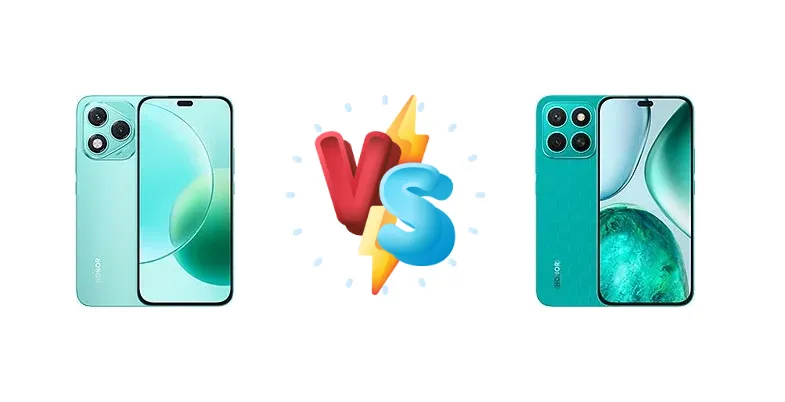
Honor's mid-range offerings, the 400 Lite and X8c, present a compelling choice for budget-conscious consumers. The 400 Lite arrives with the newer Mediatek Dimensity 7025 Ultra, while the X8c relies on the Qualcomm Snapdragon 685. This comparison dissects the key differences to determine which device delivers the best overall experience.
🏆 Quick Verdict
For users prioritizing raw performance and future-proofing, the Honor 400 Lite is the clear winner. Its Dimensity 7025 Ultra chipset offers a significant CPU and potentially GPU advantage. However, the Honor X8c remains a viable option for those seeking a reliable daily driver with adequate performance at a potentially lower price point.
| Network |
|---|
| 2G bands | GSM 850 / 900 / 1800 / 1900 | GSM 850 / 900 / 1800 / 1900 |
| 3G bands | HSDPA 850 / 900 / 1900 / 2100 | HSDPA 850 / 900 / 1900 / 2100 |
| 4G bands | LTE | LTE |
| 5G bands | SA/NSA | - |
| Speed | HSPA, LTE, 5G | HSPA, LTE |
| Technology | GSM / HSPA / LTE / 5G | GSM / HSPA / LTE |
| Launch |
|---|
| Announced | 2025, April 03 | 2025, January 14 |
| Status | Available. Released 2025, April 08 | Available. Released 2025, January 20 |
| Body |
|---|
| Build | - | Glass front, plastic frame, plastic back or silicone polymer back (eco leather) |
| Dimensions | 161 x 74.6 x 7.3 mm (6.34 x 2.94 x 0.29 in) | 161.1 x 74.6 x 7.1 mm (6.34 x 2.94 x 0.28 in) |
| SIM | Nano-SIM + Nano-SIM + eSIM (max 2 at a time) | Nano-SIM + Nano-SIM |
| Weight | 171 g (6.03 oz) | 174 g (6.14 oz) |
| Display |
|---|
| Protection | Mohs level 4 | - |
| Resolution | 1080 x 2412 pixels, 20:9 ratio (~394 ppi density) | 1080 x 2412 pixels, 20:9 ratio (~394 ppi density) |
| Size | 6.7 inches, 108.0 cm2 (~89.9% screen-to-body ratio) | 6.7 inches, 108.0 cm2 (~89.9% screen-to-body ratio) |
| Type | AMOLED, 120Hz, 3840Hz PWM, 3500 nits (peak) | AMOLED, 120Hz, 1200 nits (HBM), 2800 nits (peak) |
| Platform |
|---|
| CPU | Octa-core (2x2.5 GHz Cortex-A78 & 6x2.0 GHz Cortex-A55) | Octa-core (4x2.8 GHz Cortex-A73 & 4x1.9 GHz Cortex-A53) |
| Chipset | Mediatek Dimensity 7025 Ultra (6 nm) | Qualcomm SM6225 Snapdragon 685 (6 nm) |
| GPU | IMG BXM-8-256 | Adreno 610 |
| OS | Android 15, up to 6 major Android upgrades, MagicOS 9 | Android 15, MagicOS 9 |
| Memory |
|---|
| Card slot | No | No |
| Internal | 256GB 8GB RAM, 256GB 12GB RAM | 128GB 6GB RAM, 128GB 8GB RAM, 256GB 8GB RAM, 512GB 8GB RAM |
| Main Camera |
|---|
| Dual | 108 MP, f/1.8, (wide), 1/1.67", PDAF
5 MP, f/2.2, (ultrawide) | 108 MP, f/1.8, 24mm (wide), 1/1.67", PDAF, OIS
5 MP, f/2.2, (ultrawide) |
| Features | LED flash, HDR, panorama | LED flash, HDR, panorama |
| Video | 1080p@30fps | 1080p@30fps, gyro-EIS |
| Selfie camera |
|---|
| Single | 16 MP, f/2.5, (wide) | 50 MP, f/2.1, (wide) |
| Video | 1080p@30fps | 1080p@30fps |
| Sound |
|---|
| 35mm jack | No | No |
| Loudspeaker | Yes | Yes |
| Comms |
|---|
| Bluetooth | 5.3, A2DP, LE | 5.0/5.1, A2DP, LE |
| NFC | Yes (market/region dependent) | Yes (market/region dependent) |
| Positioning | GPS, GLONASS, GALILEO, BDS | GPS, GLONASS, GALILEO, BDS |
| Radio | Unspecified | No |
| USB | USB Type-C 2.0, OTG | USB Type-C 2.0, OTG |
| WLAN | Wi-Fi 802.11 a/b/g/n/ac, dual-band, Wi-Fi Direct | Wi-Fi 802.11 a/b/g/n/ac, dual-band, Wi-Fi Direct |
| Features |
|---|
| Sensors | Fingerprint (under display, optical), accelerometer, compass, proximity (ultrasonic) | Fingerprint (under display, optical), accelerometer, gyro, compass, proximity (ultrasonic) |
| Battery |
|---|
| Charging | 35W wired | 35W wired |
| Type | Li-Po 5230 mAh | Li-Po 5000 mAh |
| Misc |
|---|
| Colors | Marrs Green, Velvet Black, Velvet Grey | Marrs Green, Midnight Black, Moonlight White, Cloud Purple |
| Models | ABR-NX1, ABR-N31C1 | ABR-LX1, ABR-LX2, ABR-LX3 |
| Price | € 199.90 / $ 308.03 / £ 169.00 | € 190.78 / $ 213.42 / £ 159.00 |
| EU LABEL |
|---|
| Battery | 48:56h endurance, 1400 cycles | - |
| Energy | Class B | - |
| Free fall | Class B (180 falls) | - |
| Repairability | Class B | - |
Honor 400 Lite
- More powerful Dimensity 7025 Ultra chipset
- Potentially better sustained performance
- Longer battery lifespan (1400 cycles)
- May be more expensive than the X8c
- Camera specs unknown, potential for disappointment
Honor X8c
- Likely more affordable price point
- Reliable Snapdragon 685 for everyday tasks
- 35W fast charging
- Older chipset architecture
- Potentially lower performance in demanding apps
- Less future-proof
Display Comparison
Display specifications are not provided, so a direct comparison is limited. However, given the price points, both devices likely feature LCD panels. The key differentiator will be resolution and brightness. The X8c's older chipset may translate to less efficient display driving, potentially impacting battery life during prolonged screen-on time. We anticipate both will target a 60Hz refresh rate.
Camera Comparison
Camera details are absent, making a definitive comparison impossible. However, given the market segment, both phones likely feature a primary camera paired with depth and macro sensors. The quality will heavily depend on sensor size and image processing algorithms. Without specific sensor information, it's reasonable to assume the 400 Lite’s newer ISP (integrated signal processor) within the Dimensity 7025 Ultra may offer improved image processing capabilities, potentially resulting in better dynamic range and low-light performance. The inclusion of OIS (Optical Image Stabilization) would be a significant advantage, but is unknown for either device.
Performance
The core difference lies in the chipsets. The Honor 400 Lite’s Mediatek Dimensity 7025 Ultra (6nm) boasts a more modern CPU architecture with 2x 2.5 GHz Cortex-A78 cores and 6x 2.0 GHz Cortex-A55 cores. This contrasts with the Honor X8c’s Qualcomm Snapdragon 685 (6nm) featuring 4x 2.8 GHz Cortex-A73 cores and 4x 1.9 GHz Cortex-A53 cores. While the Snapdragon 685 has higher clocked A73 cores, the A78 cores in the Dimensity 7025 Ultra offer superior single-core performance, crucial for app responsiveness. The 6nm process node is shared, suggesting similar thermal efficiency, but the Dimensity’s architecture should yield better sustained performance under load. This translates to smoother multitasking and a more enjoyable gaming experience for the 400 Lite.
Battery Life
The Honor 400 Lite claims 48:56h endurance and 1400 charge cycles, indicating a focus on long-term battery health. Both devices share 35W wired charging, suggesting similar 0-100% charging times. The 400 Lite’s more efficient chipset could contribute to slightly better real-world battery life, even if the battery capacity is similar (which is unknown). The 1400 cycle claim for the 400 Lite suggests a more robust battery designed to withstand years of use.
Buying Guide
Buy the Honor 400 Lite if you need a phone capable of handling demanding apps, moderate gaming, and benefit from a more modern chipset architecture. This is the choice for users who want a device that will remain responsive for longer. Buy the Honor X8c if you prioritize a stable, dependable experience for everyday tasks like browsing, social media, and communication, and are looking for the most affordable option within the Honor ecosystem.
Frequently Asked Questions
❓ Will the Dimensity 7025 Ultra in the Honor 400 Lite handle demanding games like Genshin Impact?
While the Dimensity 7025 Ultra is a capable chipset, Genshin Impact is a particularly demanding title. Expect playable frame rates at medium settings, but don't anticipate a consistently smooth experience at the highest graphical settings. The X8c would likely struggle significantly more with this game.
❓ How does the Snapdragon 685 in the Honor X8c perform with multitasking?
The Snapdragon 685 is adequate for moderate multitasking – switching between a few apps like messaging, browsing, and social media. However, running numerous apps simultaneously or switching between resource-intensive applications may result in noticeable slowdowns. The 400 Lite’s Dimensity 7025 Ultra will handle multitasking far more efficiently.
❓ Is the 35W charging on both phones equally fast, given potential battery capacity differences?
While both phones support 35W charging, the actual charging speed will depend on the battery capacity, which is currently unknown. A smaller battery in the 400 Lite will charge faster than a larger battery in the X8c, even with the same wattage. However, the 400 Lite's more efficient chipset may also contribute to faster overall charging times.