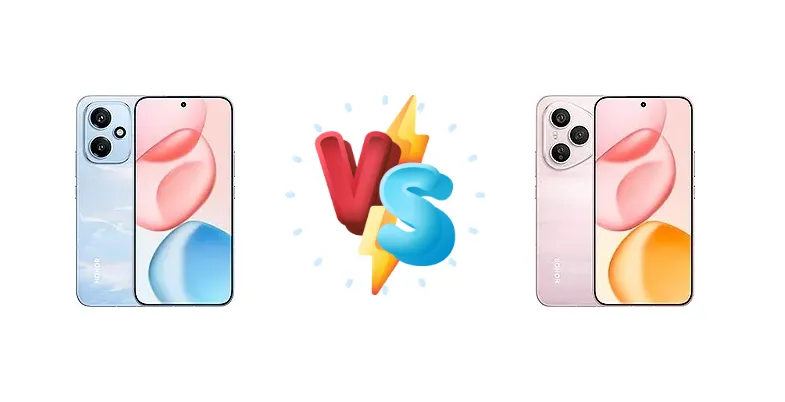
Honor has released the 400 and 400 Pro exclusively for the Chinese market, presenting a clear tiering within their lineup. The core difference lies in the chipset: the 400 utilizes the Snapdragon 7 Gen 4, aiming for a balance of performance and efficiency, while the 400 Pro boasts the flagship Snapdragon 8 Gen 3. This comparison dissects these key differences and determines which model best suits your needs.
🏆 Quick Verdict
For the average user prioritizing raw power and future-proofing, the Honor 400 Pro is the clear winner. Its Snapdragon 8 Gen 3 delivers significantly higher performance, coupled with faster wired and wireless charging. However, the Honor 400 remains a compelling option for those seeking a more efficient and affordable experience.
| Network |
|---|
| 2G bands | GSM 850 / 900 / 1800 / 1900 | GSM 850 / 900 / 1800 / 1900 |
| 3G bands | HSDPA 800 / 850 / 900 / 1700(AWS) / 1900 / 2100 | HSDPA 800 / 850 / 900 / 1700(AWS) / 1900 / 2100 |
| 4G bands | LTE | LTE |
| 5G bands | SA/NSA | SA/NSA |
| Speed | HSPA, LTE, 5G | HSPA, LTE, 5G |
| Technology | GSM / HSPA / LTE / 5G | GSM / HSPA / LTE / 5G |
| Launch |
|---|
| Announced | 2025, June 02 | 2025, June 02 |
| Status | Available. Released 2025, June 06 | Available. Released 2025, June 08 |
| Body |
|---|
| Build | Glass front, aluminum frame | Glass front, aluminum frame |
| Dimensions | 156.3 x 74.7 x 7.8 mm (6.15 x 2.94 x 0.31 in) | 156.3 x 74.7 x 7.8 mm (6.15 x 2.94 x 0.31 in) |
| SIM | Nano-SIM + Nano-SIM | Nano-SIM + Nano-SIM |
| Weight | 196 g (6.91 oz) | 204 g (7.20 oz) |
| Display |
|---|
| Protection | Aluminosilicate glass | Aluminosilicate glass |
| Resolution | 1264 x 2736 pixels, 19.5:9 ratio (~460 ppi density) | 1264 x 2736 pixels, 19.5:9 ratio (~460 ppi density) |
| Size | 6.55 inches, 105.4 cm2 (~90.3% screen-to-body ratio) | 6.55 inches, 105.4 cm2 (~90.3% screen-to-body ratio) |
| Type | AMOLED, 1B colors, 120Hz, HDR, 5000 nits (peak) | AMOLED, 1B colors, 120Hz, HDR Vivid, 5000 nits (peak) |
| Platform |
|---|
| CPU | Octa-core (1x2.8 GHz Cortex-720 & 4x2.4 GHz Cortex-720 & 3x1.8 GHz Cortex-520) | Octa-core (1x3.3 GHz Cortex-X4 & 3x3.2 GHz Cortex-A720 & 2x3.0 GHz Cortex-A720 & 2x2.3 GHz Cortex-A520) |
| Chipset | Qualcomm SM7750-AB Snapdragon 7 Gen 4 (4 nm) | Qualcomm SM8650-AB Snapdragon 8 Gen 3 (4 nm) |
| GPU | Adreno 722 | Adreno 750 |
| OS | Android 15, MagicOS 9 | Android 15, MagicOS 9 |
| Memory |
|---|
| Card slot | No | No |
| Internal | 256GB 12GB RAM, 512GB 12GB RAM, 512GB 16GB RAM | 256GB 12GB RAM, 512GB 12GB RAM, 512GB 16GB RAM, 1TB 16GB RAM |
| Main Camera |
|---|
| Dual | 200 MP, f/1.9, (wide), 1/1.4", PDAF, OIS
12 MP, f/2.2, 112˚ (ultrawide), AF | - |
| Features | LED flash, HDR, panorama | LED flash, HDR, panorama |
| Triple | - | 200 MP, f/1.9, (wide), 1/1.4", PDAF, OIS
50 MP, f/2.4, (telephoto), 1/2.0", 0.8µm, PDAF, OIS, 3x optical zoom
12 MP, f/2.2, 112˚ (ultrawide), AF |
| Video | 4K, 1080p, gyro-EIS, OIS | 4K, 1080p, gyro-EIS, OIS |
| Selfie camera |
|---|
| Features | HDR | HDR |
| Single | 50 MP, f/2.0, (wide) | 50 MP, f/2.0, (wide) |
| Video | 4K, 1080p, gyro-EIS | 4K, 1080p, gyro-EIS |
| Sound |
|---|
| 35mm jack | No | No |
| Loudspeaker | Yes, with stereo speakers | Yes, with stereo speakers |
| Comms |
|---|
| Bluetooth | 5.4, A2DP, LE, aptX HD, aptX Adaptive | 5.4, A2DP, LE, aptX HD, aptX Adaptive |
| Infrared port | Yes | Yes |
| NFC | Yes | Yes |
| Positioning | GPS, GALILEO, GLONASS, QZSS, NavIC, BDS (B1I+B1c) | GPS (L1+L5), BDS (B1I+B1C+B2a+B2b), GALILEO (E1+E5a+E5b), QZSS (L1+L5), NavIC (L5), GLONASS |
| Radio | No | No |
| USB | USB Type-C 2.0, OTG | USB Type-C 2.0, OTG |
| WLAN | Wi-Fi 802.11 a/b/g/n/ac/6, dual-band, Wi-Fi Direct | Wi-Fi 802.11 a/b/g/n/ac/6/7, dual-band, Wi-Fi Direct |
| Features |
|---|
| Sensors | Fingerprint (under display, optical), accelerometer, gyro, proximity, compass | Fingerprint (under display, optical), accelerometer, gyro, proximity, compass |
| Battery |
|---|
| Charging | 80W wired, 39% in 15 min
5W reverse wired | 90W wired, 40% in 15 min
50W wireless, 28% in 15 min
5W reverse wired
Reverse wireless |
| Type | Si/C Li-Ion 7200 mAh | Si/C Li-Ion 7200 mAh |
| Misc |
|---|
| Colors | Black, Silver, Blue, Pink | Black, Silver, Blue, Pink |
| Models | DNN-AN00 | DNP-AN00 |
| Price | About 310 EUR | About 420 EUR |
Honor 400 (China)
- More affordable price point
- Excellent efficiency with Snapdragon 7 Gen 4
- Solid performance for everyday tasks
- Significantly lower performance than the Pro model
- Lacks wireless charging
Honor 400 Pro (China)
- Flagship-level performance with Snapdragon 8 Gen 3
- Faster wired and wireless charging
- Superior camera capabilities (expected)
- Higher price tag
- Potentially higher power consumption
Display Comparison
While display specifications are not provided, it's reasonable to assume both devices feature OLED panels given Honor's recent history. The key differentiator will likely be peak brightness and potentially refresh rate. The 400 Pro, positioned as the flagship, likely boasts a higher peak brightness for improved outdoor visibility. The inclusion of LTPO technology on the Pro model is also probable, enabling adaptive refresh rates for increased power efficiency. Bezels are expected to be minimal on both, but the Pro may have a slightly more refined design.
Camera Comparison
Camera details are absent, but the Pro model will almost certainly feature a more advanced camera system. While both likely employ multi-camera setups, the 400 Pro will benefit from a larger primary sensor, potentially with optical image stabilization (OIS), resulting in better low-light performance and dynamic range. The image signal processor (ISP) within the Snapdragon 8 Gen 3 also offers superior image processing capabilities, leading to more detailed and vibrant photos and videos. Expect the Pro to offer more advanced features like 8K video recording.
Performance
The performance gap between the Snapdragon 7 Gen 4 in the Honor 400 and the Snapdragon 8 Gen 3 in the 400 Pro is substantial. The 8 Gen 3’s Cortex-X4 prime core, clocked at 3.3 GHz, offers a significant uplift over the 400’s 2.8 GHz Cortex-720. The 400’s octa-core configuration, while efficient, cannot match the sustained performance of the 8 Gen 3’s architecture. The 4nm process node is shared, but the 8 Gen 3’s superior design and larger cache translate to faster application loading, smoother multitasking, and significantly improved gaming performance. The 400 Pro will handle graphically intensive titles at higher settings with less throttling.
Battery Life
The Honor 400 supports 80W wired charging, achieving 39% charge in 15 minutes. The 400 Pro steps up to 90W wired charging, reaching 40% in the same timeframe – a modest improvement. However, the Pro’s advantage extends to 50W wireless charging, reaching 28% in 15 minutes, a feature absent on the 400. While battery capacity isn’t specified, the faster charging speeds on the Pro, combined with wireless charging, offer greater convenience and reduced downtime. The 5W reverse wired charging is consistent across both models.
Buying Guide
Buy the Honor 400 (China) if you need a capable daily driver with solid performance for everyday tasks and moderate gaming, prioritizing battery efficiency and a lower price point. Buy the Honor 400 Pro (China) if you demand the absolute best performance for demanding games, intensive multitasking, and benefit from the fastest charging speeds available, including wireless charging.
Frequently Asked Questions
❓ Does the Snapdragon 7 Gen 4 in the Honor 400 struggle with demanding games like Genshin Impact?
While the Snapdragon 7 Gen 4 is a capable chip, Genshin Impact and similar graphically intensive games will likely require reduced settings to maintain a stable frame rate on the Honor 400. The 400 Pro, with its Snapdragon 8 Gen 3, will handle these games at higher settings with significantly less performance throttling.
❓ Is the 90W charging on the Honor 400 Pro significantly faster in real-world use than the 80W on the 400?
The difference between 80W and 90W isn't massive, but the 400 Pro will likely reach a full charge slightly faster. More importantly, the addition of 50W wireless charging on the Pro provides a convenient alternative charging method that the 400 lacks.
❓ Given both phones are China-exclusive, will they receive software updates consistently?
Honor's software update track record for China-exclusive models can be inconsistent. While they typically receive updates, they may lag behind global releases. It's advisable to check online forums and communities for user reports on update frequency.
❓ What type of RAM does each phone use, and how does that impact performance?
While not explicitly stated, both devices likely utilize LPDDR5X RAM. This is the current standard for flagship and upper-midrange phones, offering faster data transfer speeds compared to older RAM standards, contributing to smoother multitasking and faster application loading.