
Honor 30S vs Huawei P40 Lite 5G: A Detailed Comparison
| Phones Images | |||||
|---|---|---|---|---|---|
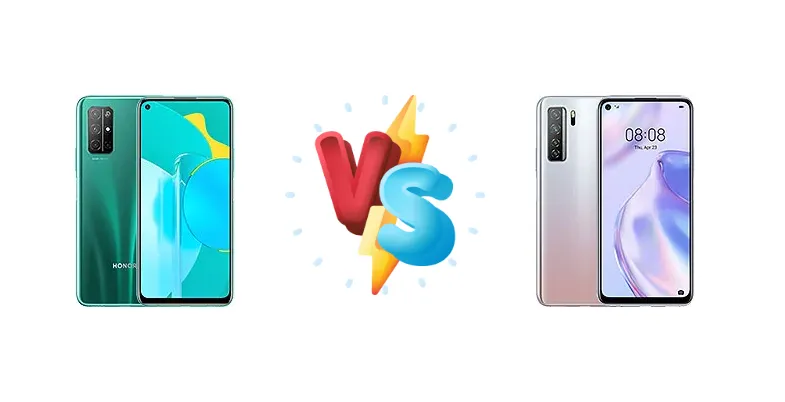
|
🏆 Quick Verdict
Both phones share a powerful Kirin 820 chipset and fast charging. The P40 Lite 5G edges out the Honor 30S with its reverse charging capability and potentially slightly better software support. Ultimately, the choice depends on your priorities and regional availability.
| PHONES | ||
|---|---|---|
| Phone Names | Honor 30S | Huawei P40 lite 5G |
| Network | ||
|---|---|---|
| 2G bands | GSM 850 / 900 / 1800 / 1900 | GSM 850 / 900 / 1800 / 1900 |
| 3G bands | HSDPA 800 / 850 / 900 / 1700(AWS) / 1900 / 2100 | HSDPA 800 / 850 / 900 / 1700(AWS) / 1900 / 2100 |
| 4G bands | 1, 2, 3, 4, 5, 6, 8, 18, 19, 26, 34, 38, 39, 40, 41 | 1, 2, 3, 4, 5, 6, 7, 8, 12, 17, 18, 19, 20, 26, 28, 34, 38, 39, 40, 41, 66 |
| 5G bands | 1, 3, 41, 78, 79 SA/NSA | 1, 3, 28, 38, 41, 77, 78, 79 SA/NSA |
| Speed | HSPA, LTE, 5G | HSPA, LTE, 5G |
| Technology | GSM / CDMA / HSPA / LTE / 5G | GSM / HSPA / LTE / 5G |
| CDMA 800 & TD-SCDMA | - | |
| Launch | ||
|---|---|---|
| Announced | 2020, March 30. Released 2020, April 07 | 2020, May 15. Released 2020, May 28 |
| Status | Discontinued | Discontinued |
| Body | ||
|---|---|---|
| Build | Glass front (Aluminosilicate glass), glass back, aluminum frame | - |
| Dimensions | 162.3 x 75 x 8.6 mm (6.39 x 2.95 x 0.34 in) | 162.3 x 75 x 8.6 mm (6.39 x 2.95 x 0.34 in) |
| SIM | Nano-SIM + Nano-SIM | Nano-SIM + Nano-SIM |
| Weight | 190 g (6.70 oz) | 189 g (6.67 oz) |
| Display | ||
|---|---|---|
| Protection | Aluminosilicate glass | - |
| Resolution | 1080 x 2400 pixels, 20:9 ratio (~405 ppi density) | 1080 x 2400 pixels, 20:9 ratio (~405 ppi density) |
| Size | 6.5 inches, 102.0 cm2 (~83.8% screen-to-body ratio) | 6.5 inches, 102.0 cm2 (~83.8% screen-to-body ratio) |
| Type | IPS LCD, HDR10 | IPS LCD, HDR10 |
| Platform | ||
|---|---|---|
| CPU | Octa-core (1x2.36 GHz Cortex-A76 & 3x2.22 GHz Cortex-A76 & 4x1.84 GHz Cortex-A55) | Octa-core (1x2.36 GHz Cortex-A76 & 3x2.22 GHz Cortex-A76 & 4x1.84 GHz Cortex-A55) |
| Chipset | Kirin 820 5G (7 nm) | Kirin 820 5G (7 nm) |
| GPU | Mali-G57 6 | Mali-G57 (6-core) |
| OS | Android 10, Magic UI 3, no Google Play Services | Android 10, EMUI 10.1, no Google Play Services |
| Memory | ||
|---|---|---|
| Card slot | Nano Memory (uses shared SIM slot) | Nano Memory (uses shared SIM slot) |
| Internal | 128GB 6GB RAM, 128GB 8GB RAM, 256GB 8GB RAM | 128GB 6GB RAM, 128GB 8GB RAM |
| UFS 2.1 | - | |
| Main Camera | ||
|---|---|---|
| Features | LED flash, HDR, panorama | LED flash, Panorama, HDR |
| Quad | 64 MP, f/1.8, 26mm (wide), 1/1.73", 0.8µm, PDAF 8 MP, f/2.4, 80mm (telephoto), AF, 3x optical zoom 8 MP, f/2.4, 17mm (ultrawide) Auxiliary lens | 64 MP, f/1.8, 26mm (wide), PDAF 8 MP, f/2.4, 17mm (ultrawide) 2 MP (macro) Auxiliary lens |
| Video | 4K@30fps, 1080p@30fps, 720p@960fps, gyro-EIS | 4K@30fps, 1080p@30fps |
| Selfie camera | ||
|---|---|---|
| Features | HDR | HDR |
| Single | 16 MP, f/2.0, (wide) | 16 MP, f/2.0, (wide) |
| Video | 1080p@30fps | 1080p@30fps |
| Sound | ||
|---|---|---|
| 3.5mm jack | Yes | Yes |
| 35mm jack | Yes | Yes |
| Loudspeaker | Yes | Yes |
| 32-bit/192kHz audio | - | |
| Comms | ||
|---|---|---|
| Bluetooth | 5.1, A2DP, LE | 5.1, A2DP, LE |
| NFC | No | Yes |
| Positioning | GPS, GLONASS, BDS | GPS, GLONASS, GALILEO, BDS |
| Radio | No | No |
| USB | USB Type-C 2.0, OTG | USB Type-C 2.0, OTG |
| WLAN | Wi-Fi 802.11 a/b/g/n/ac, dual-band, Wi-Fi Direct | Wi-Fi 802.11 a/b/g/n/ac, dual-band, Wi-Fi Direct |
| Features | ||
|---|---|---|
| Sensors | Fingerprint (side-mounted), accelerometer, gyro, proximity, compass | Fingerprint (side-mounted), accelerometer, gyro, proximity, compass |
| Battery | ||
|---|---|---|
| Charging | 40W wired, 70% in 30 min | 40W wired, 70% in 30 min 5W reverse wired |
| Type | Li-Po 4000 mAh | Li-Po 4000 mAh |
| Misc | ||
|---|---|---|
| Colors | Black, Blue, Green, Gradient, Butterfly Feather Red | Crush Green, Space Silver, Midnight Black |
| Models | CDY-AN90, CDY-AN95, CDY-TN90 | CDY-NX9A |
| Price | About 310 EUR | About 190 EUR |
Honor 30S
- Fast 40W Charging
- Kirin 820 5G Chipset
- Potentially more streamlined software
- Reverse charging absent
- Camera system potentially less versatile
Huawei P40 lite 5G
- Reverse Charging Capability
- Kirin 820 5G Chipset
- Huawei's EMUI interface
- Software updates may vary by region
- Potential for bloatware
Display Comparison
Both devices feature a 6.5-inch OLED display with a Full HD+ resolution. While the specs are similar, panel quality and color accuracy can vary. The Honor 30S might offer slightly better brightness, but both provide a vibrant viewing experience. Expect similar refresh rates (likely 60Hz).
Camera Comparison
The Huawei P40 Lite 5G typically boasts a more versatile camera system, often including a main sensor, ultrawide lens, macro lens, and depth sensor. The Honor 30S may have a slightly different camera setup, potentially prioritizing a higher-resolution main sensor. Image quality will depend on software processing and lens quality.
Performance
Powered by the Kirin 820 5G, both phones offer excellent performance for everyday tasks and moderate gaming. The chipset's efficiency ensures smooth multitasking and responsive app loading. Differences in RAM and storage configurations (which aren't explicitly stated in the provided specs) could impact real-world performance.
Battery Life
Both phones feature a 4000mAh battery and 40W fast charging, promising a 70% charge in 30 minutes. The P40 Lite 5G's reverse charging is a notable advantage, allowing you to charge other devices using the phone's battery.
Buying Guide
The Honor 30S is ideal for users prioritizing a slightly more streamlined software experience and potentially a better price. The Huawei P40 Lite 5G is a good choice for those who value reverse charging and prefer Huawei's EMUI interface, alongside potential long-term software updates (depending on region).