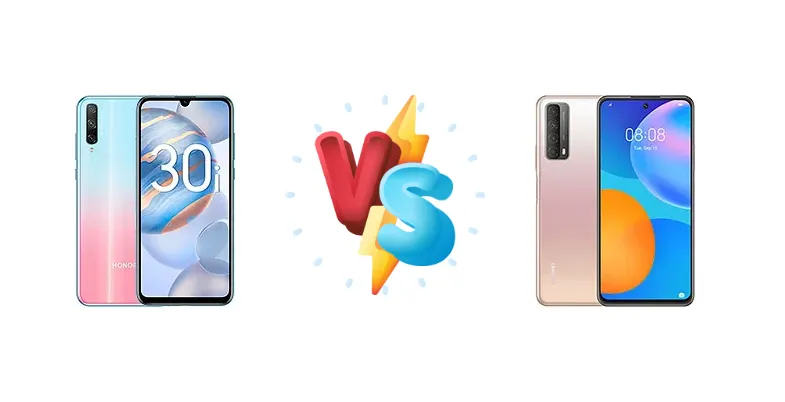
The Honor 30i and Huawei P smart 2021 represent compelling options in the crowded budget smartphone market. Both leverage Huawei’s Kirin chipset family, but subtle differences in fabrication and charging capabilities create distinct user experiences. This comparison dives deep into these nuances to determine which device delivers the most value.
🏆 Quick Verdict
For the average user prioritizing faster charging and slightly better display brightness, the Huawei P smart 2021 is the superior choice. Its 22.5W charging significantly reduces downtime compared to the Honor 30i’s 10W charging, and the measured 442 nits brightness offers a more visible outdoor experience.
| Network |
|---|
| 2G bands | GSM 900 / 1800 / 1900 | GSM 900 / 1800 / 1900 |
| 3G bands | HSDPA 850 / 900 / 1900 / 2100 | HSDPA 850 / 900 / 1700(AWS) / 1900 / 2100 |
| 4G bands | 1, 2, 3, 4, 5, 7, 8, 19, 20, 26, 28, 34, 38, 39, 40, 41 | 1, 3, 5, 7, 8, 20, 28, 38, 40, 41 |
| Speed | HSPA, LTE | HSPA, LTE |
| Technology | GSM / CDMA / HSPA / LTE | GSM / HSPA / LTE |
| | CDMA 800 & TD-SCDMA | - |
| Launch |
|---|
| Announced | 2020, September 11. Released 2020, September 12 | 2020, September 28. Released 2020, September 28 |
| Status | Discontinued | Discontinued |
| Body |
|---|
| Dimensions | 157.2 x 73.2 x 7.7 mm (6.19 x 2.88 x 0.30 in) | 165.7 x 76.9 x 9.3 mm (6.52 x 3.03 x 0.37 in) |
| SIM | Nano-SIM + Nano-SIM | Nano-SIM + Nano-SIM |
| Weight | 171.5 g (6.07 oz) | 206 g (7.27 oz) |
| Display |
|---|
| Resolution | 1080 x 2400 pixels, 20:9 ratio (~418 ppi density) | 1080 x 2400 pixels, 20:9 ratio (~395 ppi density) |
| Size | 6.3 inches, 95.8 cm2 (~83.3% screen-to-body ratio) | 6.67 inches, 107.4 cm2 (~84.3% screen-to-body ratio) |
| Type | AMOLED, 600 nits (typ) | IPS LCD |
| Platform |
|---|
| CPU | Octa-core (4x2.2 GHz Cortex-A73 & 4x1.7 GHz Cortex-A53) | Octa-core (4x2.0 GHz Cortex-A73 & 4x1.7 GHz Cortex-A53) |
| Chipset | Kirin 710F (12 nm) | Kirin 710A (14 nm) |
| GPU | Mali-G51 MP4 | Mali-G51 MP4 |
| OS | Android 10, Magic UI 2.1 | Android 10, EMUI 10.1, no Google Play Services |
| Memory |
|---|
| Card slot | Nano Memory (uses shared SIM slot) | microSDXC (dedicated slot) |
| Internal | 128GB 4GB RAM | 64GB 4GB RAM, 128GB 4GB RAM |
| Main Camera |
|---|
| Features | LED flash, HDR, panorama | LED flash, HDR, panorama |
| Quad | - | 48 MP, f/1.8, 26mm (wide), 1/2.0", 0.8µm, PDAF
8 MP, f/2.4, 120˚ (ultrawide), 1/4.0", 1.12µm
2 MP (macro)
Auxiliary lens |
| Triple | 48 MP, f/1.8, 28mm (wide), 1/2.0", 0.8µm, PDAF
8 MP, f/2.4, 120˚ (ultrawide)
Auxiliary lens | - |
| Video | 1080p@30fps | 1080p@30/60fps |
| Selfie camera |
|---|
| Features | HDR | HDR |
| Single | 16 MP, f/2.0, 26mm (wide), 1/3.06", 1.0µm | 8 MP, f/2.0, (wide) |
| Video | 1080p@30fps | 1080p@30fps |
| Sound |
|---|
| 3.5mm jack | Yes | Yes |
| 35mm jack | Yes | Yes |
| Loudspeaker | Yes | Yes |
| Comms |
|---|
| Bluetooth | 5.1, A2DP, LE | 5.1, A2DP, LE |
| NFC | Yes | No |
| Positioning | GPS, GLONASS, BDS | GPS, GLONASS, BDS |
| Radio | FM radio | FM radio, built-in antenna |
| USB | USB Type-C 2.0, OTG | USB Type-C 2.0, OTG |
| WLAN | Wi-Fi 802.11 a/b/g/n/ac, dual-band, Wi-Fi Direct | Wi-Fi 802.11 b/g/n, Wi-Fi Direct |
| Features |
|---|
| Sensors | Fingerprint (under display, optical), accelerometer, gyro, proximity, compass | Fingerprint (side-mounted), accelerometer, proximity, compass |
| Battery |
|---|
| Charging | 10W wired | 22.5W wired, 46% in 30 min |
| Type | Li-Po 4000 mAh | Li-Po 5000 mAh |
| Misc |
|---|
| Colors | Ultraviolet Sunset, Turquoise, Midnight Black | Crush Green, Blush Gold, Midnight Black |
| Models | LRA-LX1 | PPA-LX1, PPA-LX2 |
| Price | About 200 EUR | About 230 EUR |
| Tests |
|---|
| Battery life | - | Endurance rating 119h |
| Camera | - |
Photo / Video |
| Display | - |
Contrast ratio: 1252:1 (nominal) |
| Loudspeaker | - |
-28.8 LUFS (Average) |
| Performance | - |
AnTuTu: 169253 (v8)
GeekBench: 1334 (v5.1)
GFXBench: 7fps (ES 3.1 onscreen) |
Honor 30i
- Potentially lower price point
- Slightly higher CPU clock speed (Kirin 710F)
- More efficient 12nm chipset fabrication
- Significantly slower 10W charging
- No published display brightness data
Huawei P smart 2021
- Faster 22.5W charging with 30-minute boost
- Brighter display (442 nits measured)
- Potentially better image processing
- Less efficient 14nm chipset fabrication
- Slightly lower CPU clock speed (Kirin 710A)
Display Comparison
The Huawei P smart 2021 boasts a measured peak brightness of 442 nits, a noticeable advantage over the Honor 30i, which lacks published brightness data. Both displays share a 1252:1 contrast ratio, suggesting similar dynamic range. However, the P smart 2021’s higher brightness translates to better visibility in direct sunlight, a crucial factor for outdoor use. While both likely utilize IPS LCD panels, the P smart 2021’s brightness gives it a clear edge.
Camera Comparison
Both the Honor 30i and Huawei P smart 2021 feature 'Photo / Video' capabilities, but detailed camera specifications are lacking. Without sensor size or aperture information, a direct comparison is difficult. It’s reasonable to assume both phones rely on multi-camera setups, potentially including a main sensor, ultrawide, and depth sensor. Given Huawei’s image processing expertise, the P smart 2021 likely benefits from more refined software algorithms, potentially resulting in better image quality, particularly in challenging lighting conditions. The absence of detail regarding OIS suggests neither phone offers optical image stabilization.
Performance
Both devices are powered by Kirin 710 series chipsets, but the Huawei P smart 2021 utilizes the Kirin 710A, fabricated on a 14nm process, while the Honor 30i features the Kirin 710F on a more efficient 12nm process. Despite the smaller node, the Kirin 710F has a slightly higher CPU clock speed (2.2 GHz vs 2.0 GHz), potentially offering a marginal performance boost in CPU-intensive tasks. Both CPUs share the same core configuration (4x2.2 GHz Cortex-A73 & 4x1.7 GHz Cortex-A53). However, the 14nm process of the 710A may lead to slightly higher power consumption under load. Neither chipset is designed for demanding gaming, but will handle everyday tasks and light multitasking adequately.
Battery Life
Both devices achieve an endurance rating of 119 hours, indicating similar overall battery life. However, the charging capabilities differ significantly. The Huawei P smart 2021 supports 22.5W wired charging, capable of reaching 46% charge in just 30 minutes. In contrast, the Honor 30i is limited to a slow 10W charging rate. This disparity in charging speed is a major differentiating factor, as the P smart 2021 allows for significantly faster top-ups, reducing downtime and improving usability for power users.
Buying Guide
Buy the Honor 30i if you prioritize a potentially lower price point and are comfortable with slower charging speeds. It’s a solid option for users who primarily use their phone for basic tasks and aren’t heavily reliant on quick top-ups. Buy the Huawei P smart 2021 if you value faster charging, a brighter display, and a more modern charging standard, making it ideal for users who are frequently on the go and need to minimize downtime.
Frequently Asked Questions
❓ Does the Kirin 710A chipset in the Huawei P smart 2021 struggle with multitasking compared to the 710F?
While the Kirin 710F has a slightly higher clock speed, the difference is unlikely to be noticeable in everyday multitasking. Both chipsets are designed for efficient handling of common tasks like browsing, social media, and messaging. The 710A’s 14nm process might result in slightly more heat during prolonged, intensive multitasking, but it shouldn't cause significant performance throttling.
❓ How much of a difference does the 22.5W charging make in real-world use on the Huawei P smart 2021?
The 22.5W charging on the P smart 2021 is a significant advantage. Reaching 46% charge in 30 minutes means you can quickly top up your phone during a short break, minimizing downtime. The Honor 30i’s 10W charging will take considerably longer to achieve the same level of charge, making it less convenient for users who frequently need to recharge.
❓ Are the cameras on either phone capable of recording 1080p video at 60fps?
While not explicitly stated in the provided specifications, it's highly probable that both the Honor 30i and Huawei P smart 2021 can record 1080p video at 30fps. 60fps recording is less certain, and would likely be a marketing highlight if supported. Without further information, it's best to assume 1080p/30fps is the maximum recording capability.