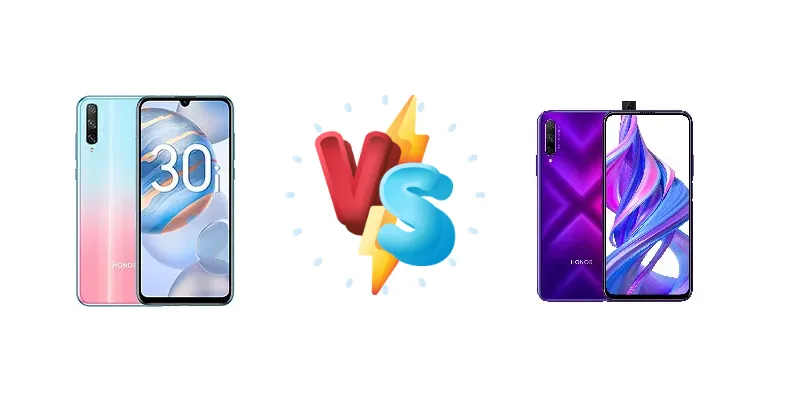
The Honor 9X Pro and 30i represent different points in Honor’s mid-range strategy. The 9X Pro, with its Kirin 810, aimed for a more performance-focused experience, while the 30i, powered by the Kirin 710F, prioritized affordability. This comparison dissects the key differences to determine which device best suits your needs in 2024.
🏆 Quick Verdict
For most users, the Honor 9X Pro is the superior choice. Its Kirin 810 chipset delivers significantly better performance than the 30i’s Kirin 710F, making it more capable for demanding tasks and future-proofing. While both share the same 10W charging, the 9X Pro’s overall experience justifies the potential price difference.
| Network |
|---|
| 2G bands | GSM 900 / 1800 / 1900 | GSM 850 / 900 / 1800 / 1900 |
| 3G bands | HSDPA 850 / 900 / 1900 / 2100 | HSDPA 850 / 900 / 2100 |
| 4G bands | 1, 2, 3, 4, 5, 7, 8, 19, 20, 26, 28, 34, 38, 39, 40, 41 | 1, 3, 7, 8, 20, 38, 40, 41 - International |
| Speed | HSPA, LTE | HSPA 42.2/5.76 Mbps, LTE (2CA) Cat12 600/50 Mbps |
| Technology | GSM / CDMA / HSPA / LTE | GSM / CDMA / HSPA / EVDO / LTE |
| | CDMA 800 & TD-SCDMA | 1, 3, 5, 8, 38, 39, 40, 41 - China |
| Launch |
|---|
| Announced | 2020, September 11. Released 2020, September 12 | 2019, July 23. Released 2019, August 09 |
| Status | Discontinued | Discontinued |
| Body |
|---|
| Build | - | Glass front, glass back, aluminum frame |
| Dimensions | 157.2 x 73.2 x 7.7 mm (6.19 x 2.88 x 0.30 in) | 163.5 x 77.3 x 8.8 mm (6.44 x 3.04 x 0.35 in) |
| SIM | Nano-SIM + Nano-SIM | Nano-SIM + Nano-SIM |
| Weight | 171.5 g (6.07 oz) | 202 g (7.13 oz) |
| Display |
|---|
| Resolution | 1080 x 2400 pixels, 20:9 ratio (~418 ppi density) | 1080 x 2340 pixels, 19.5:9 ratio (~391 ppi density) |
| Size | 6.3 inches, 95.8 cm2 (~83.3% screen-to-body ratio) | 6.59 inches, 106.6 cm2 (~84.3% screen-to-body ratio) |
| Type | AMOLED, 600 nits (typ) | IPS LCD |
| Platform |
|---|
| CPU | Octa-core (4x2.2 GHz Cortex-A73 & 4x1.7 GHz Cortex-A53) | Octa-core (2x2.27 GHz Cortex-A76 & 6x1.88 GHz Cortex-A55) |
| Chipset | Kirin 710F (12 nm) | Kirin 810 (7 nm) |
| GPU | Mali-G51 MP4 | Mali-G52 MP6 |
| OS | Android 10, Magic UI 2.1 | Android 9.0 (Pie), upgradable to Android 10, EMUI 9.1, no Google Play Services |
| Memory |
|---|
| Card slot | Nano Memory (uses shared SIM slot) | microSDXC (uses shared SIM slot) |
| Internal | 128GB 4GB RAM | 128GB 8GB RAM, 256GB 6GB RAM, 256GB 8GB RAM |
| Main Camera |
|---|
| Features | LED flash, HDR, panorama | LED flash, HDR, panorama |
| Triple | 48 MP, f/1.8, 28mm (wide), 1/2.0", 0.8µm, PDAF
8 MP, f/2.4, 120˚ (ultrawide)
Auxiliary lens | 48 MP, f/1.8, (wide), 1/2.0", 0.8µm, PDAF
8 MP, f/2.4, 120˚ (ultrawide)
Auxiliary lens |
| Video | 1080p@30fps | 1080p@30fps, gyro-EIS |
| Selfie camera |
|---|
| Features | HDR | - |
| Single | 16 MP, f/2.0, 26mm (wide), 1/3.06", 1.0µm | Motorized pop-up 16 MP, f/2.2, 26mm (wide), 1/3.06", 1.0µm |
| Video | 1080p@30fps | 1080p@60fps |
| Sound |
|---|
| 3.5mm jack | Yes | Yes |
| 35mm jack | Yes | Yes |
| Loudspeaker | Yes | Yes |
| Comms |
|---|
| Bluetooth | 5.1, A2DP, LE | 4.2, A2DP, LE (International)5.0, A2DP, LE (China) |
| NFC | Yes | No |
| Positioning | GPS, GLONASS, BDS | GPS, GLONASS, BDS |
| Radio | FM radio | FM radio |
| USB | USB Type-C 2.0, OTG | USB Type-C 2.0 |
| WLAN | Wi-Fi 802.11 a/b/g/n/ac, dual-band, Wi-Fi Direct | Wi-Fi 802.11 a/b/g/n/ac, dual-band, Wi-Fi Direct |
| Features |
|---|
| Sensors | Fingerprint (under display, optical), accelerometer, gyro, proximity, compass | Fingerprint (side-mounted), accelerometer, gyro, proximity, compass |
| Battery |
|---|
| Charging | 10W wired | 10W wired |
| Type | Li-Po 4000 mAh | Li-Po 4000 mAh, non-removable |
| Misc |
|---|
| Colors | Ultraviolet Sunset, Turquoise, Midnight Black | Midnight Black, Phantom Purple |
| Models | LRA-LX1 | HLK-AL10, HLK-TL10, HLK-L41, HLK-L42 |
| Price | About 200 EUR | About 230 EUR |
| Tests |
|---|
| Battery life | - |
Endurance rating 104h
|
| Camera | - |
Photo / Video |
| Display | - |
Contrast ratio: 1319:1 (nominal) |
| Loudspeaker | - |
-31.1 LUFS (Below average)
|
| Performance | - |
AnTuTu: 312668 (v8)
GeekBench: 7836 (v4.4), 1911 (v5.1)
GFXBench: 18fps (ES 3.1 onscreen) |
Honor 30i
- More affordable price point
- Decent battery endurance for basic use
- Acceptable display contrast ratio
- Significantly weaker processor performance
- Slower app loading times
- Limited gaming capabilities
Honor 9X Pro
- Superior processor performance (Kirin 810)
- Brighter display for outdoor visibility
- Better multitasking and gaming experience
- Potentially higher price
- Same slow 10W charging as the 30i
- Camera details are lacking
Display Comparison
Both the Honor 9X Pro and 30i feature displays with a 1319:1 contrast ratio, suggesting similar visual pop. However, the 9X Pro boasts a measured peak brightness of 517 nits, providing a noticeably brighter and more visible screen in outdoor conditions. While both use a nominal 1319:1 contrast ratio, real-world viewing experiences will likely favor the 9X Pro due to its superior brightness. Details regarding panel technology (IPS vs. TFT) are missing, but given the price points, both likely utilize IPS LCDs.
Camera Comparison
Both devices are listed as having 'Photo / Video' capabilities, but specific details are lacking. Without sensor size, aperture, or image processing details, a direct comparison is difficult. However, given the 9X Pro’s more powerful chipset, it’s reasonable to assume it benefits from more sophisticated image processing algorithms, potentially resulting in better image quality, especially in low-light conditions. The absence of details suggests neither phone is a standout performer in the camera department.
Performance
The core difference lies in the chipsets. The Honor 9X Pro’s Kirin 810 (7nm) is a substantial upgrade over the 30i’s Kirin 710F (12nm). The 810 utilizes Cortex-A76 cores (2x2.27 GHz) alongside A55 cores, offering significantly improved single-core and multi-core performance compared to the 30i’s A73/A53 configuration. The 7nm process node of the Kirin 810 also translates to better power efficiency and reduced thermal throttling during sustained workloads. This means the 9X Pro will handle gaming and demanding apps with greater ease and stability.
Battery Life
Interestingly, both the Honor 9X Pro and 30i achieve an endurance rating of 104 hours. This suggests similar battery life despite the Kirin 810’s higher performance. The 9X Pro likely compensates for its more power-hungry chipset through software optimizations and potentially a slightly larger battery capacity (details missing). Both phones are limited to 10W wired charging, meaning relatively slow charging speeds – expect over 2 hours for a full charge.
Buying Guide
Buy the Honor 30i if you prioritize extreme affordability and only need a phone for basic tasks like calls, messaging, and light social media. It’s a suitable option for first-time smartphone users or those on a very tight budget. Buy the Honor 9X Pro if you value performance for gaming, multitasking, or running demanding applications. The 9X Pro offers a smoother, more responsive experience and is a better long-term investment.
Frequently Asked Questions
❓ Is the Kirin 810 in the Honor 9X Pro powerful enough for modern mobile games like PUBG or Call of Duty?
Yes, the Kirin 810 is capable of running PUBG and Call of Duty at medium to high settings. While it won't deliver the absolute highest frame rates, it provides a smooth and enjoyable gaming experience, especially considering the phone's price point. Expect some frame drops during intense scenes, but overall performance should be satisfactory.
❓ Both phones have 10W charging. How long does it take to fully charge each device?
With 10W charging, both the Honor 9X Pro and 30i will take approximately 2.5 to 3 hours to fully charge from 0% to 100%. This is a relatively slow charging speed compared to modern smartphones with fast charging capabilities. It's best to charge these phones overnight.
❓ What kind of storage options were available for the Honor 9X Pro and 30i?
While specific configurations varied by region, the Honor 9X Pro typically came in options of 128GB or 256GB of internal storage. The Honor 30i was generally available with 64GB or 128GB of storage. Both devices supported microSD card expansion for additional storage.
❓ Does the Honor 9X Pro support widevine L1 certification for HD streaming on platforms like Netflix and Amazon Prime Video?
Yes, the Honor 9X Pro does support Widevine L1 certification, allowing you to stream HD content from popular platforms like Netflix and Amazon Prime Video. This is a crucial feature for users who frequently consume streaming media.