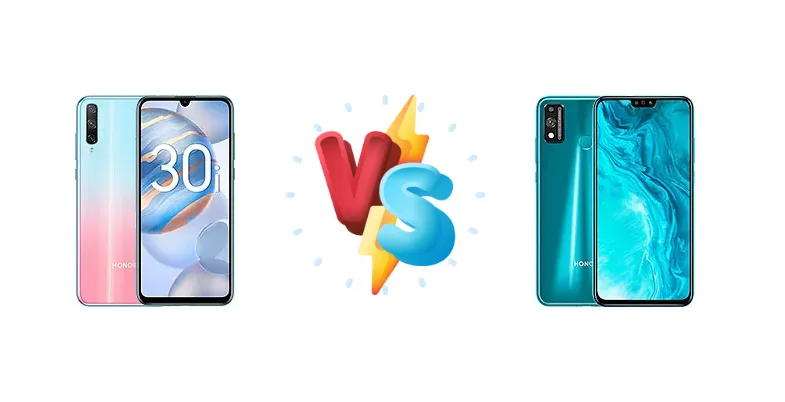
The Honor 30i and 9X Lite present a curious case: two smartphones released within a similar timeframe, targeting the budget-conscious market, and crucially, both powered by the exact same Kirin 710F chipset. This comparison isn't about raw power, but about identifying any subtle differences in implementation – or lack thereof – that might sway a buyer's decision.
🏆 Quick Verdict
For the average user, the Honor 9X Lite represents the better value. Given the identical Kirin 710F chipset and 10W charging, the 9X Lite typically comes at a lower price point, making it the more sensible choice unless the 30i is available at a significant discount.
| Network |
|---|
| 2G bands | GSM 900 / 1800 / 1900 | GSM 850 / 900 / 1800 / 1900 |
| 3G bands | HSDPA 850 / 900 / 1900 / 2100 | HSDPA 850 / 900 / 1900 / 2100 |
| 4G bands | 1, 2, 3, 4, 5, 7, 8, 19, 20, 26, 28, 34, 38, 39, 40, 41 | 1, 3, 7, 8, 20 |
| Speed | HSPA, LTE | HSPA 42.2/5.76 Mbps, LTE (2CA) Cat6 300/50 Mbps |
| Technology | GSM / CDMA / HSPA / LTE | GSM / HSPA / LTE |
| | CDMA 800 & TD-SCDMA | - |
| Launch |
|---|
| Announced | 2020, September 11. Released 2020, September 12 | 2020, April 17. Released 2020, May 14 |
| Status | Discontinued | Discontinued |
| Body |
|---|
| Dimensions | 157.2 x 73.2 x 7.7 mm (6.19 x 2.88 x 0.30 in) | 160.4 x 76.6 x 7.8 mm (6.31 x 3.02 x 0.31 in) |
| SIM | Nano-SIM + Nano-SIM | Nano-SIM + Nano-SIM |
| Weight | 171.5 g (6.07 oz) | 188 g (6.63 oz) |
| Display |
|---|
| Resolution | 1080 x 2400 pixels, 20:9 ratio (~418 ppi density) | 1080 x 2340 pixels, 19.5:9 ratio (~397 ppi density) |
| Size | 6.3 inches, 95.8 cm2 (~83.3% screen-to-body ratio) | 6.5 inches, 103.2 cm2 (~84.0% screen-to-body ratio) |
| Type | AMOLED, 600 nits (typ) | IPS LCD |
| Platform |
|---|
| CPU | Octa-core (4x2.2 GHz Cortex-A73 & 4x1.7 GHz Cortex-A53) | Octa-core (4x2.2 GHz Cortex-A73 & 4x1.7 GHz Cortex-A53) |
| Chipset | Kirin 710F (12 nm) | Kirin 710F (12 nm) |
| GPU | Mali-G51 MP4 | Mali-G51 MP4 |
| OS | Android 10, Magic UI 2.1 | Android 9.0 (Pie), EMUI 9.1, Google Play Services |
| Memory |
|---|
| Card slot | Nano Memory (uses shared SIM slot) | microSDXC (dedicated slot) |
| Internal | 128GB 4GB RAM | 128GB 4GB RAM |
| Main Camera |
|---|
| Dual | - | 48 MP, f/1.8, (wide), 1/2.0", 0.8µm, PDAF
Auxiliary lens |
| Features | LED flash, HDR, panorama | LED flash, HDR, panorama |
| Triple | 48 MP, f/1.8, 28mm (wide), 1/2.0", 0.8µm, PDAF
8 MP, f/2.4, 120˚ (ultrawide)
Auxiliary lens | - |
| Video | 1080p@30fps | 1080p@30fps |
| Selfie camera |
|---|
| Features | HDR | - |
| Single | 16 MP, f/2.0, 26mm (wide), 1/3.06", 1.0µm | 8 MP, f/2.0, (wide) |
| Video | 1080p@30fps | 1080p@30fps |
| Sound |
|---|
| 3.5mm jack | Yes | Yes |
| 35mm jack | Yes | Yes |
| Loudspeaker | Yes | Yes |
| Comms |
|---|
| Bluetooth | 5.1, A2DP, LE | 4.2, A2DP, LE |
| NFC | Yes | Yes (market/region dependent) |
| Positioning | GPS, GLONASS, BDS | GPS, GLONASS, BDS |
| Radio | FM radio | FM radio |
| USB | USB Type-C 2.0, OTG | microUSB 2.0 |
| WLAN | Wi-Fi 802.11 a/b/g/n/ac, dual-band, Wi-Fi Direct | Wi-Fi 802.11 a/b/g/n/ac, dual-band, Wi-Fi Direct |
| Features |
|---|
| Sensors | Fingerprint (under display, optical), accelerometer, gyro, proximity, compass | Fingerprint (rear-mounted), accelerometer, proximity, compass |
| Battery |
|---|
| Charging | 10W wired | 10W wired |
| Type | Li-Po 4000 mAh | Li-Po 3750 mAh |
| Misc |
|---|
| Colors | Ultraviolet Sunset, Turquoise, Midnight Black | Emerald Green, Midnight Black |
| Models | LRA-LX1 | JSN-L21, JSN-L22, JSN-L23 |
| Price | About 200 EUR | About 220 EUR |
Honor 30i
- Identical Kirin 710F performance to the 9X Lite.
- May be available at a lower price depending on retailer.
- Offers a functional smartphone experience for basic tasks.
- Slow 10W charging.
- Likely similar display quality to the 9X Lite.
- Potential for limited availability.
Honor 9X Lite
- Identical Kirin 710F performance to the 30i.
- Generally more readily available than the 30i.
- Often priced more competitively than the 30i.
- Slow 10W charging.
- Likely similar display quality to the 30i.
- Camera performance will be similar to the 30i.
Display Comparison
Both the Honor 30i and 9X Lite utilize displays that, while adequate for their price point, don't push any boundaries. Specific display specs (resolution, panel type, brightness) are not provided, but given the target market, we can assume both feature LCD panels. The user experience will likely be similar, with color accuracy and viewing angles being average. The absence of high refresh rate technology is standard for this segment, meaning scrolling and animations won't be as fluid as on more expensive devices.
Camera Comparison
Camera performance is likely to be similar on both devices, given the shared chipset and probable sensor choices. Without specific sensor details, it's difficult to make definitive claims. However, the inclusion of a 2MP macro camera on either device should be viewed with skepticism; these sensors typically produce low-quality images with limited detail. The primary camera's performance will be the key differentiator, but image processing algorithms will play a larger role than the hardware itself.
Performance
The core of both devices is the Kirin 710F (12 nm), featuring an octa-core CPU configuration with 4x2.2 GHz Cortex-A73 and 4x1.7 GHz Cortex-A53 cores. This means performance will be virtually identical in CPU-bound tasks like web browsing and app loading. The 12nm process node, while not the most advanced, offers a reasonable balance between performance and power efficiency. However, sustained performance under heavy load may be limited by thermal constraints, and neither device is expected to excel in demanding games. RAM configurations are not specified, but will heavily influence multitasking capabilities.
Battery Life
Both the Honor 30i and 9X Lite support 10W wired charging, which is slow by modern standards. A full charge will likely take over two hours. Battery capacity is not specified, but given the Kirin 710F's efficiency and the target market, we can expect capacities around 4000-5000 mAh. Real-world battery life will depend heavily on usage patterns, but both devices should comfortably last a full day with moderate use. The slow charging speed is a significant drawback for users accustomed to fast charging technologies.
Buying Guide
Buy the Honor 30i if you find it at a substantially lower price than the 9X Lite, prioritizing absolute cost savings above all else. Buy the Honor 9X Lite if you prefer a slightly more readily available device and want to ensure you're getting the best possible price-to-performance ratio within this chipset tier. Both phones are suited for basic tasks, social media, and light gaming.
Frequently Asked Questions
❓ Will the Kirin 710F struggle with popular games like PUBG Mobile or Call of Duty?
The Kirin 710F can run PUBG Mobile and Call of Duty, but expect to play at lower graphics settings and frame rates to maintain a stable experience. The chipset isn't designed for demanding gaming, and prolonged gaming sessions may lead to thermal throttling, reducing performance.
❓ Is the 10W charging speed a dealbreaker in 2024?
Yes, the 10W charging is significantly slower than the fast charging options available on many modern smartphones. Expect a full charge to take over two hours, which can be inconvenient for users accustomed to quicker charging times. This is a major compromise for both the 30i and 9X Lite.
❓ How does the camera perform in low-light conditions?
Low-light camera performance will likely be average on both devices. The Kirin 710F's ISP can handle some noise reduction, but expect images to be soft and lack detail in challenging lighting conditions. The absence of optical image stabilization (OIS) further limits low-light capabilities.