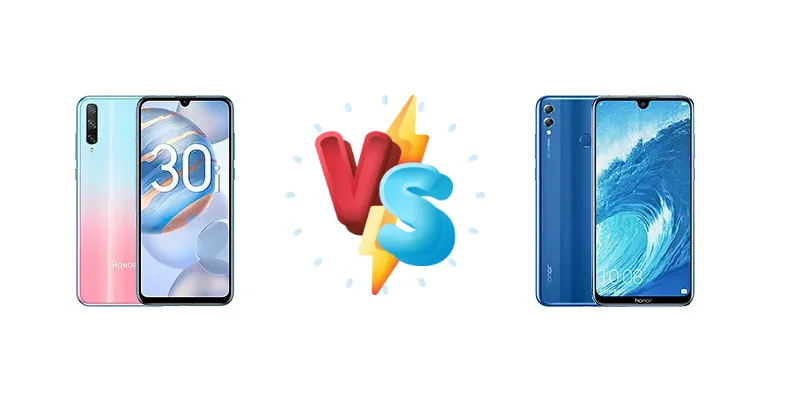
The Honor 30i and 8X Max represent different approaches to the budget smartphone market. The 8X Max, released earlier, prioritized a large display and relatively quick charging. The 30i, arriving later, features a newer Kirin chipset, aiming for improved processing power. This comparison dissects their key differences to determine which device delivers the best value.
🏆 Quick Verdict
For most users, the Honor 8X Max emerges as the slightly better choice. While the Kirin 710F in the 30i is newer, the Snapdragon 660’s 14nm process and optimized architecture provide a smoother overall experience, coupled with significantly faster 18W charging. The 30i’s 10W charging feels outdated in comparison.
| Network |
|---|
| 2G bands | GSM 900 / 1800 / 1900 | GSM 850 / 900 / 1800 / 1900 |
| 3G bands | HSDPA 850 / 900 / 1900 / 2100 | HSDPA 850 / 900 / 2100 |
| 4G bands | 1, 2, 3, 4, 5, 7, 8, 19, 20, 26, 28, 34, 38, 39, 40, 41 | 1, 3, 5, 7, 8, 20, 38, 40, 41 - Global |
| Speed | HSPA, LTE | HSPA 42.2/5.76 Mbps, LTE Cat4 150/50 Mbps |
| Technology | GSM / CDMA / HSPA / LTE | GSM / CDMA / HSPA / LTE |
| | CDMA 800 & TD-SCDMA | 1, 3, 5, 8, 38, 39, 40, 41 - China |
| Launch |
|---|
| Announced | 2020, September 11. Released 2020, September 12 | 2018, September. Released 2018, September |
| Status | Discontinued | Discontinued |
| Body |
|---|
| Dimensions | 157.2 x 73.2 x 7.7 mm (6.19 x 2.88 x 0.30 in) | 177.6 x 86.3 x 8.1 mm (6.99 x 3.40 x 0.32 in) |
| SIM | Nano-SIM + Nano-SIM | Nano-SIM + Nano-SIM |
| Weight | 171.5 g (6.07 oz) | 210 g (7.41 oz) |
| Display |
|---|
| Resolution | 1080 x 2400 pixels, 20:9 ratio (~418 ppi density) | 1080 x 2244 pixels, 18.7:9 ratio (~350 ppi density) |
| Size | 6.3 inches, 95.8 cm2 (~83.3% screen-to-body ratio) | 7.12 inches, 127.8 cm2 (~83.4% screen-to-body ratio) |
| Type | AMOLED, 600 nits (typ) | IPS LCD |
| Platform |
|---|
| CPU | Octa-core (4x2.2 GHz Cortex-A73 & 4x1.7 GHz Cortex-A53) | Octa-core (4x1.95 GHz Kryo 260 Gold & 4x1.8 GHz Kryo 260 Silver) |
| Chipset | Kirin 710F (12 nm) | Qualcomm SDM660 Snapdragon 660 (14 nm) |
| GPU | Mali-G51 MP4 | Adreno 512 |
| OS | Android 10, Magic UI 2.1 | Android 8.1 (Oreo), upgradable to Android 9 (Pie), EMUI 9 |
| Memory |
|---|
| Card slot | Nano Memory (uses shared SIM slot) | microSDXC (dedicated slot) |
| Internal | 128GB 4GB RAM | 64GB 4GB RAM, 64GB 6GB RAM, 128GB 4GB RAM, 128GB 6GB RAM |
| | - | eMMC 5.1 |
| Main Camera |
|---|
| Dual | - | 16 MP, f/2.0, PDAF
Auxiliary lens |
| Features | LED flash, HDR, panorama | LED flash, panorama, HDR |
| Triple | 48 MP, f/1.8, 28mm (wide), 1/2.0", 0.8µm, PDAF
8 MP, f/2.4, 120˚ (ultrawide)
Auxiliary lens | - |
| Video | 1080p@30fps | 1080p@30fps |
| Selfie camera |
|---|
| Features | HDR | HDR |
| Single | 16 MP, f/2.0, 26mm (wide), 1/3.06", 1.0µm | 8 MP, f/2.0 |
| Video | 1080p@30fps | 1080p@30fps |
| Sound |
|---|
| 3.5mm jack | Yes | Yes |
| 35mm jack | Yes | Yes |
| Loudspeaker | Yes | Yes, with stereo speakers |
| Comms |
|---|
| Bluetooth | 5.1, A2DP, LE | 4.2, A2DP, LE |
| NFC | Yes | No |
| Positioning | GPS, GLONASS, BDS | GPS, GLONASS, BDS |
| Radio | FM radio | FM radio |
| USB | USB Type-C 2.0, OTG | microUSB 2.0, OTG |
| WLAN | Wi-Fi 802.11 a/b/g/n/ac, dual-band, Wi-Fi Direct | Wi-Fi 802.11 a/b/g/n/ac, Wi-Fi Direct |
| Features |
|---|
| Sensors | Fingerprint (under display, optical), accelerometer, gyro, proximity, compass | Fingerprint (rear-mounted), accelerometer, gyro, proximity, compass |
| Battery |
|---|
| Charging | 10W wired | 18W wired
5W reverse wired |
| Type | Li-Po 4000 mAh | Li-Po 5000 mAh, non-removable |
| Misc |
|---|
| Colors | Ultraviolet Sunset, Turquoise, Midnight Black | Black, Blue, Red |
| Models | LRA-LX1 | ARE-AL00, ARE-L22HN, ARE-AL10 |
| Price | About 200 EUR | About 250 EUR |
Honor 30i
- Newer Kirin 710F chipset
- Potentially better multitasking performance
- More modern architecture
- Significantly slower 10W charging
- Less efficient 12nm process
- Likely more thermal throttling under load
Honor 8X Max
- Faster 18W wired charging with 5W reverse charging
- More efficient 14nm Snapdragon 660
- Potentially smoother overall user experience
- Older Snapdragon 660 chipset
- Less powerful CPU cores compared to the 30i
- Larger process node
Display Comparison
Neither device boasts a particularly impressive display. Both likely utilize IPS LCD panels, common in this price bracket. The Honor 8X Max’s larger size is its primary advantage, offering a more immersive viewing experience. However, detailed specs like peak brightness and color gamut coverage are unavailable, making a precise comparison impossible. We can assume both displays prioritize power efficiency over color accuracy.
Camera Comparison
Camera performance is difficult to assess without detailed sensor information. Both phones likely feature a multi-camera setup, but the specifics are unknown. Given the market segment, image processing will likely prioritize scene recognition and software enhancements over raw sensor quality. The absence of Optical Image Stabilization (OIS) on either device suggests a reliance on software stabilization, which can introduce artifacts in low-light conditions. We can assume both phones will struggle in challenging lighting scenarios.
Performance
The core difference lies in the chipsets. The Honor 30i’s Kirin 710F (12nm) features an octa-core configuration with Cortex-A73 and A53 cores. The Honor 8X Max utilizes the Qualcomm Snapdragon 660 (14nm), also octa-core, but with Kryo 260 Gold and Silver cores. While the Kirin 710F benefits from a newer architecture, the Snapdragon 660’s 14nm process is more mature and generally offers better thermal efficiency. This translates to less throttling under sustained load, potentially providing a more consistent gaming experience. The Snapdragon 660 is known for its optimized power management, which could lead to better real-world battery life despite the 30i’s newer chip.
Battery Life
The Honor 8X Max’s 18W wired charging is a significant advantage over the Honor 30i’s 10W charging. This difference translates to a much faster 0-100% charge time, reducing downtime. While battery capacity isn’t specified, the faster charging speed of the 8X Max mitigates any potential disadvantage from a slightly smaller battery. The 8X Max also includes 5W reverse wired charging, a niche feature allowing it to charge other devices, absent on the 30i.
Buying Guide
Buy the Honor 30i if you prioritize a newer chipset and anticipate needing to run multiple apps simultaneously, even if it means sacrificing charging speed. Buy the Honor 8X Max if you value faster charging, a more consistently responsive user experience, and don't heavily rely on demanding multitasking or gaming. The 8X Max is ideal for everyday users focused on media consumption and basic productivity.
Frequently Asked Questions
❓ Will the Honor 30i handle demanding games like PUBG Mobile smoothly?
While the Kirin 710F is capable, the Snapdragon 660 in the 8X Max is likely to provide a more consistent frame rate due to its better thermal management. Expect to potentially need to lower graphics settings on the 30i to avoid significant frame drops during extended gaming sessions.
❓ How long will it take to fully charge each phone from 0%?
The Honor 8X Max, with its 18W charging, will likely reach 100% in around 1.5 to 2 hours. The Honor 30i, limited to 10W charging, will take considerably longer – potentially 3 to 4 hours, making it less convenient for users who need a quick top-up.
❓ Does the Snapdragon 660 in the 8X Max still feel responsive in 2024?
Yes, the Snapdragon 660 remains a capable processor for everyday tasks like browsing, social media, and video streaming. Its optimized architecture and efficient power management ensure a smooth and responsive user experience, even years after its initial release.