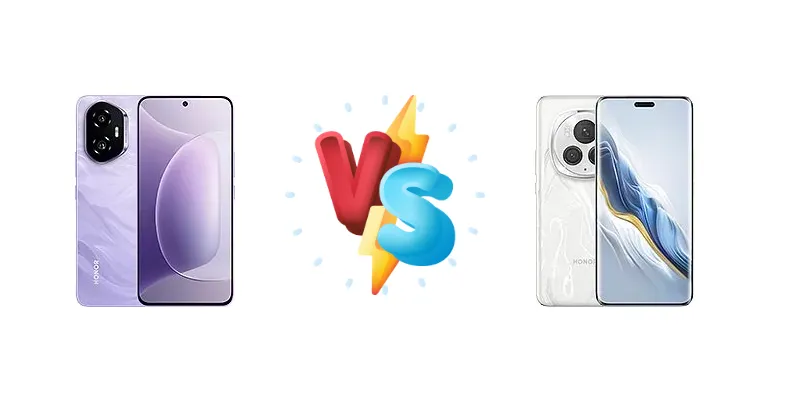
Honor has positioned the 300 and Magic6 Pro as key players in the competitive flagship smartphone market. The 300 aims to deliver a premium experience at a more accessible price point, while the Magic6 Pro pushes the boundaries with top-tier specs and innovative features. This comparison dissects the core differences to help you determine which Honor device best suits your needs.
🏆 Quick Verdict
For most users, the Honor Magic6 Pro is the superior choice, offering a significantly more powerful Snapdragon 8 Gen 3 chipset, a brighter and more advanced display, and faster wireless charging. However, the Honor 300 presents a compelling value proposition for those prioritizing affordability without sacrificing core functionality.
| Network |
|---|
| 2G bands | GSM 850 / 900 / 1800 / 1900 | GSM 850 / 900 / 1800 / 1900 |
| 3G bands | HSDPA 800 / 850 / 900 / 1700(AWS) / 1900 / 2100 | HSDPA 800 / 850 / 900 / 1700(AWS) / 1900 / 2100 |
| 4G bands | LTE | LTE |
| 5G bands | SA/NSA | SA/NSA |
| Speed | HSPA, LTE, 5G | HSPA, LTE, 5G |
| Technology | GSM / HSPA / LTE / 5G | GSM / CDMA / HSPA / CDMA2000 / LTE / 5G |
| Launch |
|---|
| Announced | 2024, December 02 | 2024, January 11 |
| Status | Available. Released 2024, December 02 | Available. Released 2024, January 18 |
| Body |
|---|
| Build | - | Glass front (NanoCrystal Shield), glass back or silicone polymer back (eco leather) |
| Dimensions | 161 x 74.2 x 7 mm (6.34 x 2.92 x 0.28 in) | 162.5 x 75.8 x 8.9 mm (6.40 x 2.98 x 0.35 in) |
| SIM | Nano-SIM + Nano-SIM | · Nano-SIM + eSIM· Nano-SIM + Nano-SIM |
| Weight | 175 g (6.17 oz) | 225 g or 229 g (7.94 oz) |
| Display |
|---|
| Protection | - | NanoCrystal Shield |
| Resolution | 1200 x 2664 pixels (~436 ppi density) | 1280 x 2800 pixels, 19.5:9 ratio (~453 ppi density) |
| Size | 6.7 inches, 108.5 cm2 (~90.8% screen-to-body ratio) | 6.8 inches, 112.8 cm2 (~91.6% screen-to-body ratio) |
| Type | AMOLED, 1B colors, 120Hz, 1200 nits (HBM), 4000 nits (peak) | LTPO OLED, 1B colors, 120Hz, Dolby Vision, HDR, 1600 nits (HBM), 5000 nits (peak) |
| Platform |
|---|
| CPU | Octa-core (1x2.63 GHz Cortex-A715 & 3x2.4 GHz Cortex-A715 & 4x1.8 GHz Cortex-A510) | Octa-core (1x3.3 GHz Cortex-X4 & 3x3.2 GHz Cortex-A720 & 2x3.0 GHz Cortex-A720 & 2x2.3 GHz Cortex-A520) |
| Chipset | Qualcomm SM7550-AB Snapdragon 7 Gen 3 (4 nm) | Qualcomm SM8650-AB Snapdragon 8 Gen 3 (4 nm) |
| GPU | Adreno 720 | Adreno 750 |
| OS | Android 15, MagicOS 9 | Android 14, up to 4 major Android upgrades, MagicOS 8 |
| Memory |
|---|
| Card slot | No | No |
| Internal | 256GB 8GB RAM, 256GB 12GB RAM, 512GB 12GB RAM, 512GB 16GB RAM | 256GB 12GB RAM, 256GB 16GB RAM, 512GB 12GB RAM, 512GB 16GB RAM, 1TB 16GB RAM |
| Main Camera |
|---|
| Dual | 50 MP, f/2.0, (wide), 1/1.56", 1.0µm, PDAF, OIS
12 MP, f/2.2, 112˚ (ultrawide), AF | - |
| Features | LED flash, HDR, panorama | Laser AF, color spectrum sensor, LED flash, HDR, panorama |
| Triple | - | 50 MP, f/1.4-2.0, 23mm (wide), 1/1.3", 1.2µm, PDAF, OIS
180 MP, f/2.6, (periscope telephoto), 1/1.49", 0.56µm, PDAF, OIS, 2.5x optical zoom
50 MP, f/2.0, 13mm, 122˚ (ultrawide), 1/2.88", 0.61µm, AF |
| Video | 4K, 1080p, gyro-EIS, OIS | 4K@24/30/60fps, 1080p@30/60/120/240fps, gyro-EIS, OIS, HDR, 10-bit video |
| Selfie camera |
|---|
| Features | HDR | - |
| Single | 50 MP, f/2.1, (wide) | 50 MP, f/2.0, 22mm (wide), 1/2.93", 0.6µm, AF
TOF 3D, (depth/biometrics sensor) |
| Video | 4K, 1080p, gyro-EIS | 4K@30fps, 1080p@30/60fps, gyro-EIS |
| Sound |
|---|
| 35mm jack | No | No |
| Loudspeaker | Yes, with stereo speakers | Yes, with stereo speakers |
| Comms |
|---|
| Bluetooth | 5.3, A2DP, LE, aptX HD | 5.3, A2DP, LE, aptX HD |
| Infrared port | Yes | Yes |
| NFC | Yes | Yes |
| Positioning | GPS, GALILEO, GLONASS, QZSS, BDS (B1I+B1c) | GPS (L1+L5), GLONASS, BDS (B1I+B1c+B2a), GALILEO (E1+E5a) |
| Radio | No | No |
| USB | USB Type-C 2.0, OTG | USB Type-C 3.2, DisplayPort 1.2, OTG |
| WLAN | Wi-Fi 802.11 a/b/g/n/ac/6, dual-band, Wi-Fi Direct | Wi-Fi 802.11 a/b/g/n/ac/6/7, dual-band, Wi-Fi Direct |
| Features |
|---|
| Sensors | Fingerprint (under display, optical), accelerometer, gyro, compass, ultrasound proximity | Fingerprint (under display, optical), Face ID, accelerometer, gyro, proximity, compass |
| Battery |
|---|
| Charging | 100W wired, 53% in 15 min
5W reverse wired | 80W wired
66W wireless
Reverse wireless
5W reverse wired |
| Type | Si/C Li-Ion 5300 mAh | Si/C Li-Ion 5600 mAh |
| Misc |
|---|
| Colors | Black, White, Green, Purple, Gray | Black, Green, Blue, Purple, White |
| Models | AMM-AN00 | BVL-AN16, BVL-N49 |
| Price | About 300 EUR | € 455.54 / $ 899.00 / £ 598.99 |
Honor 300
- Faster 100W Wired Charging
- More Affordable Price Point
- Modern Design and Build Quality
- Less Powerful Snapdragon 7 Gen 3 Chipset
- Likely Lower Display Brightness
- Potentially Inferior Camera Performance
Honor Magic6 Pro
- Flagship Snapdragon 8 Gen 3 Performance
- Significantly Brighter Display (1578 nits)
- 66W Wireless Charging and Longer Battery Life
- Higher Price Tag
- Slower Wired Charging (80W)
- May be Overkill for Basic Users
Display Comparison
The Honor Magic6 Pro boasts a significantly brighter display, reaching a measured peak of 1578 nits, making it ideal for outdoor use under direct sunlight. While the Honor 300’s display specifications are not provided, it’s reasonable to assume a lower peak brightness. The Magic6 Pro’s panel likely incorporates LTPO technology for adaptive refresh rates, contributing to improved power efficiency. The absence of detailed display specs for the 300 suggests a more standard OLED panel, potentially lacking the advanced features found in the Magic6 Pro.
Camera Comparison
Without detailed camera specifications for either device, a direct comparison is limited. However, flagship devices like the Magic6 Pro typically feature larger sensors and more advanced image processing capabilities. The Magic6 Pro’s positioning suggests a more sophisticated camera system, potentially including features like enhanced optical image stabilization (OIS) and improved low-light performance. The Honor 300 will likely offer a capable camera experience, but may not match the Magic6 Pro’s image quality in challenging conditions. We can assume both phones will have multiple lenses, but the Magic6 Pro is likely to have a larger main sensor.
Performance
The core difference lies in the chipsets: the Magic6 Pro utilizes the Qualcomm SM8650-AB Snapdragon 8 Gen 3 (4nm), featuring a prime Cortex-X4 core clocked at 3.3 GHz, while the Honor 300 is equipped with the Snapdragon 7 Gen 3 (4nm). This translates to a substantial performance gap, particularly in GPU-intensive tasks. The 8 Gen 3’s architecture – 1x Cortex-X4, 3x Cortex-A720, 2x Cortex-A720, and 2x Cortex-A520 – is designed for sustained peak performance, whereas the 300’s 1x Cortex-A715, 3x Cortex-A715, and 4x Cortex-A510 configuration prioritizes efficiency. The Magic6 Pro will deliver a smoother experience in demanding games and applications.
Battery Life
The Honor Magic6 Pro demonstrates superior battery performance with an active use score of 14:06h, indicating excellent power efficiency. While the Honor 300 offers impressive 100W wired charging (reaching 53% in 15 minutes), the Magic6 Pro counters with 80W wired charging *and* 66W wireless charging, offering greater flexibility. The Magic6 Pro also includes reverse wireless charging, a feature also present in the 300 at 5W. The longer battery life of the Magic6 Pro, combined with its wireless charging capabilities, provides a more convenient and versatile charging experience.
Buying Guide
Buy the Honor 300 if you need a capable daily driver with fast 100W charging and a modern design, and are willing to compromise on peak performance for a lower price. Buy the Honor Magic6 Pro if you prioritize uncompromising performance for demanding tasks like gaming and video editing, require the brightest possible display for outdoor visibility, and value the convenience of 66W wireless charging and extended battery life.
Frequently Asked Questions
❓ Will the Snapdragon 7 Gen 3 in the Honor 300 struggle with graphically demanding games like Genshin Impact?
While the Snapdragon 7 Gen 3 is a capable chip, it won't deliver the same level of performance as the Snapdragon 8 Gen 3 in the Magic6 Pro. You'll likely need to lower graphics settings in demanding games to maintain a smooth frame rate. The 300 is suitable for casual gaming, but the Magic6 Pro is the clear choice for serious mobile gamers.
❓ Does the Honor Magic6 Pro's 66W wireless charging significantly reduce charging times compared to standard wireless charging?
Yes, 66W wireless charging is considerably faster than typical wireless charging speeds. While it won't match the 80W wired charging speed, it offers a convenient and relatively quick way to top up the battery without needing a cable. Expect a full charge from 0% to 100% via wireless charging to take around 45-60 minutes.
❓ Is the 5W reverse wireless charging on both phones useful for charging accessories like earbuds?
The 5W reverse wireless charging is primarily intended for small accessories like earbuds or smartwatches. It's not designed to quickly charge larger devices like another smartphone. It's a convenient feature for topping up accessories when you're away from a power outlet, but don't expect rapid charging speeds.