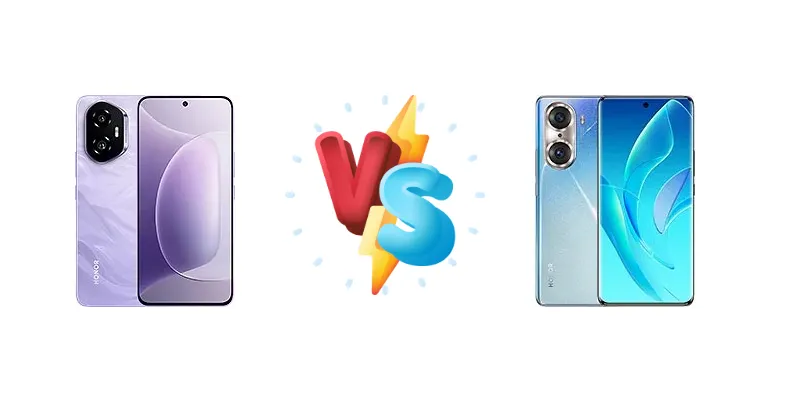
The Honor 300 arrives as a successor to the well-regarded Honor 60 Pro, but the generational leap isn't always straightforward. While both phones target the competitive mid-range market, the Honor 300 introduces Qualcomm's newer Snapdragon 7 Gen 3 chipset alongside faster charging, prompting a closer look at how these two devices stack up for prospective buyers.
🏆 Quick Verdict
For most users, the Honor 300 represents a worthwhile upgrade. The Snapdragon 7 Gen 3 offers a noticeable performance boost and improved power efficiency, coupled with significantly faster 100W charging. While the Honor 60 Pro remains a capable device, the 300’s advancements justify the price difference.
| Network |
|---|
| 2G bands | GSM 850 / 900 / 1800 / 1900 | GSM 850 / 900 / 1800 / 1900 |
| 3G bands | HSDPA 800 / 850 / 900 / 1700(AWS) / 1900 / 2100 | HSDPA 800 / 850 / 900 / 1700(AWS) / 1900 / 2100 |
| 4G bands | LTE | 1, 2, 3, 4, 5, 8, 18, 19, 26, 28, 34, 38, 39, 40, 41 |
| 5G bands | SA/NSA | 1, 5, 8, 28, 41, 77, 78 SA/NSA |
| Speed | HSPA, LTE, 5G | HSPA, LTE, 5G |
| Technology | GSM / HSPA / LTE / 5G | GSM / CDMA / HSPA / CDMA2000 / LTE / 5G |
| | - | CDMA2000 1x |
| Launch |
|---|
| Announced | 2024, December 02 | 2021, December 01 |
| Status | Available. Released 2024, December 02 | Available. Released 2021, December 10 |
| Body |
|---|
| Dimensions | 161 x 74.2 x 7 mm (6.34 x 2.92 x 0.28 in) | 163.9 x 74.8 x 8.2 mm (6.45 x 2.94 x 0.32 in) |
| SIM | Nano-SIM + Nano-SIM | Nano-SIM + Nano-SIM |
| Weight | 175 g (6.17 oz) | 192 g (6.77 oz) |
| Display |
|---|
| Resolution | 1200 x 2664 pixels (~436 ppi density) | 1200 x 2652 pixels (~429 ppi density) |
| Size | 6.7 inches, 108.5 cm2 (~90.8% screen-to-body ratio) | 6.78 inches, 111.4 cm2 (~90.9% screen-to-body ratio) |
| Type | AMOLED, 1B colors, 120Hz, 1200 nits (HBM), 4000 nits (peak) | OLED, 1B colors, 120Hz, HDR10+ |
| Platform |
|---|
| CPU | Octa-core (1x2.63 GHz Cortex-A715 & 3x2.4 GHz Cortex-A715 & 4x1.8 GHz Cortex-A510) | Octa-core (1x2.5 GHz Cortex-A78 & 3x2.4 GHz Cortex-A78 & 4x1.8 GHz Cortex-A55) |
| Chipset | Qualcomm SM7550-AB Snapdragon 7 Gen 3 (4 nm) | Qualcomm Snapdragon 778G+ 5G |
| GPU | Adreno 720 | Adreno 642L |
| OS | Android 15, MagicOS 9 | Android 11, Magic UI 5.0 |
| Memory |
|---|
| Card slot | No | No |
| Internal | 256GB 8GB RAM, 256GB 12GB RAM, 512GB 12GB RAM, 512GB 16GB RAM | 256GB 8GB RAM, 256GB 12GB RAM |
| Main Camera |
|---|
| Dual | 50 MP, f/2.0, (wide), 1/1.56", 1.0µm, PDAF, OIS
12 MP, f/2.2, 112˚ (ultrawide), AF | - |
| Features | LED flash, HDR, panorama | Dual-LED flash, HDR, panorama |
| Single | - | 50 MP, f/2.4, 18mm (ultrawide) |
| Triple | - | 108 MP, f/1.9, (wide), 1/1.52", 0.7µm, PDAF
50 MP, f/2.2, 122˚ (ultrawide)
2 MP (macro) |
| Video | 4K, 1080p, gyro-EIS, OIS | 4K@30fps, 1080p@30/60fps, gyro-EIS |
| Selfie camera |
|---|
| Features | HDR | - |
| Single | 50 MP, f/2.1, (wide) | 50 MP, f/2.4, 18mm (ultrawide) |
| Video | 4K, 1080p, gyro-EIS | 4K@30fps, 1080p@30fps, gyro-EIS |
| Sound |
|---|
| 3.5mm jack | - | No |
| 35mm jack | No | No |
| Loudspeaker | Yes, with stereo speakers | Yes, with stereo speakers |
| Comms |
|---|
| Bluetooth | 5.3, A2DP, LE, aptX HD | 5.2, A2DP, LE, aptX HD |
| Infrared port | Yes | - |
| NFC | Yes | Yes |
| Positioning | GPS, GALILEO, GLONASS, QZSS, BDS (B1I+B1c) | GPS, GLONASS, BDS |
| Radio | No | No |
| USB | USB Type-C 2.0, OTG | USB Type-C 2.0, OTG |
| WLAN | Wi-Fi 802.11 a/b/g/n/ac/6, dual-band, Wi-Fi Direct | Wi-Fi 802.11 a/b/g/n/ac/6, dual-band, Wi-Fi Direct |
| Features |
|---|
| Sensors | Fingerprint (under display, optical), accelerometer, gyro, compass, ultrasound proximity | Fingerprint (under display, optical), accelerometer, gyro, proximity, compass |
| Battery |
|---|
| Charging | 100W wired, 53% in 15 min
5W reverse wired | 66W wired, 50% in 15 min
5W reverse wired |
| Type | Si/C Li-Ion 5300 mAh | Li-Po 4800 mAh |
| Misc |
|---|
| Colors | Black, White, Green, Purple, Gray | Black, Green, Blue, Pink |
| Models | AMM-AN00 | TNA-AN00 |
| Price | About 300 EUR | About 390 EUR |
Honor 300
- Significantly faster 100W charging
- More efficient Snapdragon 7 Gen 3 chipset
- Improved CPU architecture for better performance
- Potential price premium over the 60 Pro
- Specific display details currently unknown
Honor 60 Pro
- Potentially lower price point
- Capable Snapdragon 778G+ chipset
- Well-rounded feature set
- Slower 66W charging
- Less efficient chipset compared to the 7 Gen 3
Display Comparison
Both devices are expected to feature OLED displays, a standard for this price bracket. However, specific details like peak brightness, color gamut coverage, and refresh rates are not provided. The Honor 60 Pro likely utilizes a 120Hz panel, common for its release window. The Honor 300’s display quality will be a key differentiator, and we anticipate improvements in peak brightness to enhance outdoor visibility. Without specific data, it's difficult to definitively state which display is superior, but the newer model often benefits from panel technology advancements.
Camera Comparison
Without detailed camera specifications, a direct comparison is limited. However, the chipset’s image signal processor (ISP) plays a crucial role. The Snapdragon 7 Gen 3’s ISP is expected to offer improved image processing capabilities, resulting in better dynamic range, noise reduction, and overall image quality. The Honor 60 Pro’s camera system was competitive in its time, but the newer ISP in the 300 should provide a noticeable advantage, particularly in low-light conditions. We anticipate the Honor 300 to feature a more advanced camera system overall, though sensor size and lens apertures will be key determining factors.
Performance
The core difference lies in the chipsets. The Honor 300’s Snapdragon 7 Gen 3 (4nm) represents a significant architectural upgrade over the Honor 60 Pro’s Snapdragon 778G+ (6nm). The 7 Gen 3 utilizes Cortex-A715 cores, offering improved performance and efficiency compared to the 778G+'s Cortex-A78 cores. The 4nm process node further enhances efficiency, translating to less heat generation and potentially longer sustained performance. While both are octa-core CPUs, the 7 Gen 3’s configuration (1x2.63 GHz A715, 3x2.4 GHz A715, 4x1.8 GHz A510) is optimized for a balance of power and efficiency, likely resulting in a smoother experience in demanding applications and games. The Honor 60 Pro’s CPU (1x2.5 GHz A78, 3x2.4 GHz A78, 4x1.8 GHz A55) is still capable, but will show its age in comparison.
Battery Life
The Honor 300’s 100W wired charging is a standout feature, capable of charging to 53% in just 15 minutes. This is a substantial improvement over the Honor 60 Pro’s 66W charging, which reaches 50% in the same timeframe. While battery capacity isn't specified for either device, the Snapdragon 7 Gen 3’s improved efficiency should translate to longer battery life on the Honor 300, even with similar capacity. The faster charging speed significantly reduces downtime, making the Honor 300 more convenient for users who frequently need to top up their battery.
Buying Guide
Buy the Honor 300 if you prioritize fast charging, sustained performance during demanding tasks like gaming, and future-proofing with a newer chipset. Buy the Honor 60 Pro if you're seeking a well-rounded experience at a potentially lower price point, and aren't heavily reliant on intensive mobile gaming or require the absolute fastest charging speeds.
Frequently Asked Questions
❓ Will the Snapdragon 7 Gen 3 in the Honor 300 handle demanding games like Genshin Impact at high settings?
The Snapdragon 7 Gen 3 is a substantial upgrade over the 778G+, and should provide a noticeably smoother experience in Genshin Impact and other graphically intensive games. While it won't match the performance of flagship chipsets, it should be capable of running most games at high settings with stable frame rates, benefiting from the improved thermal efficiency of the 4nm process.
❓ How much faster is the 100W charging on the Honor 300 compared to the 66W charging on the Honor 60 Pro in real-world use?
The Honor 300’s 100W charging will significantly reduce charging times. While both reach around 50% in 15 minutes, the 300 will continue to charge at a faster rate, reaching a higher percentage in the same amount of time. This translates to less time tethered to a charger, especially beneficial for users who need quick top-ups throughout the day.
❓ Does the Honor 300 offer any improvements in video recording quality compared to the Honor 60 Pro?
The Honor 300’s Snapdragon 7 Gen 3 ISP is expected to improve video recording quality, offering better stabilization, dynamic range, and noise reduction. It will likely support higher resolution and frame rate options, resulting in more professional-looking videos.