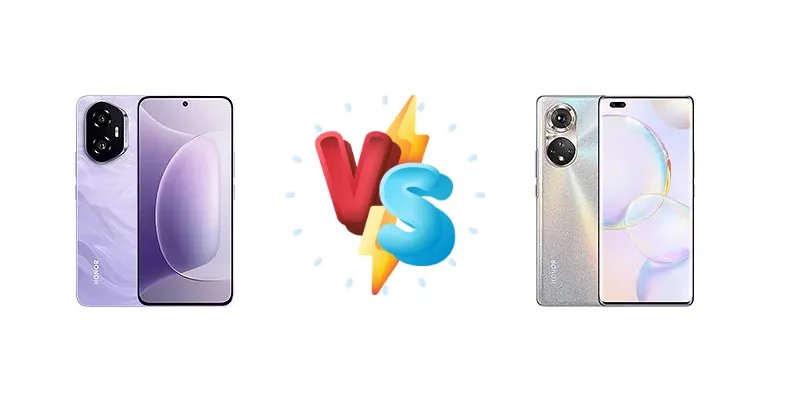
The Honor 300 arrives as a successor aiming to refine the mid-range experience previously established by the Honor 50 Pro. While both phones share a similar price bracket and 100W charging, they diverge significantly in their core processing power and underlying architecture. This comparison dissects these differences, helping you determine which device best suits your needs.
🏆 Quick Verdict
For most users, the Honor 300 emerges as the better choice. Its newer Snapdragon 7 Gen 3 chipset, built on a more efficient 4nm process, offers a compelling blend of performance and battery life improvements over the Honor 50 Pro’s Snapdragon 778G. While the 50 Pro remains a capable device, the 300 represents a tangible step forward.
| Network |
|---|
| 2G bands | GSM 850 / 900 / 1800 / 1900 | GSM 850 / 900 / 1800 / 1900 |
| 3G bands | HSDPA 800 / 850 / 900 / 1700(AWS) / 1900 / 2100 | HSDPA 800 / 850 / 900 / 1700(AWS) / 1900 / 2100 |
| 4G bands | LTE | 1, 2, 4, 5, 8, 19, 34, 38, 39, 40, 41 |
| 5G bands | SA/NSA | 1, 5, 8, 41, 77, 78 SA/NSA |
| Speed | HSPA, LTE, 5G | HSPA, LTE, 5G |
| Technology | GSM / HSPA / LTE / 5G | GSM / CDMA / HSPA / CDMA2000 / LTE / 5G |
| | - | CDMA2000 1x |
| Launch |
|---|
| Announced | 2024, December 02 | 2021, June 16 |
| Status | Available. Released 2024, December 02 | Available. Released 2021, June 25 |
| Body |
|---|
| Dimensions | 161 x 74.2 x 7 mm (6.34 x 2.92 x 0.28 in) | 163.5 x 74.7 x 8 mm (6.44 x 2.94 x 0.31 in) |
| SIM | Nano-SIM + Nano-SIM | Nano-SIM + Nano-SIM |
| Weight | 175 g (6.17 oz) | 187 g (6.60 oz) |
| Display |
|---|
| Resolution | 1200 x 2664 pixels (~436 ppi density) | 1236 x 2676 pixels, 19.5:9 ratio (~439 ppi density) |
| Size | 6.7 inches, 108.5 cm2 (~90.8% screen-to-body ratio) | 6.72 inches, 110.9 cm2 (~90.8% screen-to-body ratio) |
| Type | AMOLED, 1B colors, 120Hz, 1200 nits (HBM), 4000 nits (peak) | OLED, 1B colors, 120Hz |
| Platform |
|---|
| CPU | Octa-core (1x2.63 GHz Cortex-A715 & 3x2.4 GHz Cortex-A715 & 4x1.8 GHz Cortex-A510) | Octa-core (1x2.4 GHz Cortex-A78 & 3x2.2 GHz Cortex-A78 & 4x1.9 GHz Cortex-A55) |
| Chipset | Qualcomm SM7550-AB Snapdragon 7 Gen 3 (4 nm) | Qualcomm SM7325 Snapdragon 778G 5G (6 nm) |
| GPU | Adreno 720 | Adreno 642L |
| OS | Android 15, MagicOS 9 | Android 11, Magic UI 4.2, Google Play Services |
| Memory |
|---|
| Card slot | No | No |
| Internal | 256GB 8GB RAM, 256GB 12GB RAM, 512GB 12GB RAM, 512GB 16GB RAM | 256GB 8GB RAM, 256GB 12GB RAM |
| Main Camera |
|---|
| Dual | 50 MP, f/2.0, (wide), 1/1.56", 1.0µm, PDAF, OIS
12 MP, f/2.2, 112˚ (ultrawide), AF | 12 MP, f/2.4, 18mm, 100˚ (ultrawide), 1/2.8", 1.25µm
32 MP, f/2.2, 22mm (wide), 1/3.14" |
| Features | LED flash, HDR, panorama | LED flash, HDR, panorama |
| Quad | - | 108 MP, f/1.9, (wide), 1/1.52", 0.7µm, PDAF
8 MP, f/2.2, 120˚, 17mm (ultrawide)
2 MP (macro)
Auxiliary lens |
| Video | 4K, 1080p, gyro-EIS, OIS | 4K@30fps, 1080p@30/60fps, gyro-EIS |
| Selfie camera |
|---|
| Dual | - | 12 MP, f/2.4, 18mm, 100˚ (ultrawide), 1/2.8", 1.25µm
32 MP, f/2.2, 22mm (wide), 1/3.14" |
| Features | HDR | - |
| Single | 50 MP, f/2.1, (wide) | - |
| Video | 4K, 1080p, gyro-EIS | 1080p@30fps |
| Sound |
|---|
| 3.5mm jack | - | No |
| 35mm jack | No | No |
| Loudspeaker | Yes, with stereo speakers | Yes |
| Comms |
|---|
| Bluetooth | 5.3, A2DP, LE, aptX HD | 5.2, A2DP, LE, aptX HD |
| Infrared port | Yes | - |
| NFC | Yes | Yes |
| Positioning | GPS, GALILEO, GLONASS, QZSS, BDS (B1I+B1c) | GPS, GLONASS, BDS |
| Radio | No | No |
| USB | USB Type-C 2.0, OTG | USB Type-C 2.0, OTG |
| WLAN | Wi-Fi 802.11 a/b/g/n/ac/6, dual-band, Wi-Fi Direct | Wi-Fi 802.11 a/b/g/n/ac/6, dual-band, Wi-Fi Direct |
| Features |
|---|
| Sensors | Fingerprint (under display, optical), accelerometer, gyro, compass, ultrasound proximity | Fingerprint (under display, optical), accelerometer, gyro, proximity, compass |
| Battery |
|---|
| Charging | 100W wired, 53% in 15 min
5W reverse wired | 100W wired, 100% in 25 min |
| Type | Si/C Li-Ion 5300 mAh | Li-Po 4000 mAh |
| Misc |
|---|
| Colors | Black, White, Green, Purple, Gray | Frost Crystal, Amber Red, Emerald Green, Midnight Black |
| Models | AMM-AN00 | RNA-AN00 |
| Price | About 300 EUR | About 480 EUR |
Honor 300
- More efficient Snapdragon 7 Gen 3 chipset
- Faster initial charging speed (53% in 15 mins)
- Improved ISP for better image processing
- May have a slightly higher price point
- Software experience may be less mature than the 50 Pro
Honor 50 Pro
- Proven Snapdragon 778G performance
- Full 100% charge in 25 minutes
- Potentially lower price due to being an older model
- Less power-efficient chipset
- Older CPU architecture
Display Comparison
Both devices are expected to feature high-quality OLED displays, though specific details like peak brightness and refresh rates aren't provided. However, the core difference lies in the underlying chipsets' ability to drive these displays efficiently. The Snapdragon 7 Gen 3's improved ISP could translate to more accurate color reproduction and better HDR performance. Bezels are likely comparable, given both phones target a similar market segment.
Camera Comparison
Without detailed camera specifications, a direct comparison is limited. However, the Snapdragon 7 Gen 3’s improved ISP (Image Signal Processor) in the Honor 300 is a key advantage. This ISP enables faster image processing, better noise reduction, and improved dynamic range. While both phones likely feature similar camera setups in terms of megapixel count, the 300’s ISP will likely deliver superior image quality, particularly in challenging lighting conditions. The 778G in the 50 Pro is still capable, but the 300 has a clear edge in computational photography.
Performance
The Honor 300’s Qualcomm SM7550-AB Snapdragon 7 Gen 3 (4nm) represents a significant architectural leap over the Honor 50 Pro’s Snapdragon 778G (6nm). The 7 Gen 3 utilizes Cortex-A715 cores, offering a performance uplift over the 778G’s Cortex-A78. The 4nm fabrication process further enhances efficiency, reducing heat and improving sustained performance. While the 778G is a proven performer, the 300’s CPU configuration (1x2.63 GHz Cortex-A715, 3x2.4 GHz Cortex-A715, 4x1.8 GHz Cortex-A510) suggests a more balanced approach to multi-core tasks compared to the 778G’s (1x2.4 GHz Cortex-A78, 3x2.2 GHz Cortex-A78, 4x1.9 GHz Cortex-A55). This translates to smoother multitasking and potentially better gaming performance, especially in titles optimized for newer Arm architectures.
Battery Life
Both phones feature 100W wired charging, but the implementation differs. The Honor 50 Pro achieves 100% charge in 25 minutes, while the Honor 300 reaches 53% in 15 minutes. While the 50 Pro’s full charge time is faster, the 300’s initial charging speed is significantly quicker, providing a substantial boost in a short period. More importantly, the Snapdragon 7 Gen 3’s 4nm process contributes to significantly improved power efficiency. This means the Honor 300 will likely offer longer battery life for the same usage patterns compared to the Honor 50 Pro, despite potentially having a similar battery capacity.
Buying Guide
Buy the Honor 300 if you prioritize long-term performance, improved power efficiency for all-day use, and future-proofing with a newer chipset. Buy the Honor 50 Pro if you can find it at a significantly discounted price and value its established track record, particularly if your usage revolves around less demanding tasks and you appreciate a slightly more mature software experience.
Frequently Asked Questions
❓ Will the Honor 300’s Snapdragon 7 Gen 3 handle demanding games like Genshin Impact at high settings?
Yes, the Snapdragon 7 Gen 3 is a capable chipset for gaming. While it won't match the performance of flagship Snapdragon 8 series chips, it should comfortably run Genshin Impact at medium to high settings with stable frame rates. The 4nm process also helps mitigate thermal throttling during extended gaming sessions.
❓ Is the 100W charging on the Honor 300 compatible with all USB-PD chargers?
While 100W charging is fast, Honor's implementation may not be fully compatible with all USB-PD chargers. It's recommended to use the charger included in the box or a charger specifically certified for Honor's 100W SuperCharge protocol to ensure optimal charging speeds and safety.
❓ Does the Honor 50 Pro still receive software updates?
The Honor 50 Pro is likely to continue receiving security updates for a period, but major Android version updates may be limited. Honor typically provides at least two years of security updates for its devices, but the long-term software support is less extensive than newer models like the Honor 300.
❓ How does the thermal performance of the Honor 300 compare to the 50 Pro under sustained load?
The Honor 300 benefits from the Snapdragon 7 Gen 3’s 4nm process, which generates less heat than the 6nm Snapdragon 778G in the 50 Pro. This translates to better thermal management and reduced throttling during prolonged tasks like gaming or video recording, resulting in more consistent performance.