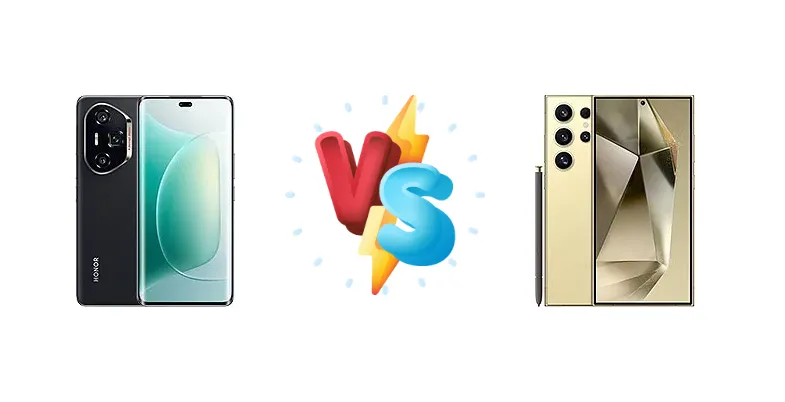
The Honor 300 Ultra arrives as a challenger to Samsung’s established flagship dominance with the Galaxy S24 Ultra. Both devices leverage the Qualcomm Snapdragon 8 Gen 3, but diverge significantly in charging speeds, display characteristics, and overall user experience. This comparison dissects these differences to determine which phone best suits your needs.
🏆 Quick Verdict
For users prioritizing charging speed and a potentially more aggressive price point, the Honor 300 Ultra is the winner. However, the Samsung Galaxy S24 Ultra delivers a more refined experience with a brighter display and demonstrably longer battery life in active use, making it the better choice for power users.
| Network |
|---|
| 2G bands | GSM 850 / 900 / 1800 / 1900 | GSM 850 / 900 / 1800 / 1900 |
| 3G bands | HSDPA 800 / 850 / 900 / 1700(AWS) / 1900 / 2100 | HSDPA 850 / 900 / 1700(AWS) / 1900 / 2100 |
| 4G bands | LTE | 1, 2, 3, 4, 5, 7, 8, 12, 13, 17, 18, 19, 20, 25, 26, 28, 32, 38, 39, 40, 41, 66 - International |
| 5G bands | SA/NSA | 1, 2, 3, 5, 7, 8, 12, 20, 25, 26, 28, 38, 40, 41, 66, 75, 77, 78 SA/NSA/Sub6 - International |
| Speed | HSPA, LTE, 5G | HSPA, LTE (up to 7CA), 5G |
| Technology | GSM / HSPA / LTE / 5G | GSM / CDMA / HSPA / EVDO / LTE / 5G |
| Launch |
|---|
| Announced | 2024, December 02 | 2024, January 17 |
| Status | Available. Released 2024, December 07 | Available. Released 2024, January 24 |
| Body |
|---|
| Build | Glass front, glass back or silicone polymer back (eco leather) | Glass front (Corning Gorilla Armor), glass back (Corning Gorilla Armor), titanium frame (grade 2) |
| Dimensions | 163.8 x 75.3 x 8.2 mm (6.45 x 2.96 x 0.32 in) | 162.3 x 79 x 8.6 mm (6.39 x 3.11 x 0.34 in) |
| SIM | Nano-SIM + Nano-SIM | · Nano-SIM + Nano-SIM + eSIM + eSIM (max 2 at a time) - INT· Nano-SIM + eSIM + eSIM (max 2 at a time) - USA· Nano-SIM + Nano-SIM - CN |
| Weight | 198 g (6.98 oz) | 232 g or 233 g (8.18 oz) |
| Display |
|---|
| Protection | Giant rhino glass | Corning Gorilla Armor |
| Resolution | 1224 x 2700 pixels (~437 ppi density) | 1440 x 3120 pixels, 19.5:9 ratio (~505 ppi density) |
| Size | 6.78 inches, 111.5 cm2 (~90.4% screen-to-body ratio) | 6.8 inches, 113.5 cm2 (~88.5% screen-to-body ratio) |
| Type | AMOLED, 1B colors, 120Hz, HDR, 1200 nits (HBM), 4000 nits (peak) | Dynamic LTPO AMOLED 2X, 120Hz, HDR10+, 2600 nits (peak) |
| Platform |
|---|
| CPU | Octa-core (1x3.0 GHz Cortex-X4 & 5x2.95 GHz Cortex-A720 & 2x2.0 GHz Cortex-A520) | 8-core (1x3.39GHz Cortex-X4 & 3x3.1GHz Cortex-A720 & 2x2.9GHz Cortex-A720 & 2x2.2GHz Cortex-A520) |
| Chipset | Qualcomm SM8650-AB Snapdragon 8 Gen 3 (4 nm) | Qualcomm SM8650-AC Snapdragon 8 Gen 3 (4 nm) |
| GPU | Adreno 750 | Adreno 750 (1 GHz) |
| OS | Android 15, MagicOS 9 | Android 14, up to 7 major Android upgrades, One UI 8.0 |
| Memory |
|---|
| Card slot | No | No |
| Internal | 512GB 12GB RAM, 1TB 16GB RAM | 256GB 12GB RAM, 512GB 12GB RAM, 1TB 12GB RAM |
| Main Camera |
|---|
| Features | LED flash, HDR, panorama | Laser AF, LED flash, auto-HDR, panorama |
| Quad | - | 200 MP, f/1.7, 24mm (wide), 1/1.3", 0.6µm, multi-directional PDAF, OIS
10 MP, f/2.4, 67mm (telephoto), 1/3.52", 1.12µm, PDAF, OIS, 3x optical zoom
50 MP, f/3.4, 111mm (periscope telephoto), 1/2.52", 0.7µm, PDAF, OIS, 5x optical zoom
12 MP, f/2.2, 13mm, 120˚ (ultrawide), 1/2.55", 1.4µm, dual pixel PDAF, Super Steady video |
| Triple | 50 MP, f/2.0, (wide), 1/1.56", 1.0µm, PDAF, OIS
50 MP, f/3.0, (periscope telephoto), 1/2.51", 0.7µm, PDAF, OIS, 3.8x optical zoom
12 MP, f/2.2, 112˚ (ultrawide), AF | - |
| Video | 4K, 1080p, gyro-EIS, OIS | 8K@24/30fps, 4K@30/60/120fps, 1080p@30/60/120/240fps, HDR10+, stereo sound rec., gyro-EIS |
| Selfie camera |
|---|
| Dual | 50 MP, f/2.1, (wide)
2 MP, f/2.4, (depth) | - |
| Features | HDR | HDR, HDR10+ |
| Single | - | 12 MP, f/2.2, 26mm (wide), 1/3.2", 1.12µm, dual pixel PDAF |
| Video | 4K, 1080p, gyro-EIS | 4K@30/60fps, 1080p@30fps |
| Sound |
|---|
| 35mm jack | No | No |
| Loudspeaker | Yes, with stereo speakers | Yes, with stereo speakers |
| Comms |
|---|
| Bluetooth | 5.3, A2DP, LE, aptX HD | 5.3, A2DP, LE |
| Infrared port | Yes | - |
| NFC | Yes | Yes |
| Positioning | GPS, GALILEO, GLONASS, QZSS, BDS (B1I+B1c) | GPS, GLONASS, BDS, GALILEO, QZSS |
| Radio | No | No |
| USB | USB Type-C 2.0, OTG | USB Type-C 3.2, DisplayPort 1.2, OTG |
| WLAN | Wi-Fi 802.11 a/b/g/n/ac/6/7, dual-band, Wi-Fi Direct | Wi-Fi 802.11 a/b/g/n/ac/6e/7, tri-band, Wi-Fi Direct |
| Features |
|---|
| Sensors | Fingerprint (under display, ultrasonic), accelerometer, gyro, compass, ultrasound proximity | Fingerprint (under display, ultrasonic), accelerometer, gyro, proximity, compass, barometer |
| Battery |
|---|
| Charging | 100W wired, 59% in 15 min
80W wireless, 39% in 15 min
5W reverse wired
Reverse wireless | 45W wired, PD3.0, 65% in 30 min
15W wireless (Qi)
4.5W reverse wireless |
| Type | Si/C Li-Ion 5300 mAh | Li-Ion 5000 mAh |
| Misc |
|---|
| Colors | Black, White | Titanium Black, Titanium Gray, Titanium Violet, Titanium Yellow, Titanium Blue, Titanium Green, Titanium Orange |
| Models | - | SM-S928B, SM-S928B/DS, SM-S928U, SM-S928U1, SM-S928W, SM-S928N, SM-S9280, SM-S928E, SM-S928E/DS |
| Price | About 550 EUR | $ 514.94 / C$ 929.99 / £ 630.00 / € 658.53 / ₹ 84,999 |
| SAR | - | 1.26 W/kg (head) 0.62 W/kg (body) |
| SAR EU | - | 1.06 W/kg (head) 1.30 W/kg (body) |
Honor 300 Ultra
- Blazing-fast 100W wired charging
- 80W wireless charging is industry-leading
- Potentially more affordable price point
- Limited information on display quality
- Camera specs currently unknown
Samsung Galaxy S24 Ultra
- Exceptional 13:49h active use battery life
- Bright and color-accurate display (1447 nits)
- Refined software and feature set
- Slower 45W wired charging
- Higher price compared to potential Honor 300 Ultra pricing
Display Comparison
The Samsung Galaxy S24 Ultra boasts a significantly brighter display, reaching a measured 1447 nits. While the Honor 300 Ultra’s display specs are currently unavailable, Samsung’s panel technology is known for its color accuracy and outdoor visibility. The S24 Ultra likely utilizes LTPO technology for adaptive refresh rates, conserving battery life. The lack of detailed display information for the Honor 300 Ultra makes a direct comparison challenging, but Samsung’s established expertise in display technology gives it a clear advantage.
Camera Comparison
Detailed camera specifications for the Honor 300 Ultra are currently unavailable. The Samsung Galaxy S24 Ultra is expected to feature a sophisticated camera system with advanced image processing. The S24 Ultra’s strengths likely lie in its computational photography capabilities, offering excellent dynamic range and low-light performance. Without knowing the sensor sizes, apertures, and OIS implementation on the Honor 300 Ultra, it’s difficult to assess its camera performance relative to the S24 Ultra. We can assume the S24 Ultra will offer a more versatile and refined camera experience.
Performance
Both the Honor 300 Ultra and the Samsung Galaxy S24 Ultra are powered by the Qualcomm Snapdragon 8 Gen 3 (4nm). However, the S24 Ultra’s CPU configuration features a slightly higher peak clock speed on its prime core (3.39GHz vs 3.0GHz), and a higher clock speed on three of its performance cores (3.1GHz vs 2.95GHz). This suggests a potential edge in single-core and multi-core performance for the S24 Ultra, though real-world differences may be minimal. Thermal management will be crucial; the S24 Ultra’s larger chassis may offer better heat dissipation, potentially mitigating throttling during extended gaming sessions. Both devices utilize LPDDR5x RAM, but the specific speed is unknown for the Honor 300 Ultra.
Battery Life
The Samsung Galaxy S24 Ultra achieves an impressive 13:49h of active use, demonstrating excellent battery life. The Honor 300 Ultra compensates with significantly faster charging: 100W wired (59% in 15 minutes) and 80W wireless (39% in 15 minutes) compared to the S24 Ultra’s 45W wired (65% in 30 minutes) and 15W wireless. While the Honor 300 Ultra’s battery capacity is unknown, the faster charging speeds allow for quick top-ups. The S24 Ultra prioritizes longevity, while the Honor 300 Ultra focuses on minimizing downtime.
Buying Guide
Buy the Honor 300 Ultra if you need the absolute fastest charging available on a smartphone and value a potentially lower price. Its 100W wired and 80W wireless charging are unmatched. Buy the Samsung Galaxy S24 Ultra if you prioritize sustained performance, a brighter and more color-accurate display, and all-day battery life, even with heavy usage. The S24 Ultra is the safer bet for those seeking a polished, feature-rich experience.
Frequently Asked Questions
❓ How much faster is the Honor 300 Ultra's charging compared to the S24 Ultra in a typical use case?
The Honor 300 Ultra can gain 59% charge in 15 minutes with its 100W wired charging, while the S24 Ultra requires 30 minutes to reach 65% with its 45W charging. This means a significantly quicker top-up for the Honor 300 Ultra, ideal for users who frequently need a quick boost.
❓ Will the Snapdragon 8 Gen 3 in the Honor 300 Ultra throttle under sustained load, given its potentially less robust cooling system?
While both phones use the same chipset, the Samsung Galaxy S24 Ultra's larger form factor likely allows for a more effective cooling solution. This could result in less thermal throttling during prolonged gaming or demanding tasks on the S24 Ultra, maintaining higher sustained performance.
❓ Does the Honor 300 Ultra support reverse wireless charging for accessories like earbuds?
Yes, the Honor 300 Ultra supports both reverse wired and wireless charging, allowing you to use it as a power bank for other devices. However, the power output (5W wireless) is relatively low, so it's best suited for small accessories.
❓ What kind of display technology is likely used in the Honor 300 Ultra, and how does it compare to the S24 Ultra's?
Without official specifications, it's difficult to say definitively. However, given the S24 Ultra's use of LTPO for adaptive refresh rates, it's likely the Honor 300 Ultra will employ a similar technology to conserve battery life. The S24 Ultra currently holds an advantage in peak brightness and color accuracy.