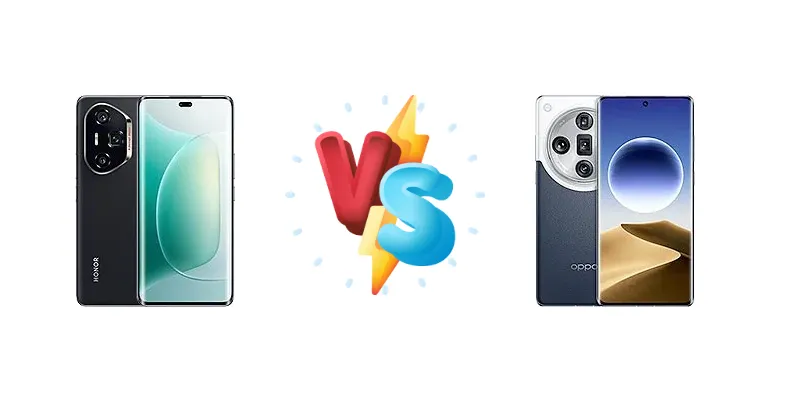
Both the Honor 300 Ultra and Oppo Find X7 Ultra represent the pinnacle of Android smartphone technology, powered by the latest Qualcomm Snapdragon 8 Gen 3 chipset. However, these devices diverge in key areas like charging technology, display capabilities, and battery optimization, making the choice between them far from straightforward. This comparison will dissect these differences to determine which phone best suits your needs.
🏆 Quick Verdict
For the average user prioritizing rapid charging and a potentially more streamlined software experience, the Honor 300 Ultra emerges as the winner. Its 100W wired and 80W wireless charging significantly outpace the Oppo Find X7 Ultra, and while battery life is competitive, the charging advantage is decisive.
| Network |
|---|
| 2G bands | GSM 850 / 900 / 1800 / 1900 | GSM 850 / 900 / 1800 / 1900 |
| 3G bands | HSDPA 800 / 850 / 900 / 1700(AWS) / 1900 / 2100 | HSDPA 800 / 850 / 900 / 1700(AWS) / 1900 / 2100 |
| 4G bands | LTE | 1, 2, 3, 4, 5, 7, 8, 12, 17, 18, 19, 20, 26, 28, 34, 38, 39, 40, 41, 66 |
| 5G bands | SA/NSA | 1, 2, 3, 5, 7, 8, 20, 28, 38, 40, 41, 66, 77, 78, 79 SA/NSA |
| Speed | HSPA, LTE, 5G | HSPA, LTE, 5G |
| Technology | GSM / HSPA / LTE / 5G | GSM / CDMA / HSPA / CDMA2000 / LTE / 5G |
| Launch |
|---|
| Announced | 2024, December 02 | 2024, January 08 |
| Status | Available. Released 2024, December 07 | Available. Released 2024, January 12 |
| Body |
|---|
| Build | Glass front, glass back or silicone polymer back (eco leather) | Glass front (Gorilla Glass Victus 2), glass back (Gorilla Glass) or eco leather back, aluminum frame |
| Dimensions | 163.8 x 75.3 x 8.2 mm (6.45 x 2.96 x 0.32 in) | 164.3 x 76.2 x 9.5 mm (6.47 x 3.00 x 0.37 in) |
| SIM | Nano-SIM + Nano-SIM | Nano-SIM + Nano-SIM |
| Weight | 198 g (6.98 oz) | 221 g (7.80 oz) |
| Display |
|---|
| Protection | Giant rhino glass | Corning Gorilla Glass Victus 2 |
| Resolution | 1224 x 2700 pixels (~437 ppi density) | 1440 x 3168 pixels (~510 ppi density) |
| Size | 6.78 inches, 111.5 cm2 (~90.4% screen-to-body ratio) | 6.82 inches, 113.0 cm2 (~90.3% screen-to-body ratio) |
| Type | AMOLED, 1B colors, 120Hz, HDR, 1200 nits (HBM), 4000 nits (peak) | LTPO AMOLED, 1B colors, 120Hz, Dolby Vision, HDR10+, 1600 nits (typ), 2600 nits (HBM), 4500 nits (peak) |
| Platform |
|---|
| CPU | Octa-core (1x3.0 GHz Cortex-X4 & 5x2.95 GHz Cortex-A720 & 2x2.0 GHz Cortex-A520) | Octa-core (1x3.3 GHz Cortex-X4 & 3x3.2 GHz Cortex-A720 & 2x3.0 GHz Cortex-A720 & 2x2.3 GHz Cortex-A520) |
| Chipset | Qualcomm SM8650-AB Snapdragon 8 Gen 3 (4 nm) | Qualcomm SM8650-AB Snapdragon 8 Gen 3 (4 nm) |
| GPU | Adreno 750 | Adreno 750 |
| OS | Android 15, MagicOS 9 | Android 14, up to 4 major Android upgrades, ColorOS 14 |
| Memory |
|---|
| Card slot | No | No |
| Internal | 512GB 12GB RAM, 1TB 16GB RAM | 256GB 12GB RAM, 256GB 16GB RAM, 512GB 16GB RAM |
| Main Camera |
|---|
| Features | LED flash, HDR, panorama | Laser AF, color spectrum sensor, Hasselblad Color Calibration, LED flash, HDR, panorama |
| Quad | - | 50 MP, f/1.8, 23mm (wide), 1.0"-type, 1.6µm, dual pixel PDAF, OIS
50 MP, f/2.6, 65mm (periscope telephoto), 1/1.56", 1.0µm, 2.8x optical zoom, multi-directional PDAF (25cm - ∞), OIS
50 MP, f/4.3, 135mm (periscope telephoto), 1/2.51", 0.7µm, 6x optical zoom, dual pixel PDAF (35cm - ∞), OIS
50 MP, f/2.0, 14mm, 123˚ (ultrawide), 1/1.95", 1.0µm, PDAF |
| Triple | 50 MP, f/2.0, (wide), 1/1.56", 1.0µm, PDAF, OIS
50 MP, f/3.0, (periscope telephoto), 1/2.51", 0.7µm, PDAF, OIS, 3.8x optical zoom
12 MP, f/2.2, 112˚ (ultrawide), AF | - |
| Video | 4K, 1080p, gyro-EIS, OIS | 4K@30/60fps, 1080p@30/60/240fps; gyro-EIS; HDR, 10‑bit video, Dolby Vision |
| Selfie camera |
|---|
| Dual | 50 MP, f/2.1, (wide)
2 MP, f/2.4, (depth) | - |
| Features | HDR | Panorama |
| Single | - | 32 MP, f/2.4, 21mm (wide), 1/2.74", 0.8µm, PDAF |
| Video | 4K, 1080p, gyro-EIS | 4K@30/60fps, 1080p@30fps, gyro-EIS |
| Sound |
|---|
| 35mm jack | No | No |
| Loudspeaker | Yes, with stereo speakers | Yes, with stereo speakers |
| Comms |
|---|
| Bluetooth | 5.3, A2DP, LE, aptX HD | 5.4, A2DP, LE, aptX HD, LHDC |
| Infrared port | Yes | Yes |
| NFC | Yes | Yes |
| Positioning | GPS, GALILEO, GLONASS, QZSS, BDS (B1I+B1c) | GPS (L1+L5), BDS (B1I+B1c+B2a), GALILEO (E1+E5a), QZSS (L1+L5), GLONASS |
| Radio | No | No |
| USB | USB Type-C 2.0, OTG | USB Type-C 3.2, OTG |
| WLAN | Wi-Fi 802.11 a/b/g/n/ac/6/7, dual-band, Wi-Fi Direct | Wi-Fi 802.11 a/b/g/n/ac/6e/7, dual-band, Wi-Fi Direct |
| Features |
|---|
| Sensors | Fingerprint (under display, ultrasonic), accelerometer, gyro, compass, ultrasound proximity | Fingerprint (under display, optical), accelerometer, gyro, proximity, compass |
| Battery |
|---|
| Charging | 100W wired, 59% in 15 min
80W wireless, 39% in 15 min
5W reverse wired
Reverse wireless | 100W wired, PD, 50% in 10 min, 100% in 26 min
50W wireless
10W reverse wireless |
| Type | Si/C Li-Ion 5300 mAh | 5000 mAh |
| Misc |
|---|
| Colors | Black, White | Black, Dark Blue, Light Brown |
| Models | - | PHY110, PHY120 |
| Price | About 550 EUR | $ 546.64 |
Honor 300 Ultra
- Significantly faster wired and wireless charging
- Potentially more aggressive pricing
- Reverse wired charging capability
- Unspecified display peak brightness
- Less detailed CPU core configuration
Oppo Find X7 Ultra
- Brighter display for outdoor visibility
- Longer active use battery life
- Slightly higher clocked CPU core
- Slower charging speeds (wired and wireless)
- Lower reverse wireless charging wattage
Display Comparison
The Oppo Find X7 Ultra boasts a significantly brighter display, reaching a measured peak of 1165 nits, compared to an unspecified peak brightness for the Honor 300 Ultra. This difference translates to superior visibility under direct sunlight. While both likely utilize AMOLED panels, the Oppo’s higher brightness suggests a more advanced panel technology or calibration. The absence of refresh rate data for the Honor 300 Ultra leaves a gap in the comparison, but both are expected to offer at least 120Hz for smooth scrolling and gaming.
Camera Comparison
Unfortunately, the provided data lacks camera specifications for both devices. Given their flagship status, both are expected to feature multi-camera systems with high-resolution primary sensors. However, without details on sensor size, aperture, and optical image stabilization (OIS), a meaningful comparison is impossible. Brand history suggests Oppo typically prioritizes camera innovation, potentially giving them an edge in image processing and low-light performance. We can assume both will offer a range of shooting modes, but the quality will hinge on the hardware not provided.
Performance
Both the Honor 300 Ultra and Oppo Find X7 Ultra are equipped with the Qualcomm SM8650-AB Snapdragon 8 Gen 3 (4nm). However, the Oppo features a slightly higher clocked primary core at 3.3 GHz versus the Honor’s 3.0 GHz. While this difference is marginal, it could translate to a small performance edge in CPU-intensive tasks. The Oppo also utilizes a more varied Cortex-A720 configuration (3x3.2 GHz & 2x3.0 GHz) compared to the Honor’s uniform 5x2.95 GHz setup. Both devices utilize LPDDR5x RAM, but the specific speed isn’t provided, making a direct comparison impossible. Thermal management will be crucial; the 4nm process helps, but sustained performance will depend on each manufacturer’s cooling solution.
Battery Life
The Oppo Find X7 Ultra demonstrates a clear advantage in battery endurance, achieving 12:47h of active use. The Honor 300 Ultra’s battery capacity is not specified, making a direct mAh comparison impossible. However, the Honor compensates with significantly faster charging: 100W wired (59% in 15 minutes) and 80W wireless (39% in 15 minutes) versus the Oppo’s 100W wired (50% in 10 minutes, 100% in 26 minutes) and 50W wireless. The Honor also offers 5W reverse wired and reverse wireless charging, while the Oppo provides 10W reverse wireless. The Honor’s charging speed is a major differentiator, potentially mitigating any capacity disadvantage.
Buying Guide
Buy the Honor 300 Ultra if you need the absolute fastest charging speeds, both wired and wireless, and value a potentially more aggressive price point. This phone is ideal for users who frequently top up their battery throughout the day or need a quick boost before a long trip. Buy the Oppo Find X7 Ultra if you prioritize longer sustained battery life during active use and a brighter display for outdoor visibility. This device caters to users who prefer a 'set it and forget it' approach to battery management and demand a vibrant viewing experience.
Frequently Asked Questions
❓ How does the Honor 300 Ultra's 100W charging compare to other fast charging solutions in terms of heat generation?
While 100W charging is incredibly fast, Honor likely employs advanced thermal management techniques to mitigate heat generation. The 4nm Snapdragon 8 Gen 3 also contributes to improved thermal efficiency. However, prolonged use of extremely fast charging can still result in some heat buildup, which is a trade-off for the convenience of rapid top-ups.
❓ Does the Oppo Find X7 Ultra's battery life suffer significantly when using power-intensive features like 5G or gaming?
The Oppo Find X7 Ultra's 12:47h active use score suggests robust battery optimization. However, 5G connectivity and demanding games will inevitably reduce battery life. The Snapdragon 8 Gen 3's efficiency helps, but sustained high performance will draw more power. Expect a noticeable, but not catastrophic, decrease in battery life during these scenarios.
❓ Is the difference in CPU clock speeds between the Honor 300 Ultra and Oppo Find X7 Ultra noticeable in everyday tasks?
The 0.3 GHz difference in primary core clock speeds is unlikely to be perceptible in most everyday tasks like browsing, social media, or video playback. The Snapdragon 8 Gen 3 is already exceptionally powerful, and the difference in clock speed is a minor optimization rather than a game-changer. The more significant difference lies in the A720 core configuration.