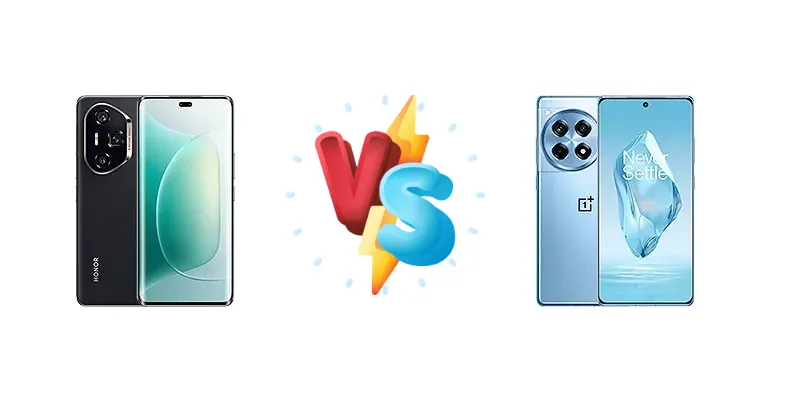
The Honor 300 Ultra arrives as a new contender boasting the latest Snapdragon 8 Gen 3, while the OnePlus 12R continues to offer excellent value with the previous-generation Snapdragon 8 Gen 2. This comparison dissects the key differences between these two Android powerhouses, focusing on performance, battery life, and charging capabilities to determine which device delivers the best experience for your needs.
🏆 Quick Verdict
For users prioritizing raw performance and cutting-edge features, the Honor 300 Ultra takes the lead thanks to its Snapdragon 8 Gen 3. However, the OnePlus 12R provides a compelling alternative with its impressive 14:32 hour active use battery life and 100W charging, making it the smarter choice for budget-conscious users.
| Network |
|---|
| 2G bands | GSM 850 / 900 / 1800 / 1900 | GSM 850 / 900 / 1800 / 1900 |
| 3G bands | HSDPA 800 / 850 / 900 / 1700(AWS) / 1900 / 2100 | HSDPA 850 / 900 / 1700(AWS) / 1900 / 2100 |
| 4G bands | LTE | 1, 2, 3, 4, 5, 7, 8, 12, 17, 18, 19, 20, 26, 28, 32, 38, 39, 40, 41, 66 |
| 5G bands | SA/NSA | 1, 2, 3, 5, 7, 8, 12, 20, 28, 38, 40, 41, 66, 77, 78 SA/NSA |
| Speed | HSPA, LTE, 5G | HSPA, LTE, 5G |
| Technology | GSM / HSPA / LTE / 5G | GSM / CDMA / HSPA / LTE / 5G |
| Launch |
|---|
| Announced | 2024, December 02 | 2024, January 23 |
| Status | Available. Released 2024, December 07 | Available. Released 2024, February 06 |
| Body |
|---|
| Build | Glass front, glass back or silicone polymer back (eco leather) | Glass front (Gorilla Glass Victus 2), aluminum frame, glass back |
| Dimensions | 163.8 x 75.3 x 8.2 mm (6.45 x 2.96 x 0.32 in) | 163.3 x 75.3 x 8.8 mm (6.43 x 2.96 x 0.35 in) |
| SIM | Nano-SIM + Nano-SIM | · Nano-SIM + Nano-SIM + eSIM (max 2 at a time)· Nano-SIM + Nano-SIM |
| Weight | 198 g (6.98 oz) | 207 g (7.30 oz) |
| Display |
|---|
| Protection | Giant rhino glass | Corning Gorilla Glass Victus 2 |
| Resolution | 1224 x 2700 pixels (~437 ppi density) | 1264 x 2780 pixels (~450 ppi density) |
| Size | 6.78 inches, 111.5 cm2 (~90.4% screen-to-body ratio) | 6.78 inches, 111.7 cm2 (~90.9% screen-to-body ratio) |
| Type | AMOLED, 1B colors, 120Hz, HDR, 1200 nits (HBM), 4000 nits (peak) | LTPO4 AMOLED, 1B colors, 120Hz, HDR10+, Dolby Vision, 1600 nits (HBM), 4500 nits (peak) |
| Platform |
|---|
| CPU | Octa-core (1x3.0 GHz Cortex-X4 & 5x2.95 GHz Cortex-A720 & 2x2.0 GHz Cortex-A520) | Octa-core (1x3.2 GHz Cortex-X3 & 2x2.8 GHz Cortex-A715 & 2x2.8 GHz Cortex-A710 & 3x2.0 GHz Cortex-A510) |
| Chipset | Qualcomm SM8650-AB Snapdragon 8 Gen 3 (4 nm) | Qualcomm SM8550-AB Snapdragon 8 Gen 2 (4 nm) |
| GPU | Adreno 750 | Adreno 740 |
| OS | Android 15, MagicOS 9 | Android 14, up to 3 major Android upgrades, OxygenOS 15 |
| Memory |
|---|
| Card slot | No | No |
| Internal | 512GB 12GB RAM, 1TB 16GB RAM | 128GB 8GB RAM, 256GB 8GB RAM, 256GB 12GB RAM, 256GB 16GB RAM |
| Main Camera |
|---|
| Features | LED flash, HDR, panorama | Laser AF, color spectrum sensor, LED flash, HDR, panorama |
| Triple | 50 MP, f/2.0, (wide), 1/1.56", 1.0µm, PDAF, OIS
50 MP, f/3.0, (periscope telephoto), 1/2.51", 0.7µm, PDAF, OIS, 3.8x optical zoom
12 MP, f/2.2, 112˚ (ultrawide), AF | 50 MP, f/1.8, 24mm (wide), 1/1.56", 1.0µm, multi-directional PDAF, OIS
8 MP, f/2.2, 16mm, 112˚ (ultrawide), 1/4.0", 1.12µm
2 MP (macro) |
| Video | 4K, 1080p, gyro-EIS, OIS | 4K@30/60fps, 1080p@30/60/120/240fps, gyro-EIS, OIS |
| Selfie camera |
|---|
| Dual | 50 MP, f/2.1, (wide)
2 MP, f/2.4, (depth) | - |
| Features | HDR | HDR, panorama |
| Single | - | 16 MP, f/2.4, 26mm (wide), 1/3", 1.0µm |
| Video | 4K, 1080p, gyro-EIS | 1080p@30fps, gyro-EIS |
| Sound |
|---|
| 35mm jack | No | No |
| Loudspeaker | Yes, with stereo speakers | Yes, with stereo speakers |
| Comms |
|---|
| Bluetooth | 5.3, A2DP, LE, aptX HD | 5.3, A2DP, LE, aptX HD |
| Infrared port | Yes | Yes |
| NFC | Yes | Yes |
| Positioning | GPS, GALILEO, GLONASS, QZSS, BDS (B1I+B1c) | GPS, GALILEO, GLONASS, BDS, QZSS |
| Radio | No | No |
| USB | USB Type-C 2.0, OTG | USB Type-C 2.0 |
| WLAN | Wi-Fi 802.11 a/b/g/n/ac/6/7, dual-band, Wi-Fi Direct | Wi-Fi 802.11 a/b/g/n/ac/6/7, dual-band |
| Features |
|---|
| Sensors | Fingerprint (under display, ultrasonic), accelerometer, gyro, compass, ultrasound proximity | Fingerprint (under display, optical), accelerometer, gyro, proximity, compass |
| Battery |
|---|
| Charging | 100W wired, 59% in 15 min
80W wireless, 39% in 15 min
5W reverse wired
Reverse wireless | 100W wired, 100% in 26 min |
| Type | Si/C Li-Ion 5300 mAh | Li-Ion 5500 mAh |
| Misc |
|---|
| Colors | Black, White | Iron Gray, Cool Blue, Electric Violet, Sunset Dune |
| Models | - | CPH2609, CPH2585, CPH2611 |
| Price | About 550 EUR | € 410.84 / $ 399.95 / £ 649.00 |
| SAR | - | 1.19 W/kg (head) 0.82 W/kg (body) |
Honor 300 Ultra
- Latest Snapdragon 8 Gen 3 processor for top-tier performance
- Faster 80W wireless charging
- Potential for superior camera capabilities (assuming flagship sensors)
- Battery life potentially compromised by the power-hungry processor
- Price likely to be significantly higher than the OnePlus 12R
OnePlus 12R
- Excellent 14:32h active use battery life
- Competitive 100W wired charging (full charge in 26 minutes)
- More affordable price point
- Older Snapdragon 8 Gen 2 processor
- Slower wireless charging (not specified, assumed lower than Honor)
Display Comparison
While both devices likely feature high-refresh-rate OLED panels, the OnePlus 12R’s measured peak brightness of 1181 nits is a concrete advantage, suggesting superior visibility in direct sunlight. The Honor 300 Ultra’s display specifications are currently unknown, but a flagship device at this price point would be expected to match or exceed this brightness. The absence of LTPO information for either device means we can’t assess dynamic refresh rate efficiency, but it’s a feature commonly found in flagship models.
Camera Comparison
Without detailed camera specifications for the Honor 300 Ultra, a direct comparison is limited. However, flagship devices typically prioritize larger sensors and advanced image processing. The OnePlus 12R’s camera system, while capable, is likely to be outmatched by a modern flagship. The focus should be on the main sensor size and optical image stabilization (OIS) on the Honor 300 Ultra, as these are key indicators of low-light performance and image quality. We can assume the Honor 300 Ultra will offer more advanced computational photography features.
Performance
The Honor 300 Ultra’s Snapdragon 8 Gen 3, built on a 4nm process, represents a significant architectural leap over the OnePlus 12R’s Snapdragon 8 Gen 2. The 8 Gen 3 features a new Cortex-X4 prime core clocked at 3.0 GHz, compared to the 8 Gen 2’s Cortex-X3 at 3.2 GHz. While the 8 Gen 2 has a slightly higher clock speed on its prime core, the architectural improvements in the 8 Gen 3, coupled with its newer process node, translate to better sustained performance and efficiency. The Honor 300 Ultra’s CPU configuration (1x3.0 GHz X4, 5x2.95 GHz A720, 2x2.0 GHz A520) is optimized for both peak performance and power efficiency, while the OnePlus 12R’s (1x3.2 GHz X3, 2x2.8 GHz A715, 2x2.8 GHz A710, 3x2.0 GHz A510) offers a strong but less refined experience.
Battery Life
The OnePlus 12R boasts an impressive 14:32h active use battery score, demonstrating excellent real-world endurance. The Honor 300 Ultra’s battery capacity is currently unknown, but its more powerful processor could offset any capacity advantage. Charging speeds are a key differentiator: the Honor 300 Ultra supports 100W wired charging (59% in 15 minutes) and 80W wireless charging (39% in 15 minutes), while the OnePlus 12R offers 100W wired charging (100% in 26 minutes). The Honor 300 Ultra’s wireless charging is significantly faster, but the OnePlus 12R’s complete wired charge time is competitive.
Buying Guide
Buy the Honor 300 Ultra if you demand the absolute fastest processing speeds for demanding tasks like video editing, high-end gaming, and consistently smooth multitasking. Buy the OnePlus 12R if you prioritize all-day battery life, fast charging, and a balanced experience without the flagship price tag. The 12R is ideal for users who value efficiency and reliability over bleeding-edge specs.
Frequently Asked Questions
❓ How much will the Snapdragon 8 Gen 3 in the Honor 300 Ultra improve gaming performance compared to the 8 Gen 2 in the OnePlus 12R?
The Snapdragon 8 Gen 3 offers a substantial GPU upgrade over the 8 Gen 2, resulting in noticeably higher frame rates and improved graphics fidelity in demanding games. While the 8 Gen 2 is still capable, the 8 Gen 3 provides a smoother and more immersive gaming experience, especially at higher settings and resolutions. Expect a 10-20% performance uplift in most titles.
❓ Does the Honor 300 Ultra's 100W wired charging actually feel faster than the OnePlus 12R's, given the 26-minute full charge time of the 12R?
While the OnePlus 12R achieves a full charge in 26 minutes with 100W, the Honor 300 Ultra's 100W charging reaches 59% in just 15 minutes. This means for a quick top-up, the Honor 300 Ultra is significantly faster. However, the OnePlus 12R maintains a consistent charging speed throughout, resulting in a relatively quick full charge.
❓ Is the 80W wireless charging on the Honor 300 Ultra worth the convenience over the OnePlus 12R's wired charging?
The Honor 300 Ultra's 80W wireless charging is a significant advantage, reaching 39% in 15 minutes – far faster than most wireless charging solutions. If you frequently use wireless charging and value the convenience, it's a compelling feature. However, wired charging remains faster overall, and the OnePlus 12R's 100W wired speed is still very competitive.