
Honor 300 Ultra vs. iPhone 15 Pro Max: A Head-to-Head Flagship Battle
| Phones Images | |||||
|---|---|---|---|---|---|
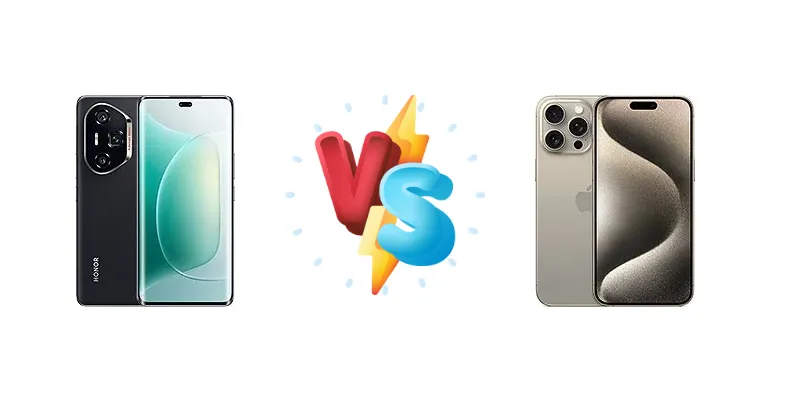
|
🏆 Quick Verdict
For the power user prioritizing charging speed and Android flexibility, the Honor 300 Ultra is the clear winner. Its 100W wired and 80W wireless charging are unmatched. However, the iPhone 15 Pro Max secures victory for users deeply embedded in the Apple ecosystem, valuing long-term software support and consistently excellent battery endurance.
| PHONES | ||
|---|---|---|
| Phone Names | Honor 300 Ultra | Apple iPhone 15 Pro Max |
| Network | ||
|---|---|---|
| 2G bands | GSM 850 / 900 / 1800 / 1900 | GSM 850 / 900 / 1800 / 1900 |
| 3G bands | HSDPA 800 / 850 / 900 / 1700(AWS) / 1900 / 2100 | HSDPA 850 / 900 / 1700(AWS) / 1900 / 2100 |
| 4G bands | LTE | 1, 2, 3, 4, 5, 7, 8, 12, 13, 17, 18, 19, 20, 25, 26, 28, 30, 32, 34, 38, 39, 40, 41, 42, 46, 48, 53, 66 - A3106 |
| 5G bands | SA/NSA | 1, 2, 3, 5, 7, 8, 12, 20, 25, 26, 28, 30, 38, 40, 41, 48, 53, 66, 70, 77, 78, 79 SA/NSA/Sub6 - A3106 |
| Speed | HSPA, LTE, 5G | HSPA, LTE, 5G, EV-DO Rev.A 3.1 Mbps |
| Technology | GSM / HSPA / LTE / 5G | GSM / CDMA / HSPA / EVDO / LTE / 5G |
| Launch | ||
|---|---|---|
| Announced | 2024, December 02 | 2023, September 12 |
| Status | Available. Released 2024, December 07 | Available. Released 2023, September 22 |
| Body | ||
|---|---|---|
| Build | Glass front, glass back or silicone polymer back (eco leather) | Glass front, glass back, titanium frame (grade 5) |
| Dimensions | 163.8 x 75.3 x 8.2 mm (6.45 x 2.96 x 0.32 in) | 159.9 x 76.7 x 8.3 mm (6.30 x 3.02 x 0.33 in) |
| SIM | Nano-SIM + Nano-SIM | · Nano-SIM + eSIM + eSIM (max 2 at a time; International)· eSIM + eSIM (8 or more, max 2 at a time; USA)· Nano-SIM + Nano-SIM (China) |
| Weight | 198 g (6.98 oz) | 221 g (7.80 oz) |
| Display | ||
|---|---|---|
| Protection | Giant rhino glass | Ceramic Shield glass |
| Resolution | 1224 x 2700 pixels (~437 ppi density) | 1290 x 2796 pixels, 19.5:9 ratio (~460 ppi density) |
| Size | 6.78 inches, 111.5 cm2 (~90.4% screen-to-body ratio) | 6.7 inches, 110.2 cm2 (~89.8% screen-to-body ratio) |
| Type | AMOLED, 1B colors, 120Hz, HDR, 1200 nits (HBM), 4000 nits (peak) | LTPO Super Retina XDR OLED, 120Hz, HDR10, Dolby Vision, 1000 nits (typ), 2000 nits (HBM) |
| Platform | ||
|---|---|---|
| CPU | Octa-core (1x3.0 GHz Cortex-X4 & 5x2.95 GHz Cortex-A720 & 2x2.0 GHz Cortex-A520) | Hexa-core (2x3.78 GHz + 4x2.11 GHz) |
| Chipset | Qualcomm SM8650-AB Snapdragon 8 Gen 3 (4 nm) | Apple A17 Pro (3 nm) |
| GPU | Adreno 750 | Apple GPU (6-core graphics) |
| OS | Android 15, MagicOS 9 | iOS 17, upgradable to iOS 26.1 |
| Memory | ||
|---|---|---|
| Card slot | No | No |
| Internal | 512GB 12GB RAM, 1TB 16GB RAM | 256GB 8GB RAM, 512GB 8GB RAM, 1TB 8GB RAM |
| Main Camera | ||
|---|---|---|
| Features | LED flash, HDR, panorama | Dual-LED dual-tone flash, HDR (photo/panorama) |
| Triple | 50 MP, f/2.0, (wide), 1/1.56", 1.0µm, PDAF, OIS 50 MP, f/3.0, (periscope telephoto), 1/2.51", 0.7µm, PDAF, OIS, 3.8x optical zoom 12 MP, f/2.2, 112˚ (ultrawide), AF | 48 MP, f/1.8, 24mm (wide), 1/1.28", 1.22µm, dual pixel PDAF, sensor-shift OIS 12 MP, f/2.8, 120mm (periscope telephoto), 1/3.06", 1.12µm, dual pixel PDAF, 3D sensor‑shift OIS, 5x optical zoom 12 MP, f/2.2, 13mm, 120˚ (ultrawide), 1/2.55", 1.4µm, dual pixel PDAF TOF 3D LiDAR scanner (depth) |
| Video | 4K, 1080p, gyro-EIS, OIS | 4K@24/25/30/60fps, 1080p@25/30/60/120/240fps, 10-bit HDR, Dolby Vision HDR (up to 60fps), ProRes, 3D (spatial) video, stereo sound rec. |
| Selfie camera | ||
|---|---|---|
| Dual | 50 MP, f/2.1, (wide) 2 MP, f/2.4, (depth) | - |
| Features | HDR | HDR, Dolby Vision HDR |
| Single | - | 12 MP, f/1.9, 23mm (wide), 1/3.6", 1.0µm, PDAF, OIS SL 3D, (depth/biometrics sensor) |
| Video | 4K, 1080p, gyro-EIS | 4K@24/25/30/60fps, 1080p@25/30/60/120fps, gyro-EIS |
| Sound | ||
|---|---|---|
| 35mm jack | No | No |
| Loudspeaker | Yes, with stereo speakers | Yes, with stereo speakers |
| Comms | ||
|---|---|---|
| Bluetooth | 5.3, A2DP, LE, aptX HD | 5.3, A2DP, LE |
| Infrared port | Yes | - |
| NFC | Yes | Yes |
| Positioning | GPS, GALILEO, GLONASS, QZSS, BDS (B1I+B1c) | GPS (L1+L5), GLONASS, GALILEO, BDS, QZSS, NavIC |
| Radio | No | No |
| USB | USB Type-C 2.0, OTG | USB Type-C 3.2 Gen 2, DisplayPort |
| WLAN | Wi-Fi 802.11 a/b/g/n/ac/6/7, dual-band, Wi-Fi Direct | Wi-Fi 802.11 a/b/g/n/ac/6e, tri-band, hotspot |
| Features | ||
|---|---|---|
| Sensors | Fingerprint (under display, ultrasonic), accelerometer, gyro, compass, ultrasound proximity | Face ID, accelerometer, gyro, proximity, compass, barometer |
| Battery | ||
|---|---|---|
| Charging | 100W wired, 59% in 15 min 80W wireless, 39% in 15 min 5W reverse wired Reverse wireless | Wired, PD2.0, 50% in 30 min 15W wireless (MagSafe) 15W wireless (Qi2) - requires iOS 17.2 update 4.5W reverse wired |
| Type | Si/C Li-Ion 5300 mAh | Li-Ion 4441 mAh |
| Misc | ||
|---|---|---|
| Colors | Black, White | Black Titanium, White Titanium, Blue Titanium, Natural Titanium |
| Models | - | A2849, A3105, A3106, A3108, iPhone16,2 |
| Price | About 550 EUR | € 758.79 / $ 579.87 / £ 628.29 |
| SAR | - | 1.07 W/kg (head) 1.11 W/kg (body) |
| SAR EU | - | 0.98 W/kg (head) 0.98 W/kg (body) |
Honor 300 Ultra
- Blazing-fast 100W wired charging
- 80W wireless charging is industry-leading
- Powerful Snapdragon 8 Gen 3 processor
- Android OS offers greater customization
- Long-term software support may be limited
- Camera specs currently unknown
Apple iPhone 15 Pro Max
- Exceptional battery life (16:01h active use)
- A17 Pro chip offers leading performance
- Seamless integration with Apple ecosystem
- Excellent camera quality and ProRes video
- Slower charging speeds (50% in 30 min)
- Less customization options compared to Android
Display Comparison
The iPhone 15 Pro Max boasts a measured peak brightness of 1787 nits, ensuring excellent visibility even in direct sunlight. While the Honor 300 Ultra’s display specifications are currently unavailable, Honor typically employs high-quality OLED panels. The iPhone’s ProMotion technology (adaptive refresh rate) is a key advantage, offering smoother scrolling and animations. The absence of refresh rate data for the Honor 300 Ultra leaves a gap in comparison, but the iPhone’s brightness and adaptive technology give it a clear edge in display quality.
Camera Comparison
Detailed camera analysis is hampered by a lack of Honor 300 Ultra camera specifications. However, given Honor’s recent focus, we can anticipate a strong emphasis on main sensor resolution and computational photography. The iPhone 15 Pro Max excels in both photo and video capture, leveraging its advanced image processing pipeline and ProRes video recording capabilities. Without specific details on the Honor 300 Ultra’s sensor size, aperture, and OIS implementation, it’s difficult to definitively assess its camera performance, but the iPhone’s established track record and ProRes support provide a significant advantage for professional videographers.
Performance
The core of the performance difference lies in the chipsets: Qualcomm’s Snapdragon 8 Gen 3 (4nm) in the Honor 300 Ultra versus Apple’s A17 Pro (3nm) in the iPhone 15 Pro Max. The A17 Pro’s 3nm process offers superior transistor density and power efficiency, translating to potentially better sustained performance and thermal management. The Snapdragon 8 Gen 3’s octa-core configuration (1x3.0 GHz Cortex-X4, 5x2.95 GHz Cortex-A720, 2x2.0 GHz Cortex-A520) is powerful, but Apple’s hexa-core (2x3.78 GHz + 4x2.11 GHz) design is optimized for single-core performance, crucial for many everyday tasks. The iPhone’s advantage in chip fabrication likely results in a more efficient and powerful experience, despite the core count difference.
Battery Life
The iPhone 15 Pro Max delivers an impressive 16:01 hours of active use and an endurance rating of 118 hours, showcasing exceptional battery life. The Honor 300 Ultra compensates with incredibly fast charging: 100W wired (59% in 15 minutes) and 80W wireless (39% in 15 minutes). While the Honor 300 Ultra’s battery capacity is unknown, the charging speeds dramatically reduce downtime. The iPhone’s slower 50% charge in 30 minutes is a significant contrast. The Honor prioritizes quick top-ups, while the iPhone focuses on maximizing overall runtime.
Buying Guide
Buy the Honor 300 Ultra if you need incredibly fast charging, prefer the Android operating system, and prioritize raw processing power for demanding tasks. Buy the Apple iPhone 15 Pro Max if you value seamless integration with other Apple devices, prioritize long-term software updates, and require exceptional all-day battery life with a refined user experience.