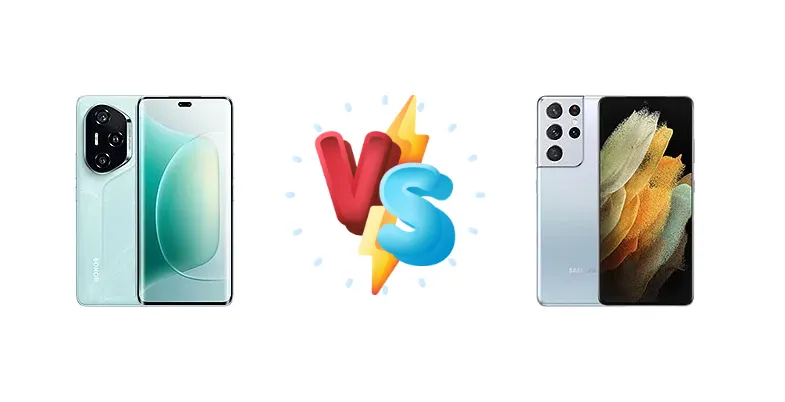
The Samsung Galaxy S21 Ultra, once the king of Android, now faces a new challenger in the Honor 300 Pro. While the S21 Ultra benefits from significant price drops, the Honor 300 Pro arrives with cutting-edge silicon and charging technology. This comparison dissects whether the newer hardware justifies the investment, or if the S21 Ultra remains a compelling option for value-conscious buyers.
🏆 Quick Verdict
For most users, the Honor 300 Pro emerges as the superior choice. Its Snapdragon 8 Gen 3 chipset delivers significantly improved performance and efficiency, coupled with blazing-fast 100W wired and 80W wireless charging. While the S21 Ultra’s camera remains capable, the 300 Pro’s modern platform offers a more future-proof experience.
| Network |
|---|
| 2G bands | GSM 850 / 900 / 1800 / 1900 | GSM 850 / 900 / 1800 / 1900 |
| 3G bands | HSDPA 800 / 850 / 900 / 1700(AWS) / 1900 / 2100 | HSDPA 850 / 900 / 1700(AWS) / 1900 / 2100 |
| 4G bands | LTE | 1, 2, 3, 4, 5, 7, 8, 12, 13, 14, 18, 19, 20, 25, 26, 28, 30, 38, 39, 40, 41, 46, 48, 66, 71 - SM-G998U1 |
| 5G bands | SA/NSA | 2, 5, 25, 41, 66, 71, 260, 261 SA/NSA/Sub6/mmWave - SM-G998U1 |
| Speed | HSPA, LTE, 5G | HSPA 42.2/5.76 Mbps, LTE (7CA) Cat20 2000/200 Mbps, 5G (5+ Gbps DL) |
| Technology | GSM / HSPA / LTE / 5G | GSM / CDMA / HSPA / EVDO / LTE / 5G |
| | - | 1, 3, 5, 7, 8, 20, 28, 38, 40, 41, 66, 77, 78 SA/NSA/Sub6 - SM-G998B |
| Launch |
|---|
| Announced | 2024, December 02 | 2021, January 14 |
| Status | Available. Released 2024, December 07 | Available. Released 2021, January 29 |
| Body |
|---|
| Build | - | Glass front (Gorilla Glass Victus), glass back (Gorilla Glass Victus), aluminum frame |
| Dimensions | 163.8 x 75.3 x 8.2 mm (6.45 x 2.96 x 0.32 in) | 165.1 x 75.6 x 8.9 mm (6.5 x 2.98 x 0.35 in) |
| SIM | Nano-SIM + Nano-SIM | · Nano-SIM + eSIM· Nano-SIM + Nano-SIM + eSIM (max 2 at a time) |
| Weight | 199 g (7.02 oz) | 227 g (Sub6), 229 g (mmWave) (8.01 oz) |
| | - | IP68 dust/water resistant (up to 1.5m for 30 min)
Stylus support |
| Display |
|---|
| Protection | - | Corning Gorilla Glass Victus |
| Resolution | 1224 x 2700 pixels (~437 ppi density) | 1440 x 3200 pixels, 20:9 ratio (~515 ppi density) |
| Size | 6.78 inches, 111.5 cm2 (~90.4% screen-to-body ratio) | 6.8 inches, 112.1 cm2 (~89.8% screen-to-body ratio) |
| Type | AMOLED, 1B colors, 120Hz, HDR, 1200 nits (HBM), 4000 nits (peak) | Dynamic AMOLED 2X, 120Hz, HDR10+, 1500 nits (peak) |
| | - | Always-on display |
| Platform |
|---|
| CPU | Octa-core (1x3.0 GHz Cortex-X4 & 5x2.95 GHz Cortex-A720 & 2x2.0 GHz Cortex-A520) | Octa-core (1x2.9 GHz Cortex-X1 & 3x2.80 GHz Cortex-A78 & 4x2.2 GHz Cortex-A55) - InternationalOcta-core (1x2.84 GHz Cortex-X1 & 3x2.42 GHz Cortex-A78 & 4x1.80 GHz Cortex-A55) - USA/China |
| Chipset | Qualcomm SM8650-AB Snapdragon 8 Gen 3 (4 nm) | Exynos 2100 (5 nm) - InternationalQualcomm SM8350 Snapdragon 888 5G (5 nm) - USA/China |
| GPU | Adreno 750 | Mali-G78 MP14 - InternationalAdreno 660 - USA/China |
| OS | Android 15, MagicOS 9 | Android 11, up to 4 major Android upgrades, One UI 6.1 |
| Memory |
|---|
| Card slot | No | No |
| Internal | 256GB 12GB RAM, 512GB 12GB RAM, 512GB 16GB RAM | 128GB 8GB RAM, 128GB 12GB RAM, 256GB 12GB RAM, 256GB 16GB RAM, 512GB 12GB RAM, 512GB 16GB RAM |
| | - | UFS 3.1
|
| Main Camera |
|---|
| Features | LED flash, HDR, panorama | Laser AF, LED flash, auto-HDR, panorama |
| Quad | - | 108 MP, f/1.8, 24mm (wide), 1/1.33", 0.8µm, PDAF, OIS
10 MP, f/2.4, 72mm (telephoto), 1/3.24", 1.22µm, dual pixel PDAF, OIS, 3x optical zoom
10 MP, f/4.9, 240mm (periscope telephoto), 1/3.24", 1.22µm, dual pixel PDAF, OIS, 10x optical zoom
12 MP, f/2.2, 13mm (ultrawide), 1/2.55", 1.4µm, dual pixel PDAF, Super Steady video |
| Triple | 50 MP, f/2.0, (wide), 1/1.56", 1.0µm, PDAF, OIS
50 MP, f/2.4, (telephoto), PDAF, OIS, 3x optical zoom
12 MP, f/2.2, 112˚ (ultrawide), AF | - |
| Video | 4K, 1080p, gyro-EIS, OIS | 8K@24fps, 4K@30/60fps, 1080p@30/60/120/240fps, HDR10+, stereo sound rec., gyro-EIS |
| Selfie camera |
|---|
| Dual | 50 MP, f/2.1, (wide)
2 MP, f/2.4, (depth) | - |
| Features | HDR | HDR |
| Single | - | 40 MP, f/2.2, 26mm (wide), 1/2.8", 0.7µm, PDAF |
| Video | 4K, 1080p, gyro-EIS | 4K@30/60fps, 1080p@30fps |
| Sound |
|---|
| 3.5mm jack | - | No |
| 35mm jack | No | No |
| Loudspeaker | Yes, with stereo speakers | Yes, with stereo speakers |
| | - | 32-bit/384kHz audio
Tuned by AKG |
| Comms |
|---|
| Bluetooth | 5.3, A2DP, LE, aptX HD | 5.2, A2DP, LE |
| Infrared port | Yes | - |
| NFC | Yes | Yes |
| Positioning | GPS, GALILEO, GLONASS, QZSS, BDS (B1I+B1c) | GPS, GLONASS, BDS, GALILEO |
| Radio | No | FM radio (Snapdragon model only; market/operator dependent) |
| USB | USB Type-C 2.0, OTG | USB Type-C 3.2, OTG |
| WLAN | Wi-Fi 802.11 a/b/g/n/ac/6/7, dual-band, Wi-Fi Direct | Wi-Fi 802.11 a/b/g/n/ac/6e, dual-band, Wi-Fi Direct |
| Features |
|---|
| Sensors | Fingerprint (under display, optical), accelerometer, gyro, compass, ultrasound proximity | Fingerprint (under display, ultrasonic), accelerometer, gyro, proximity, compass, barometer |
| | - | Samsung DeX, Samsung Wireless DeX (desktop experience support)
Bixby natural language commands and dictation
Samsung Pay (Visa, MasterCard certified)
Ultra Wideband (UWB) support |
| Battery |
|---|
| Charging | 100W wired, 59% in 15 min
80W wireless, 39% in 15 min
5W reverse wired
Reverse wireless | 25W wired, PD3.0
15W wireless (Qi)
4.5W reverse wireless |
| Type | Si/C Li-Ion 5300 mAh | Li-Ion 5000 mAh |
| Misc |
|---|
| Colors | Black, White, Green | Phantom Black, Phantom Silver, Phantom Titanium, Phantom Navy, Phantom Brown, Navy |
| Models | AMP-AN00 | SM-G998B, SM-G998B/DS, SM-G998U, SM-G998U1, SM-G998W, SM-G998N, SM-G9980 |
| Price | About 480 EUR | $ 240.01 / C$ 353.20 / £ 202.99 / € 264.99 |
| SAR | - | 0.77 W/kg (head) 1.02 W/kg (body) |
| SAR EU | - | 0.71 W/kg (head) 1.58 W/kg (body) |
| Pricing |
|---|
| 128GB 12GB RAM | - | $ 384.99 |
| 256GB 12GB RAM | - | $ 998.00 |
| 512GB 12GB RAM | - | $ 1,179.99 |
| RENEWED | - | $ 459.00 |
| Tests |
|---|
| Battery life | - |
Endurance rating 114h
|
| Camera | - |
Photo / Video |
| Display | - |
Contrast ratio: Infinite (nominal) |
| Loudspeaker | - |
-25.5 LUFS (Very good)
|
| Performance | - |
AnTuTu: 657150 (v8)
GeekBench: 3518 (v5.1)
GFXBench: 33fps (ES 3.1 onscreen) |
Honor 300 Pro
- Significantly faster Snapdragon 8 Gen 3 processor
- Blazing-fast 100W wired and 80W wireless charging
- Likely improved thermal management
- Specific camera specs currently unknown
- Battery capacity not yet confirmed
Samsung Galaxy S21 Ultra 5G
- Excellent camera system with versatile lenses
- Vibrant and bright display
- Lower price point due to age
- Older Snapdragon 888/Exynos 2100 chipset
- Slow charging speeds (25W wired, 15W wireless)
- Potential for throttling under sustained load
Display Comparison
The Galaxy S21 Ultra boasts a peak brightness of 1023 nits, a figure still impressive today, and an 'infinite' contrast ratio. However, the Honor 300 Pro, while lacking specific brightness data, likely benefits from newer panel technology and potentially higher peak brightness. The S21 Ultra’s 120Hz adaptive refresh rate is standard for its time, but the 300 Pro may incorporate LTPO technology for more efficient refresh rate scaling, conserving battery life. Bezels are likely slimmer on the newer Honor model, contributing to a more immersive viewing experience.
Camera Comparison
Both phones are equipped with capable camera systems, but details on the Honor 300 Pro’s sensors are currently limited. The S21 Ultra’s 108MP main sensor and versatile lens array (ultra-wide, telephoto) deliver excellent image quality. However, the 300 Pro likely benefits from advancements in image processing algorithms and potentially a larger main sensor. The S21 Ultra’s video capabilities are strong, but the 300 Pro’s newer ISP (Image Signal Processor) within the Snapdragon 8 Gen 3 could offer improved dynamic range and low-light performance. We'd need to see detailed camera samples to make a definitive judgement.
Performance
The Honor 300 Pro’s Qualcomm Snapdragon 8 Gen 3 (4nm) represents a substantial leap over the Galaxy S21 Ultra’s Exynos 2100 (5nm) or Snapdragon 888 (5nm). The 8 Gen 3’s Cortex-X4 prime core, clocked at 3.0 GHz, offers significantly improved single-core performance compared to the S21 Ultra’s Cortex-X1. The newer architecture and 4nm process node translate to better thermal efficiency, reducing the likelihood of throttling during sustained workloads like gaming. The S21 Ultra’s performance, while still adequate, will show its age in demanding applications. The 300 Pro’s LPDDR5x RAM further enhances memory bandwidth, contributing to smoother multitasking.
Battery Life
The Galaxy S21 Ultra achieved an endurance rating of 114 hours with its battery, a respectable figure. However, the Honor 300 Pro’s charging capabilities are a game-changer. 100W wired charging can replenish the battery to 59% in just 15 minutes, while 80W wireless charging reaches 39% in the same timeframe. The S21 Ultra’s 25W wired and 15W wireless charging are significantly slower. While the 300 Pro’s battery capacity is unknown, the faster charging mitigates concerns about battery size, allowing for quick top-ups throughout the day.
Buying Guide
Buy the Honor 300 Pro if you prioritize raw performance, future-proofing, and incredibly fast charging speeds. It’s ideal for gamers, power users, and those who demand the latest technology. Buy the Samsung Galaxy S21 Ultra 5G if you’re on a tighter budget and still want a premium experience with a capable camera and a vibrant display, accepting the trade-offs in processing power and charging speed.
Frequently Asked Questions
❓ Does the Exynos 2100 in the S21 Ultra overheat during prolonged gaming sessions?
The Exynos 2100 variant of the S21 Ultra is known to exhibit thermal throttling under sustained load, particularly during demanding games. While not catastrophic, users may experience frame rate drops and reduced performance after extended gaming sessions. The Snapdragon 888 variant generally performs better in this regard, but still isn't as efficient as the Snapdragon 8 Gen 3.
❓ How does the 100W charging of the Honor 300 Pro compare to other fast charging solutions?
100W charging is among the fastest currently available on a smartphone. It's significantly quicker than the 65W charging found on some OnePlus devices and dwarfs the 25W charging of the Galaxy S21 Ultra. This means you can add a substantial amount of battery life in just a few minutes, minimizing downtime.
❓ Is the 2MP macro camera on the S21 Ultra actually useful for taking detailed close-up photos?
Generally, 2MP macro cameras on smartphones are more of a marketing feature than a genuinely useful tool. The low resolution often results in soft, grainy images. While it can capture close-up shots, the quality is typically far inferior to using the main camera in Pro mode and cropping.
❓ Does the Honor 300 Pro support high frame rate gaming, like 90fps or 120fps in PUBG Mobile?
Given the Snapdragon 8 Gen 3's powerful GPU, the Honor 300 Pro should easily handle high frame rate gaming in titles like PUBG Mobile. However, achieving consistently high frame rates will depend on the game's optimization and graphics settings. Expect smooth and responsive gameplay at 90fps or even 120fps with appropriate settings.