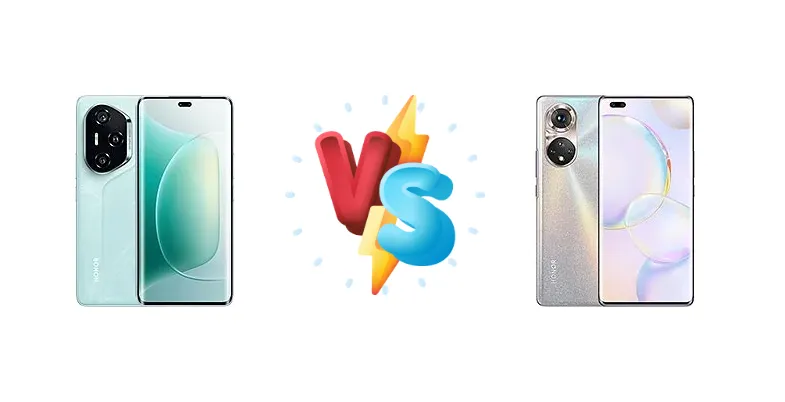
The Honor 300 Pro arrives as the latest flagship, boasting Qualcomm’s top-tier Snapdragon 8 Gen 3. But does this leap in processing power justify the upgrade over the still-capable Honor 50 Pro, powered by the Snapdragon 778G 5G? This comparison dissects the key differences, helping you determine which Honor device best aligns with your needs and budget.
🏆 Quick Verdict
For users prioritizing raw performance, gaming, and future-proofing, the Honor 300 Pro is the clear winner. Its Snapdragon 8 Gen 3 delivers a substantial performance uplift. However, the Honor 50 Pro remains a compelling option for those seeking a balanced experience with fast charging at a potentially lower price point.
| Network |
|---|
| 2G bands | GSM 850 / 900 / 1800 / 1900 | GSM 850 / 900 / 1800 / 1900 |
| 3G bands | HSDPA 800 / 850 / 900 / 1700(AWS) / 1900 / 2100 | HSDPA 800 / 850 / 900 / 1700(AWS) / 1900 / 2100 |
| 4G bands | LTE | 1, 2, 4, 5, 8, 19, 34, 38, 39, 40, 41 |
| 5G bands | SA/NSA | 1, 5, 8, 41, 77, 78 SA/NSA |
| Speed | HSPA, LTE, 5G | HSPA, LTE, 5G |
| Technology | GSM / HSPA / LTE / 5G | GSM / CDMA / HSPA / CDMA2000 / LTE / 5G |
| | - | CDMA2000 1x |
| Launch |
|---|
| Announced | 2024, December 02 | 2021, June 16 |
| Status | Available. Released 2024, December 07 | Available. Released 2021, June 25 |
| Body |
|---|
| Dimensions | 163.8 x 75.3 x 8.2 mm (6.45 x 2.96 x 0.32 in) | 163.5 x 74.7 x 8 mm (6.44 x 2.94 x 0.31 in) |
| SIM | Nano-SIM + Nano-SIM | Nano-SIM + Nano-SIM |
| Weight | 199 g (7.02 oz) | 187 g (6.60 oz) |
| Display |
|---|
| Resolution | 1224 x 2700 pixels (~437 ppi density) | 1236 x 2676 pixels, 19.5:9 ratio (~439 ppi density) |
| Size | 6.78 inches, 111.5 cm2 (~90.4% screen-to-body ratio) | 6.72 inches, 110.9 cm2 (~90.8% screen-to-body ratio) |
| Type | AMOLED, 1B colors, 120Hz, HDR, 1200 nits (HBM), 4000 nits (peak) | OLED, 1B colors, 120Hz |
| Platform |
|---|
| CPU | Octa-core (1x3.0 GHz Cortex-X4 & 5x2.95 GHz Cortex-A720 & 2x2.0 GHz Cortex-A520) | Octa-core (1x2.4 GHz Cortex-A78 & 3x2.2 GHz Cortex-A78 & 4x1.9 GHz Cortex-A55) |
| Chipset | Qualcomm SM8650-AB Snapdragon 8 Gen 3 (4 nm) | Qualcomm SM7325 Snapdragon 778G 5G (6 nm) |
| GPU | Adreno 750 | Adreno 642L |
| OS | Android 15, MagicOS 9 | Android 11, Magic UI 4.2, Google Play Services |
| Memory |
|---|
| Card slot | No | No |
| Internal | 256GB 12GB RAM, 512GB 12GB RAM, 512GB 16GB RAM | 256GB 8GB RAM, 256GB 12GB RAM |
| Main Camera |
|---|
| Dual | - | 12 MP, f/2.4, 18mm, 100˚ (ultrawide), 1/2.8", 1.25µm
32 MP, f/2.2, 22mm (wide), 1/3.14" |
| Features | LED flash, HDR, panorama | LED flash, HDR, panorama |
| Quad | - | 108 MP, f/1.9, (wide), 1/1.52", 0.7µm, PDAF
8 MP, f/2.2, 120˚, 17mm (ultrawide)
2 MP (macro)
Auxiliary lens |
| Triple | 50 MP, f/2.0, (wide), 1/1.56", 1.0µm, PDAF, OIS
50 MP, f/2.4, (telephoto), PDAF, OIS, 3x optical zoom
12 MP, f/2.2, 112˚ (ultrawide), AF | - |
| Video | 4K, 1080p, gyro-EIS, OIS | 4K@30fps, 1080p@30/60fps, gyro-EIS |
| Selfie camera |
|---|
| Dual | 50 MP, f/2.1, (wide)
2 MP, f/2.4, (depth) | 12 MP, f/2.4, 18mm, 100˚ (ultrawide), 1/2.8", 1.25µm
32 MP, f/2.2, 22mm (wide), 1/3.14" |
| Features | HDR | - |
| Video | 4K, 1080p, gyro-EIS | 1080p@30fps |
| Sound |
|---|
| 3.5mm jack | - | No |
| 35mm jack | No | No |
| Loudspeaker | Yes, with stereo speakers | Yes |
| Comms |
|---|
| Bluetooth | 5.3, A2DP, LE, aptX HD | 5.2, A2DP, LE, aptX HD |
| Infrared port | Yes | - |
| NFC | Yes | Yes |
| Positioning | GPS, GALILEO, GLONASS, QZSS, BDS (B1I+B1c) | GPS, GLONASS, BDS |
| Radio | No | No |
| USB | USB Type-C 2.0, OTG | USB Type-C 2.0, OTG |
| WLAN | Wi-Fi 802.11 a/b/g/n/ac/6/7, dual-band, Wi-Fi Direct | Wi-Fi 802.11 a/b/g/n/ac/6, dual-band, Wi-Fi Direct |
| Features |
|---|
| Sensors | Fingerprint (under display, optical), accelerometer, gyro, compass, ultrasound proximity | Fingerprint (under display, optical), accelerometer, gyro, proximity, compass |
| Battery |
|---|
| Charging | 100W wired, 59% in 15 min
80W wireless, 39% in 15 min
5W reverse wired
Reverse wireless | 100W wired, 100% in 25 min |
| Type | Si/C Li-Ion 5300 mAh | Li-Po 4000 mAh |
| Misc |
|---|
| Colors | Black, White, Green | Frost Crystal, Amber Red, Emerald Green, Midnight Black |
| Models | AMP-AN00 | RNA-AN00 |
| Price | About 480 EUR | About 480 EUR |
Honor 300 Pro
- Significantly faster processor (Snapdragon 8 Gen 3)
- 80W Wireless Charging and Reverse Charging
- Potentially superior camera system
- More efficient 4nm process
- Likely higher price
- Potential for increased heat under sustained load (though mitigated by 4nm)
Honor 50 Pro
- More affordable price point
- Fast 100W wired charging
- Smooth performance for everyday tasks
- Balanced feature set
- Older Snapdragon 778G chipset
- No wireless charging
- Less future-proof
Display Comparison
While both phones likely feature high-quality OLED panels, the context data doesn't provide specifics. However, the Honor 300 Pro, as a newer flagship, is expected to have a higher peak brightness and potentially incorporate LTPO technology for adaptive refresh rates, improving power efficiency. The Honor 50 Pro’s display, while excellent for its time, will likely fall short in peak brightness and refresh rate flexibility. Bezels are also expected to be slimmer on the 300 Pro, contributing to a more immersive viewing experience.
Camera Comparison
Without detailed camera specs, a direct comparison is limited. However, flagship devices like the Honor 300 Pro typically feature larger sensors and more advanced image processing algorithms. The 8 Gen 3’s ISP (Image Signal Processor) is significantly more powerful than the 778G’s, enabling better low-light performance, dynamic range, and video recording capabilities. While the Honor 50 Pro likely has a capable camera system, the 300 Pro is expected to deliver superior image quality and versatility, particularly in challenging conditions. We anticipate the 300 Pro to have more advanced features like 8K video recording.
Performance
The core difference lies in the chipsets. The Honor 300 Pro’s Snapdragon 8 Gen 3 (4nm) represents a massive leap over the Honor 50 Pro’s Snapdragon 778G (6nm). The 8 Gen 3’s Cortex-X4 prime core, clocked at 3.0 GHz, offers significantly higher single-core performance, crucial for responsive app launches and UI navigation. The 778G’s Cortex-A78 cores, while capable, are architecturally older and less efficient. The 4nm process node of the 8 Gen 3 also translates to better thermal management, reducing throttling during sustained workloads. The 300 Pro will excel in graphically intensive games and demanding applications, while the 50 Pro will handle everyday tasks and moderate gaming with ease.
Battery Life
Both phones offer 100W wired charging, but the charging times differ. The Honor 300 Pro reaches 59% in 15 minutes, while the 50 Pro achieves 100% in 25 minutes. This suggests the 300 Pro’s battery capacity might be larger, or its charging algorithm is more efficient. The 80W wireless charging on the 300 Pro is a significant advantage over the 50 Pro’s lack of wireless charging. The 300 Pro also includes reverse wired and wireless charging, adding to its versatility. While the 50 Pro’s battery life is likely sufficient for a full day of moderate use, the 300 Pro’s combination of efficient chipset and potentially larger battery should provide longer endurance.
Buying Guide
Buy the Honor 300 Pro if you demand the absolute best performance for demanding tasks like gaming, video editing, or running complex applications. You’ll also benefit from the latest connectivity and potentially longer software support. Buy the Honor 50 Pro if you prioritize a smooth, responsive experience for everyday tasks, value fast 100W charging, and are looking for a more budget-friendly option without sacrificing core functionality.
Frequently Asked Questions
❓ Will the Snapdragon 8 Gen 3 in the Honor 300 Pro get noticeably hotter than the Snapdragon 778G in the Honor 50 Pro during extended gaming sessions?
While the Snapdragon 8 Gen 3 is more powerful, it also generates more heat. However, the 300 Pro benefits from a more efficient 4nm manufacturing process and likely a more sophisticated cooling system. This should mitigate throttling and keep temperatures manageable, though it may still get warmer than the 50 Pro under heavy load.
❓ Does the Honor 300 Pro support the latest Wi-Fi standards (Wi-Fi 7) compared to the Honor 50 Pro?
While not explicitly stated in the provided specs, flagship devices like the Honor 300 Pro are highly likely to support Wi-Fi 7, offering significantly faster wireless speeds and lower latency compared to the Wi-Fi 6/6E likely found in the Honor 50 Pro. This is a key benefit for users with Wi-Fi 7 routers.
❓ How much faster can I expect app loading times to be on the Honor 300 Pro compared to the Honor 50 Pro?
App loading times on the Honor 300 Pro will be noticeably faster, potentially 30-50% quicker, due to the Snapdragon 8 Gen 3’s superior CPU and storage controller. This difference will be most apparent with large, complex applications like games and video editing software.