
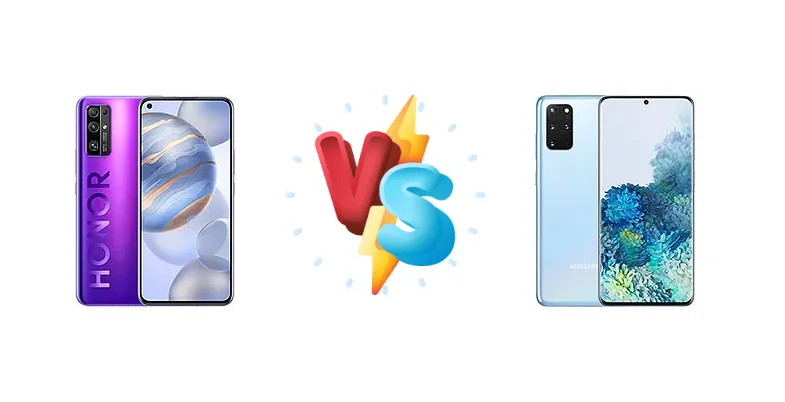
Honor 30 vs. Samsung Galaxy S20+ 5G: A Detailed Comparison of Mid-Range and Flagship Power
| Phones Images | |||||
|---|---|---|---|---|---|
|
🏆 Quick Verdict
For the average user prioritizing a well-rounded experience and broader 5G band support, the Samsung Galaxy S20+ 5G is the better choice. While the Honor 30 boasts faster 40W charging, the S20+'s more powerful processor, wireless charging, and established brand reputation provide a more premium and future-proof experience.
| PHONES | ||
|---|---|---|
| Phone Names | Honor 30 | Samsung Galaxy S20+ 5G |
| Network | ||
|---|---|---|
| 2G bands | GSM 850 / 900 / 1800 / 1900 | GSM 850 / 900 / 1800 / 1900 |
| 3G bands | HSDPA 800 / 850 / 900 / 1700(AWS) / 1800 / 1900 / 2100 | HSDPA 850 / 900 / 1700(AWS) / 1900 / 2100 |
| 4G bands | 1, 2, 3, 4, 5, 6, 7, 8, 9, 18, 19, 20, 26, 34, 38, 39, 40, 41 - International | 1, 2, 3, 4, 5, 7, 8, 12, 13, 17, 18, 19, 20, 25, 26, 28, 32, 38, 39, 40, 41, 66 - SM-G986B |
| 5G bands | 1, 3, 38, 41, 77, 78, 79 SA/NSA - International | 1, 3, 5, 7, 8, 28, 40, 77, 78 SA/NSA/Sub6 - SM-G986B |
| Speed | HSPA, LTE, 5G | HSPA 42.2/5.76 Mbps, LTE (7CA) Cat20 2000/200 Mbps, 5G (5+ Gbps DL) |
| Technology | GSM / HSPA / LTE / 5G | GSM / CDMA / HSPA / EVDO / LTE / 5G |
| 1, 3, 41, 77, 78, 79 SA/NSA - China | - | |
| Launch | ||
|---|---|---|
| Announced | 2020, April 15. Released 2020, April 21 | 2020, February 11 |
| Status | Discontinued | Available. Released 2020, March 06 |
| Body | ||
|---|---|---|
| Build | - | Glass front (Gorilla Glass 6), glass back (Gorilla Glass 6), aluminum frame |
| Dimensions | 160.3 x 74.2 x 8.1 mm (6.31 x 2.92 x 0.32 in) | 161.9 x 73.7 x 7.8 mm (6.37 x 2.90 x 0.31 in) |
| SIM | Nano-SIM + Nano-SIM | · Nano-SIM + eSIM· Nano-SIM + Nano-SIM |
| Weight | 185 g (6.53 oz) | 188 g (6.63 oz) |
| Display | ||
|---|---|---|
| Protection | - | Corning Gorilla Glass 6 |
| Resolution | 1080 x 2400 pixels, 20:9 ratio (~403 ppi density) | 1440 x 3200 pixels, 20:9 ratio (~525 ppi density) |
| Size | 6.53 inches, 102.9 cm2 (~86.6% screen-to-body ratio) | 6.7 inches, 108.0 cm2 (~90.5% screen-to-body ratio) |
| Type | OLED | Dynamic AMOLED 2X, 120Hz, HDR10+, 1200 nits (peak) |
| Platform | ||
|---|---|---|
| CPU | Octa-core (1x2.58 GHz Cortex-A76 & 3x2.40 GHz Cortex-A76 & 4x1.84 GHz Cortex-A55) | Octa-core (2x2.73 GHz Mongoose M5 & 2x2.50 GHz Cortex-A76 & 4x2.0 GHz Cortex-A55) - GlobalOcta-core (1x2.84 GHz Cortex-A77 & 3x2.42 GHz Cortex-A77 & 4x1.80 GHz Cortex-A55) - USA |
| Chipset | Kirin 985 5G (7 nm) | Exynos 990 (7 nm+) - GlobalQualcomm SM8250 Snapdragon 865 5G (7 nm+) - USA |
| GPU | Mali-G77 | Mali-G77 MP11 - GlobalAdreno 650 - USA |
| OS | Android 10, Magic UI 3, no Google Play Services | Android 10, upgradable to Android 13, One UI 5.1 |
| Memory | ||
|---|---|---|
| Card slot | Nano Memory (uses shared SIM slot) | microSDXC (uses shared SIM slot) |
| Internal | 128GB 6GB RAM, 128GB 8GB RAM, 256GB 8GB RAM | 128GB 8GB RAM, 128GB 12GB RAM, 256GB 12GB RAM, 512GB 12GB RAM |
| UFS | - | |
| Main Camera | ||
|---|---|---|
| Features | LED flash, panorama, HDR | LED flash, auto-HDR, panorama |
| Quad | 40 MP, f/1.8, 27mm (wide), 1/1.7", PDAF 8 MP, f/3.4, 125mm (Periscope telephoto), PDAF, OIS, 5x optical zoom 8 MP, f/2.4, 17mm (ultrawide) Auxiliary lens | - |
| Triple | - | 12 MP, f/1.8, 26mm (wide), 1/1.76", 1.8µm, dual pixel PDAF, OIS 64 MP, f/2.0, 29mm (telephoto), 1/1.72", 0.8µm, PDAF, OIS, 1.1x optical zoom, 3x hybrid zoom 12 MP, f/2.2, 13mm, 120˚ (ultrawide), 1/2.55" 1.4µm, Super Steady video 0.3 MP, TOF 3D, f/1.0, (depth) |
| Video | 4K@30/60fps, 1080p@30/60fps, 720p@960fps; gyro-EIS | 8K@24fps, 4K@30/60fps, 1080p@30/60/240fps, 720p@960fps, HDR10+, stereo sound rec., gyro-EIS & OIS |
| Selfie camera | ||
|---|---|---|
| Features | HDR | HDR |
| Single | 32 MP, f/2.0, 26mm (wide), 1/2.8", 0.8µm | 10 MP, f/2.2, 26mm (wide), 1/3.24", 1.22µm, dual pixel PDAF |
| Video | 4K, 1080p; gyro-EIS | 4K@30/60fps, 1080p@30fps |
| Sound | ||
|---|---|---|
| 3.5mm jack | No | No |
| 35mm jack | No | No |
| Loudspeaker | Yes | Yes, with stereo speakers |
| Comms | ||
|---|---|---|
| Bluetooth | 5.1, A2DP, LE | 5.0, A2DP, LE |
| NFC | Yes | Yes |
| Positioning | GPS (L1+L5), GLONASS, BDS, GALILEO, QZSS | GPS, GLONASS, BDS, GALILEO |
| Radio | No | FM radio (Snapdragon model only; market/operator dependent) |
| USB | USB Type-C 2.0, OTG | USB Type-C 3.2, OTG |
| WLAN | Wi-Fi 802.11 a/b/g/n/ac, dual-band, Wi-Fi Direct | Wi-Fi 802.11 a/b/g/n/ac/6, dual-band, Wi-Fi Direct |
| Features | ||
|---|---|---|
| Sensors | Fingerprint (under display, optical), accelerometer, gyro, proximity, compass | Fingerprint (under display, ultrasonic), accelerometer, gyro, proximity, compass, barometer |
| Battery | ||
|---|---|---|
| Charging | 40W wired 5W reverse wired | 25W wired, PD3.0 15W wireless (Qi) 4.5W reverse wireless |
| Type | Li-Po 4000 mAh | Li-Ion 4500 mAh |
| Misc | ||
|---|---|---|
| Colors | Titanium silver, Emerald Green, Midnight Black, Icelandic Frost, Neon purple | Cosmic Black, Cosmic Grey, Cloud Blue, Cloud White, Aura Red, Aura Blue |
| Models | BMH-AN10, BMH-AN20 | SM-G986, SM-G986F, SM-G986F/DS, SM-G986U, SM-G986U1, SM-G9860, SM-G986B/DS, SM-G986N, SM-G986B, SM-G986W, SCG02 |
| Price | About 1170 EUR | $ 174.17 / C$ 684.99 / € 299.97 |
| SAR | - | 1.08 W/kg (head) 1.02 W/kg (body) |
| SAR EU | - | 1.09 W/kg (head) 1.57 W/kg (body) |
Honor 30
- 40W SuperCharge for incredibly fast wired charging
- Potentially more affordable price point
- 5G connectivity
- Kirin 985 chipset is less powerful than Snapdragon 865/Exynos 990
- No wireless charging
- Software experience may be less polished than Samsung's One UI
Samsung Galaxy S20+ 5G
- More powerful processor (Snapdragon 865/Exynos 990)
- Wireless and reverse wireless charging
- Superior display quality (Dynamic AMOLED 2X)
- Slower 25W wired charging
- Potential for Exynos 990 throttling
- Higher initial price (though decreasing)
Display Comparison
Both devices utilize 7nm fabrication, but the display differences are notable. While specific panel details (OLED type, peak brightness) are missing for the Honor 30, the Galaxy S20+ 5G features a Dynamic AMOLED 2X display known for its vibrant colors and high peak brightness. The S20+’s display is likely to offer superior outdoor visibility and color accuracy. Bezels are comparable, but Samsung’s display technology generally leads in visual quality.
Camera Comparison
The camera systems are complex to compare without detailed image samples. However, the S20+ 5G likely holds an advantage due to its more sophisticated image processing and potentially larger sensor size (details missing for Honor 30). While both phones likely offer versatile camera setups, the S20+’s image stabilization and low-light performance are expected to be superior. The Honor 30’s camera is still capable, but the S20+’s processing pipeline is more refined.
Performance
The chipset is where the most significant difference lies. The Honor 30’s Kirin 985 5G, while a capable 7nm chip, is outperformed by the Exynos 990 (global variant) and especially the Snapdragon 865 5G (US variant) found in the S20+ 5G. The Snapdragon 865’s Cortex-A77 cores offer a performance advantage over the Kirin 985’s Cortex-A76 cores. The Exynos 990, while competitive, has been known to exhibit thermal throttling under sustained load, a potential issue the Kirin 985 may also face. The S20+ 5G benefits from potentially faster LPDDR5 RAM, contributing to smoother multitasking.
Battery Life
The Honor 30’s 40W wired charging is a clear win, significantly faster than the S20+ 5G’s 25W charging. This translates to a much quicker 0-100% charge time. However, the S20+ 5G compensates with 15W wireless charging (Qi standard) and 4.5W reverse wireless charging, features absent on the Honor 30. While battery capacity isn’t specified for the Honor 30, the S20+ 5G’s battery size, combined with the Snapdragon 865’s efficiency, could result in comparable real-world battery life despite the charging speed difference.
Buying Guide
Buy the Honor 30 if you prioritize extremely fast wired charging and are comfortable with a potentially less refined software experience. It's ideal for users who frequently need to top up their battery quickly and are less concerned with wireless convenience or extensive 5G band coverage. Buy the Samsung Galaxy S20+ 5G if you value a more polished user experience, a more powerful processor (especially the Snapdragon variant), wireless charging, and broader 5G compatibility, even if it means slightly slower wired charging.