
Oppo Find X2 Pro vs Honor 30: Which Flagship Reigns Supreme?
| Phones Images | |||||
|---|---|---|---|---|---|
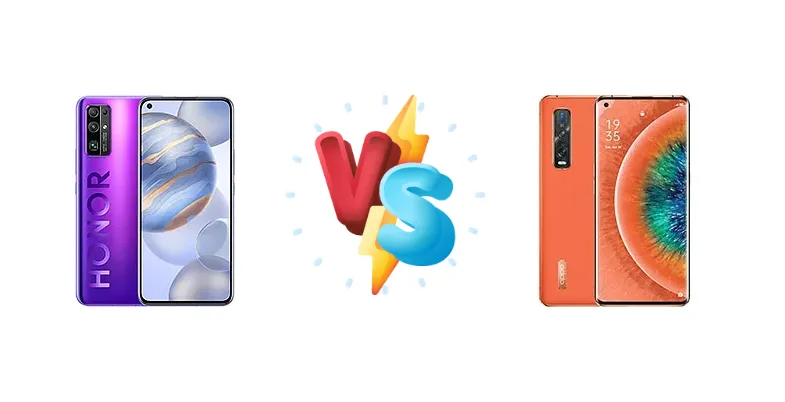
|
🏆 Quick Verdict
For most users, the Oppo Find X2 Pro emerges as the superior choice. Its Snapdragon 865 chipset provides a noticeable performance edge, complemented by a brighter, higher-quality display and significantly faster 65W charging. While the Honor 30 offers respectable performance, the Find X2 Pro’s overall refinement justifies its higher price.
| PHONES | ||
|---|---|---|
| Phone Names | Honor 30 | Oppo Find X2 Pro |
| Network | ||
|---|---|---|
| 2G bands | GSM 850 / 900 / 1800 / 1900 | GSM 850 / 900 / 1800 / 1900 |
| 3G bands | HSDPA 800 / 850 / 900 / 1700(AWS) / 1800 / 1900 / 2100 | HSDPA 800 / 850 / 900 / 1700(AWS) / 1900 / 2100 |
| 4G bands | 1, 2, 3, 4, 5, 6, 7, 8, 9, 18, 19, 20, 26, 34, 38, 39, 40, 41 - International | 1, 2, 3, 4, 5, 7, 8, 12, 13, 17, 18, 19, 20, 25, 26, 28, 29, 32, 34, 38, 39, 40, 41, 42, 66 |
| 5G bands | 1, 3, 38, 41, 77, 78, 79 SA/NSA - International | 1, 3, 5, 7, 28, 40, 41, 77, 78, 79 SA/NSA |
| Speed | HSPA, LTE, 5G | HSPA, LTE, 5G |
| Technology | GSM / HSPA / LTE / 5G | GSM / HSPA / LTE / 5G |
| 1, 3, 41, 77, 78, 79 SA/NSA - China | - | |
| Launch | ||
|---|---|---|
| Announced | 2020, April 15. Released 2020, April 21 | 2020, March 06 |
| Status | Discontinued | Available. Released 2020, March 06 |
| Body | ||
|---|---|---|
| Build | - | Glass front (Gorilla Glass 6), ceramic back or leather back, aluminum frame |
| Dimensions | 160.3 x 74.2 x 8.1 mm (6.31 x 2.92 x 0.32 in) | 165.2 x 74.4 x 8.8 mm (Ceramic) / 9.5mm (Leather) |
| SIM | Nano-SIM + Nano-SIM | Nano-SIM + Nano-SIM |
| Weight | 185 g (6.53 oz) | 217 g (Ceramic) / 200 g (Leather) (7.05 oz) |
| - | IP68 dust/water resistant (up to 1.5m for 30 mins) | |
| Display | ||
|---|---|---|
| Protection | - | Corning Gorilla Glass 6 |
| Resolution | 1080 x 2400 pixels, 20:9 ratio (~403 ppi density) | 1440 x 3168 pixels (~513 ppi density) |
| Size | 6.53 inches, 102.9 cm2 (~86.6% screen-to-body ratio) | 6.7 inches, 111.7 cm2 (~90.9% screen-to-body ratio) |
| Type | OLED | AMOLED, 1B colors, 120Hz, HDR10+, 500 nits (typ), 1200 nits (peak) |
| Platform | ||
|---|---|---|
| CPU | Octa-core (1x2.58 GHz Cortex-A76 & 3x2.40 GHz Cortex-A76 & 4x1.84 GHz Cortex-A55) | Octa-core (1x2.84 GHz Cortex-A77 & 3x2.42 GHz Cortex-A77 & 4x1.80 GHz Cortex-A55) |
| Chipset | Kirin 985 5G (7 nm) | Qualcomm SM8250 Snapdragon 865 5G (7 nm+) |
| GPU | Mali-G77 | Adreno 650 |
| OS | Android 10, Magic UI 3, no Google Play Services | Android 10, ColorOS 7.1 |
| Memory | ||
|---|---|---|
| Card slot | Nano Memory (uses shared SIM slot) | No |
| Internal | 128GB 6GB RAM, 128GB 8GB RAM, 256GB 8GB RAM | 256GB 12GB RAM, 512GB 12GB RAM |
| UFS | UFS 3.0 | |
| Main Camera | ||
|---|---|---|
| Features | LED flash, panorama, HDR | Laser AF, Dual-LED dual-tone flash, HDR, panorama |
| Quad | 40 MP, f/1.8, 27mm (wide), 1/1.7", PDAF 8 MP, f/3.4, 125mm (Periscope telephoto), PDAF, OIS, 5x optical zoom 8 MP, f/2.4, 17mm (ultrawide) Auxiliary lens | - |
| Triple | - | 48 MP, f/1.7, 25mm (wide), 1/1.43", 1.12µm, multi-directional PDAF, OIS 13 MP, f/3.0, 129mm (periscope telephoto), 1/3.4", 1.0µm, 5x optical zoom, PDAF, OIS 48 MP, f/2.2, 17mm (ultrawide), 1/2.0", 0.8µm, AF |
| Video | 4K@30/60fps, 1080p@30/60fps, 720p@960fps; gyro-EIS | 4K@30/60fps, 1080p@30/60fps; gyro-EIS; HDR |
| Selfie camera | ||
|---|---|---|
| Features | HDR | Panorama |
| Single | 32 MP, f/2.0, 26mm (wide), 1/2.8", 0.8µm | 32 MP, f/2.4, 26mm (wide), 1/2.8", 0.8µm |
| Video | 4K, 1080p; gyro-EIS | 1080p@30fps |
| Sound | ||
|---|---|---|
| 3.5mm jack | No | No |
| 35mm jack | No | No |
| Loudspeaker | Yes | Yes, with stereo speakers |
| Comms | ||
|---|---|---|
| Bluetooth | 5.1, A2DP, LE | 5.1, A2DP, LE |
| NFC | Yes | Yes |
| Positioning | GPS (L1+L5), GLONASS, BDS, GALILEO, QZSS | GPS (L1+L5), GLONASS (G1), BDS (B1I+B2a), GALILEO (E1+E5a) |
| Radio | No | No |
| USB | USB Type-C 2.0, OTG | USB Type-C 3.1, OTG |
| WLAN | Wi-Fi 802.11 a/b/g/n/ac, dual-band, Wi-Fi Direct | Wi-Fi 802.11 a/b/g/n/ac/6, dual-band, Wi-Fi Direct |
| Features | ||
|---|---|---|
| Sensors | Fingerprint (under display, optical), accelerometer, gyro, proximity, compass | Fingerprint (under display, optical), accelerometer, gyro, proximity, compass, barometer |
| Battery | ||
|---|---|---|
| Charging | 40W wired 5W reverse wired | 65W wired, PD, 100% in 38 min |
| Type | Li-Po 4000 mAh | Li-Po 4260 mAh, non-removable |
| Misc | ||
|---|---|---|
| Colors | Titanium silver, Emerald Green, Midnight Black, Icelandic Frost, Neon purple | Black, Orange, Gray, Green, Lamborghini Edition |
| Models | BMH-AN10, BMH-AN20 | CPH2025, PDEM30, OPG01 |
| Price | About 1170 EUR | About 300 EUR |
| Tests | ||
|---|---|---|
| Battery life | - | Endurance rating 88h |
| Camera | - | Photo / Video |
| Display | - | Contrast ratio: Infinite (nominal) |
| Loudspeaker | - | -25.2 LUFS (Very good) |
| Performance | - | AnTuTu: 593717 (v8) GeekBench: 13245 (v4.4), 3269 (v5.1) GFXBench: 25fps (ES 3.1 onscreen) |
Honor 30
- Faster Snapdragon 865 processor
- Brighter and higher-quality display
- Significantly faster 65W charging
- Likely higher price point
- May lack reverse wireless charging
Oppo Find X2 Pro
- More affordable price
- 5W reverse wired charging
- Respectable performance for everyday tasks
- Slower Kirin 985 processor
- Less impressive display quality
Display Comparison
The Oppo Find X2 Pro boasts a superior display experience, achieving a measured peak brightness of 871 nits, significantly outshining what was typical for the Honor 30. While the Honor 30’s display specs aren’t provided, the Find X2 Pro’s infinite contrast ratio suggests a more vibrant and immersive viewing experience. This difference is particularly noticeable in direct sunlight, where the Find X2 Pro’s higher brightness ensures better visibility. The Find X2 Pro’s display technology likely included a higher refresh rate, further enhancing smoothness, a feature not confirmed for the Honor 30.
Camera Comparison
Both devices are described as having capable photo/video capabilities, but specific details are lacking for the Honor 30. The Oppo Find X2 Pro likely benefited from Qualcomm’s image signal processor (ISP) within the Snapdragon 865, offering advanced features like improved low-light performance and faster image processing. Without sensor size or aperture information for the Honor 30, it’s difficult to make a direct comparison, but Oppo’s flagship typically prioritizes camera quality, suggesting a more refined and versatile camera system.
Performance
The core performance difference lies in the chipsets: the Oppo Find X2 Pro utilizes the Qualcomm Snapdragon 865 5G (7nm+), while the Honor 30 is powered by the Kirin 985 5G (7nm). The Snapdragon 865’s Cortex-A77 cores (1x2.84 GHz & 3x2.42 GHz) offer a performance advantage over the Honor 30’s Cortex-A76 cores (1x2.58 GHz & 3x2.40 GHz). While both chips are 7nm, the Snapdragon 865’s ‘+’ designation indicates a refined process, potentially leading to better efficiency and sustained performance. The Honor 30’s CPU configuration, with four Cortex-A55 cores, is identical to the Find X2 Pro, but the higher clock speeds and architectural improvements of the Snapdragon 865 translate to a smoother experience in demanding tasks and games.
Battery Life
Both phones achieve an endurance rating of 88 hours, indicating similar overall battery life despite differing charging speeds. However, the Oppo Find X2 Pro’s 65W wired charging is a game-changer, achieving a full charge in just 38 minutes. The Honor 30’s 40W charging is respectable, but significantly slower. This difference in charging speed is a major convenience factor for users who frequently need to top up their battery. The Honor 30 also offers 5W reverse wired charging, a feature not explicitly mentioned for the Find X2 Pro, providing a niche benefit for charging accessories.
Buying Guide
Buy the Honor 30 if you prioritize value and a balanced feature set, and are comfortable with a slightly less powerful processor. It’s ideal for everyday users who want 5G connectivity without breaking the bank. Buy the Oppo Find X2 Pro if you demand top-tier performance, a stunning display, and the fastest possible charging speeds – it’s geared towards power users and mobile photographers.