
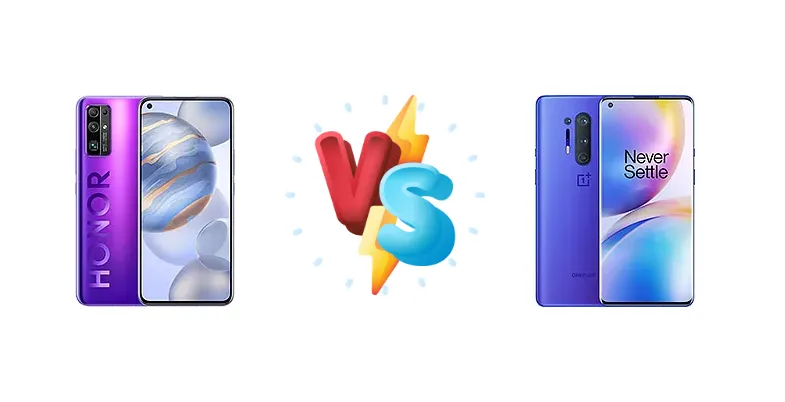
Honor 30 vs OnePlus 8 Pro: Which 5G Flagship Reigns Supreme?
| Phones Images | |||||
|---|---|---|---|---|---|
|
🏆 Quick Verdict
For the average user prioritizing raw performance and a more polished software experience, the OnePlus 8 Pro is the superior choice. While the Honor 30 offers competitive specs at a potentially lower price point, the Snapdragon 865’s processing power and the OnePlus 8 Pro’s faster charging and wireless charging capabilities provide a more compelling overall package.
| PHONES | ||
|---|---|---|
| Phone Names | Honor 30 | OnePlus 8 Pro |
| Network | ||
|---|---|---|
| 2G bands | GSM 850 / 900 / 1800 / 1900 | GSM 850 / 900 / 1800 / 1900 |
| 3G bands | HSDPA 800 / 850 / 900 / 1700(AWS) / 1800 / 1900 / 2100 | HSDPA 800 / 850 / 900 / 1700(AWS) / 1800 / 1900 / 2100 |
| 4G bands | 1, 2, 3, 4, 5, 6, 7, 8, 9, 18, 19, 20, 26, 34, 38, 39, 40, 41 - International | 1, 2, 3, 4, 5, 7, 8, 12, 13, 17, 18, 19, 20, 25, 26, 28, 32, 34, 38, 39, 40, 41, 42, 46, 66 - EU |
| 5G bands | 1, 3, 38, 41, 77, 78, 79 SA/NSA - International | 1, 3, 7, 28, 78 SA/NSA - EU |
| Speed | HSPA, LTE, 5G | HSPA 42.2/5.76 Mbps, LTE (5CA) Cat18 1200/150 Mbps, 5G 7.5 Gbps DL |
| Technology | GSM / HSPA / LTE / 5G | GSM / CDMA / HSPA / LTE / 5G |
| 1, 3, 41, 77, 78, 79 SA/NSA - China | 78 SA/NSA - IN | |
| Launch | ||
|---|---|---|
| Announced | 2020, April 15. Released 2020, April 21 | 2020, April 14 |
| Status | Discontinued | Available. Released 2020, April 21 |
| Body | ||
|---|---|---|
| Build | - | Glass front (Gorilla Glass 5), glass back (Gorilla Glass 5), aluminum frame |
| Dimensions | 160.3 x 74.2 x 8.1 mm (6.31 x 2.92 x 0.32 in) | 165.3 x 74.4 x 8.5 mm (6.51 x 2.93 x 0.33 in) |
| SIM | Nano-SIM + Nano-SIM | Nano-SIM + Nano-SIM |
| Weight | 185 g (6.53 oz) | 199 g (7.02 oz) |
| - | IP68 dust/water resistant | |
| Display | ||
|---|---|---|
| Protection | - | Corning Gorilla Glass 5 |
| Resolution | 1080 x 2400 pixels, 20:9 ratio (~403 ppi density) | 1440 x 3168 pixels (~513 ppi density) |
| Size | 6.53 inches, 102.9 cm2 (~86.6% screen-to-body ratio) | 6.78 inches, 111.7 cm2 (~90.8% screen-to-body ratio) |
| Type | OLED | Fluid AMOLED, 1B colors, 120Hz, HDR10+ |
| Platform | ||
|---|---|---|
| CPU | Octa-core (1x2.58 GHz Cortex-A76 & 3x2.40 GHz Cortex-A76 & 4x1.84 GHz Cortex-A55) | Octa-core (1x2.84 GHz Cortex-A77 & 3x2.42 GHz Cortex-A77 & 4x1.80 GHz Cortex-A55) |
| Chipset | Kirin 985 5G (7 nm) | Qualcomm SM8250 Snapdragon 865 5G (7 nm+) |
| GPU | Mali-G77 | Adreno 650 |
| OS | Android 10, Magic UI 3, no Google Play Services | Android 10, upgradable to Android 13, OxygenOS 13 |
| Memory | ||
|---|---|---|
| Card slot | Nano Memory (uses shared SIM slot) | No |
| Internal | 128GB 6GB RAM, 128GB 8GB RAM, 256GB 8GB RAM | 128GB 8GB RAM, 256GB 12GB RAM |
| UFS | UFS 3.0 | |
| Main Camera | ||
|---|---|---|
| Features | LED flash, panorama, HDR | Laser AF, Dual-LED flash, HDR, panorama |
| Quad | 40 MP, f/1.8, 27mm (wide), 1/1.7", PDAF 8 MP, f/3.4, 125mm (Periscope telephoto), PDAF, OIS, 5x optical zoom 8 MP, f/2.4, 17mm (ultrawide) Auxiliary lens | 48 MP, f/1.8, 25mm (wide), 1/1.43", 1.12µm, multi-directional PDAF, OIS 8 MP, f/2.4, (telephoto), 1/1.0µm, PDAF, OIS, 3x optical zoom 48 MP, f/2.2, 14mm, 116˚ (ultrawide), 1/2.0", 0.8µm, PDAF 5 MP, f/2.4, (Color filter camera) |
| Video | 4K@30/60fps, 1080p@30/60fps, 720p@960fps; gyro-EIS | 4K@30/60fps, 1080p@30/60/240fps, Auto HDR, gyro-EIS |
| Selfie camera | ||
|---|---|---|
| Features | HDR | HDR |
| Single | 32 MP, f/2.0, 26mm (wide), 1/2.8", 0.8µm | 16 MP, f/2.5, (wide), 1/3.06", 1.0µm |
| Video | 4K, 1080p; gyro-EIS | 1080p@30fps, gyro-EIS |
| Sound | ||
|---|---|---|
| 3.5mm jack | No | No |
| 35mm jack | No | No |
| Loudspeaker | Yes | Yes, with stereo speakers |
| Comms | ||
|---|---|---|
| Bluetooth | 5.1, A2DP, LE | 5.1, A2DP, LE, aptX HD |
| NFC | Yes | Yes |
| Positioning | GPS (L1+L5), GLONASS, BDS, GALILEO, QZSS | GPS (L1+L5), GLONASS (G1), BDS (B1), GALILEO (E1+E5a) |
| Radio | No | No |
| USB | USB Type-C 2.0, OTG | USB Type-C 3.1, OTG |
| WLAN | Wi-Fi 802.11 a/b/g/n/ac, dual-band, Wi-Fi Direct | Wi-Fi 802.11 a/b/g/n/ac/6, dual-band, Wi-Fi Direct, DLNA |
| Features | ||
|---|---|---|
| Sensors | Fingerprint (under display, optical), accelerometer, gyro, proximity, compass | Fingerprint (under display, optical), accelerometer, gyro, proximity, compass |
| Battery | ||
|---|---|---|
| Charging | 40W wired 5W reverse wired | 30W wired, 50% in 23 min 30W wireless, 50% in 30 min 3W reverse wireless |
| Type | Li-Po 4000 mAh | Li-Po 4510 mAh, non-removable |
| Misc | ||
|---|---|---|
| Colors | Titanium silver, Emerald Green, Midnight Black, Icelandic Frost, Neon purple | Glacial Green, Ultramarine Blue, Onyx Black |
| Models | BMH-AN10, BMH-AN20 | IN2023, IN2020, IN2021, IN2025 |
| Price | About 1170 EUR | About 310 EUR |
| Pricing | ||
|---|---|---|
| 128GB 8GB RAM | - | $ 428.39 |
| 256GB 12GB RAM | - | $ 853.51 |
| RENEWED | - | $ 486.00 |
| Tests | ||
|---|---|---|
| Battery life | - | Endurance rating 103h |
| Camera | - | Photo / Video |
| Display | - | Contrast ratio: Infinite (nominal) |
| Loudspeaker | - | -23.5 LUFS (Very good) |
| Performance | - | AnTuTu: 573276 (v8) GeekBench: 3374 (v5.1) GFXBench: 24fps (ES 3.1 onscreen) |
Honor 30
- Potentially lower price point
- Fast 40W wired charging
- 5G connectivity
- Less powerful chipset than Snapdragon 865
- Limited information on display quality
- Slower wireless charging
OnePlus 8 Pro
- Superior performance with Snapdragon 865
- Fast 30W wired and wireless charging
- High-quality display with 120Hz refresh rate
- Higher price tag
- OxygenOS may not appeal to all users
- Can run warm under sustained load
Display Comparison
Both the Honor 30 and OnePlus 8 Pro boast displays with an 'Infinite' (nominal) contrast ratio, suggesting excellent black levels. However, detailed display specifications like peak brightness and panel type are missing for the Honor 30. The OnePlus 8 Pro’s display is known for its high refresh rate (120Hz, not specified for Honor 30) and color accuracy, contributing to a smoother and more immersive viewing experience. Without further data on the Honor 30’s panel, the OnePlus 8 Pro likely holds an advantage in overall display quality.
Camera Comparison
Both phones are advertised as having capable photo/video systems, but specifics are limited. Without detailed sensor information, it’s difficult to make a definitive judgment. However, the market positioning of the OnePlus 8 Pro suggests a more sophisticated camera system with potentially larger sensors and more advanced image processing algorithms. The Honor 30’s camera is likely competent, but may not reach the same level of detail and dynamic range as the OnePlus 8 Pro, particularly in challenging lighting conditions. The absence of details on OIS or lens apertures hinders a more precise comparison.
Performance
The core difference lies in the chipsets. The OnePlus 8 Pro’s Snapdragon 865 (7nm+) benefits from a slightly newer architecture and a higher peak clock speed (2.84 GHz Cortex-A77) compared to the Honor 30’s Kirin 985 5G (7nm). While both utilize a 7nm process, the Snapdragon 865 generally exhibits superior GPU performance, crucial for gaming. The Kirin 985’s octa-core configuration, with a mix of Cortex-A76 and A55 cores, is capable, but likely won’t match the sustained performance of the Snapdragon 865, especially under heavy load. The OnePlus 8 Pro’s LPDDR5 RAM further enhances its multitasking capabilities.
Battery Life
The OnePlus 8 Pro has an endurance rating of 103 hours, indicating solid battery life. While the Honor 30’s battery capacity is not specified, the OnePlus 8 Pro’s 30W wired and 30W wireless charging capabilities are significantly faster than the Honor 30’s 40W wired and 5W reverse wired charging. The OnePlus 8 Pro can reach 50% charge in 23 minutes with wired charging and 30 minutes wirelessly, offering a substantial convenience advantage. The Honor 30’s slower wireless charging and lower wattage reverse charging make it less versatile in this regard.
Buying Guide
Buy the Honor 30 if you need a capable 5G phone with fast 40W wired charging and are comfortable with Huawei’s EMUI software. It’s a strong contender for users seeking a feature-rich device without the top-tier price tag. Buy the OnePlus 8 Pro if you prioritize peak performance for gaming and demanding applications, value fast wireless charging, and prefer a clean, responsive Android experience with OxygenOS. It’s the better option for power users and those willing to invest in a premium device.