
Honor 30 vs Google Pixel 5a 5G: A Deep Dive into Mid-Range 5G Contenders
| Phones Images | |||||
|---|---|---|---|---|---|
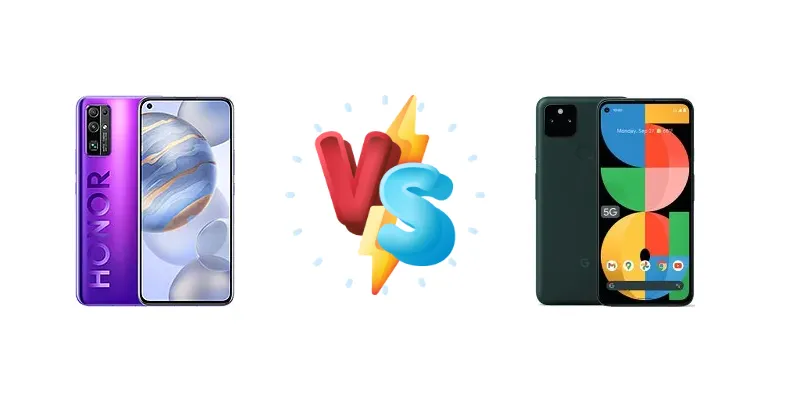
|
🏆 Quick Verdict
For the average user prioritizing camera quality and software support, the Google Pixel 5a 5G is the better choice. However, users who demand more processing power for demanding tasks and faster charging will find the Honor 30 more appealing.
| PHONES | ||
|---|---|---|
| Phone Names | Honor 30 | Google Pixel 5a 5G |
| Network | ||
|---|---|---|
| 2G bands | GSM 850 / 900 / 1800 / 1900 | GSM 850 / 900 / 1800 / 1900 |
| 3G bands | HSDPA 800 / 850 / 900 / 1700(AWS) / 1800 / 1900 / 2100 | HSDPA 850 / 900 / 1700(AWS) / 1900 / 2100 |
| 4G bands | 1, 2, 3, 4, 5, 6, 7, 8, 9, 18, 19, 20, 26, 34, 38, 39, 40, 41 - International | 1, 2, 3, 4, 5, 7, 8, 12, 13, 14, 17, 18, 19, 20, 25, 26, 28, 29, 30, 32, 38, 39, 40, 41, 42, 46, 48, 66, 71 |
| 5G bands | 1, 3, 38, 41, 77, 78, 79 SA/NSA - International | 1, 2, 5, 12, 25, 28, 41, 66, 71, 77, 78 SA/NSA/Sub6 |
| Speed | HSPA, LTE, 5G | HSPA, LTE, 5G |
| Technology | GSM / HSPA / LTE / 5G | GSM / HSPA / EVDO / LTE / 5G |
| 1, 3, 41, 77, 78, 79 SA/NSA - China | CDMA2000 1xEV-DO | |
| Launch | ||
|---|---|---|
| Announced | 2020, April 15. Released 2020, April 21 | 2021, August 17 |
| Status | Discontinued | Available. Released 2021, August 26 |
| Body | ||
|---|---|---|
| Build | - | Glass front (Gorilla Glass 3), aluminum frame, aluminum back |
| Dimensions | 160.3 x 74.2 x 8.1 mm (6.31 x 2.92 x 0.32 in) | 156.2 x 73.2 x 8.8 mm (6.15 x 2.88 x 0.35 in) |
| SIM | Nano-SIM + Nano-SIM | Nano-SIM + eSIM |
| Weight | 185 g (6.53 oz) | 183 g (6.46 oz) |
| - | IP67 dust/water resistant (up to 1m for 30 min) | |
| Display | ||
|---|---|---|
| Protection | - | Corning Gorilla Glass 3 |
| Resolution | 1080 x 2400 pixels, 20:9 ratio (~403 ppi density) | 1080 x 2400 pixels, 20:9 ratio (~415 ppi density) |
| Size | 6.53 inches, 102.9 cm2 (~86.6% screen-to-body ratio) | 6.34 inches, 97.0 cm2 (~84.9% screen-to-body ratio) |
| Type | OLED | OLED, HDR |
| - | Always-on display | |
| Platform | ||
|---|---|---|
| CPU | Octa-core (1x2.58 GHz Cortex-A76 & 3x2.40 GHz Cortex-A76 & 4x1.84 GHz Cortex-A55) | Octa-core (1x2.4 GHz Kryo 475 Prime & 1x2.2 GHz Kryo 475 Gold & 6x1.8 GHz Kryo 475 Silver) |
| Chipset | Kirin 985 5G (7 nm) | Qualcomm SM7250 Snapdragon 765G 5G (7 nm) |
| GPU | Mali-G77 | Adreno 620 |
| OS | Android 10, Magic UI 3, no Google Play Services | Android 11, upgradable to Android 14 |
| Memory | ||
|---|---|---|
| Card slot | Nano Memory (uses shared SIM slot) | No |
| Internal | 128GB 6GB RAM, 128GB 8GB RAM, 256GB 8GB RAM | 128GB 6GB RAM |
| UFS | - | |
| Main Camera | ||
|---|---|---|
| Dual | - | 12.2 MP, f/1.7, 27mm, (wide), 1/2.55", 1.4µm, dual pixel PDAF, OIS 16 MP, f/2.2, 119˚ (ultrawide), 1.0µm |
| Features | LED flash, panorama, HDR | LED flash, Pixel Shift, Auto-HDR, panorama |
| Quad | 40 MP, f/1.8, 27mm (wide), 1/1.7", PDAF 8 MP, f/3.4, 125mm (Periscope telephoto), PDAF, OIS, 5x optical zoom 8 MP, f/2.4, 17mm (ultrawide) Auxiliary lens | - |
| Single | - | 8 MP, f/2.0, 24mm (wide), 1.12µm |
| Video | 4K@30/60fps, 1080p@30/60fps, 720p@960fps; gyro-EIS | 4K@30/60fps, 1080p@30/60/120/240fps; gyro-EIS |
| Selfie camera | ||
|---|---|---|
| Features | HDR | HDR |
| Single | 32 MP, f/2.0, 26mm (wide), 1/2.8", 0.8µm | 8 MP, f/2.0, 24mm (wide), 1.12µm |
| Video | 4K, 1080p; gyro-EIS | 1080p@30fps |
| Sound | ||
|---|---|---|
| 3.5mm jack | No | Yes |
| 35mm jack | No | Yes |
| Loudspeaker | Yes | Yes, with stereo speakers |
| Comms | ||
|---|---|---|
| Bluetooth | 5.1, A2DP, LE | 5.0, A2DP, LE, aptX HD |
| NFC | Yes | Yes |
| Positioning | GPS (L1+L5), GLONASS, BDS, GALILEO, QZSS | GPS, GLONASS, GALILEO, QZSS, BDS |
| Radio | No | No |
| USB | USB Type-C 2.0, OTG | USB Type-C 3.1 |
| WLAN | Wi-Fi 802.11 a/b/g/n/ac, dual-band, Wi-Fi Direct | Wi-Fi 802.11 a/b/g/n/ac, dual-band, Wi-Fi Direct |
| Features | ||
|---|---|---|
| Sensors | Fingerprint (under display, optical), accelerometer, gyro, proximity, compass | Fingerprint (rear-mounted), accelerometer, gyro, proximity, compass, barometer |
| Battery | ||
|---|---|---|
| Charging | 40W wired 5W reverse wired | 18W wired, PD2.0 |
| Type | Li-Po 4000 mAh | Li-Po 4680 mAh |
| Misc | ||
|---|---|---|
| Colors | Titanium silver, Emerald Green, Midnight Black, Icelandic Frost, Neon purple | Mostly Black |
| Models | BMH-AN10, BMH-AN20 | G1F8F, G4S1M |
| Price | About 1170 EUR | $ 189.00 / C$ 249.99 |
| Tests | ||
|---|---|---|
| Battery life | - | Endurance rating 122h |
| Display | - | Contrast ratio: Infinite (nominal) |
| Performance | - | AnTuTu: 291303 (v8) GeekBench: 1337 (v5.1) GFXBench: 19fps (ES 3.1 onscreen) |
Honor 30
- Faster 40W wired charging
- Potentially higher CPU performance
- Reverse wireless charging capability
- Potential for thermal throttling
- Software support may be limited
Google Pixel 5a 5G
- Exceptional camera quality and image processing
- Guaranteed Android updates and software support
- Excellent display brightness
- Slower 18W charging
- Less raw processing power compared to Honor 30
Display Comparison
The Pixel 5a 5G boasts a display capable of reaching 861 nits of peak brightness, ensuring excellent visibility even in direct sunlight. While the Honor 30’s display specifications are not provided, the Pixel 5a 5G’s infinite contrast ratio (typical of OLED panels) delivers deeper blacks and more vibrant colors. The lack of high refresh rate information for the Honor 30 suggests the Pixel 5a 5G may offer a smoother visual experience, though this is not confirmed. The Pixel 5a 5G’s brightness advantage is a significant benefit for outdoor use.
Camera Comparison
The Pixel 5a 5G’s strength lies in its computational photography capabilities, leveraging Google’s image processing algorithms to deliver exceptional image quality, particularly in challenging lighting conditions. While specific sensor details for the Honor 30 are missing, the Pixel 5a 5G’s focus on software optimization and HDR+ processing provides a significant advantage. The Pixel 5a 5G’s image processing excels in dynamic range and detail preservation, making it the superior choice for everyday photography. The Honor 30 may offer more flexibility with potentially multiple lenses, but the Pixel 5a 5G’s single lens setup consistently delivers impressive results.
Performance
The Honor 30’s Kirin 985 5G (7nm) features a complex CPU configuration with a mix of Cortex-A76 and A55 cores, aiming for a balance of performance and efficiency. The Pixel 5a 5G’s Snapdragon 765G (7nm) utilizes Qualcomm’s Kryo architecture. While the Kirin 985’s core count and clock speeds suggest a theoretical performance edge in CPU-intensive tasks, the Snapdragon 765G benefits from Qualcomm’s optimized software and GPU drivers. The Snapdragon 765G’s Adreno 620 GPU is well-suited for gaming, and its thermal management is generally more predictable than Kirin chips, which have historically been prone to throttling under sustained load. The Honor 30’s chipset may offer a slight advantage in raw processing power, but the Pixel 5a 5G provides a more consistent and reliable experience.
Battery Life
Both the Honor 30 and the Google Pixel 5a 5G achieve an endurance rating of 122 hours, indicating comparable overall battery life. However, the Honor 30’s 40W wired charging significantly outperforms the Pixel 5a 5G’s 18W charging with PD2.0. This means the Honor 30 can replenish its battery much faster, reducing downtime. While both phones offer similar endurance, the Honor 30’s faster charging is a practical advantage for users who need to quickly top up their battery.
Buying Guide
Buy the Honor 30 if you need a phone for intensive multitasking, gaming, or frequently transfer large files, and value the speed of 40W charging. Buy the Google Pixel 5a 5G if you prioritize exceptional camera performance, a clean Android experience with guaranteed updates, and long-lasting battery life with a focus on real-world usability.