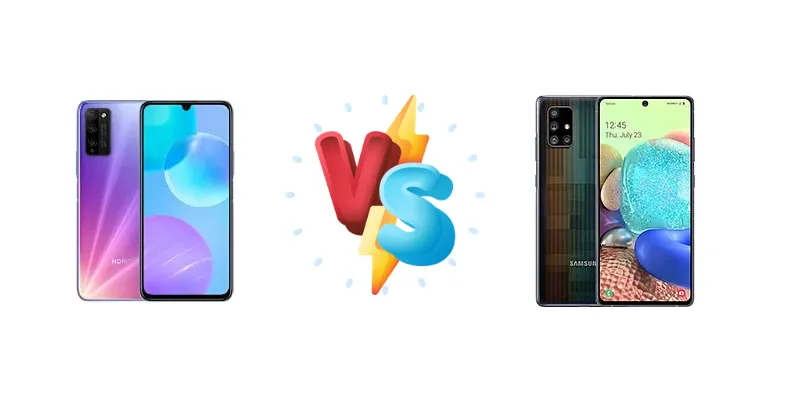
The Honor 30 Youth and Samsung Galaxy A71 5G UW represent compelling options in the increasingly crowded mid-range 5G smartphone market. Both devices aim to deliver 5G connectivity and a solid feature set without breaking the bank, but they achieve this through different approaches to chipset selection and overall design. This comparison dissects the key differences to help you determine which phone best suits your needs.
🏆 Quick Verdict
For the average user prioritizing consistent performance and a slightly more refined software experience, the Samsung Galaxy A71 5G UW is the better choice. While the Honor 30 Youth offers a competitive chipset in the Dimensity 800, the Snapdragon 765G in the A71 5G UW provides a smoother, more stable experience, particularly during demanding tasks.
| Network |
|---|
| 2G bands | GSM 900 / 1800 / 1900 | GSM 850 / 900 / 1800 / 1900 |
| 3G bands | HSDPA 850 / 900 / 1700(AWS) / 1900 / 2100 | HSDPA 850 / 900 / 1900 / 2100 |
| 4G bands | LTE | 2, 3, 4, 5, 7, 12, 13, 20, 28, 66 |
| 5G bands | 1, 38, 41, 77, 78, 79 SA/NSA | 260, 261 SA/NSA/mmWave |
| Speed | HSPA, LTE, 5G | HSPA, LTE, 5G |
| Technology | GSM / HSPA / LTE / 5G | GSM / HSPA / LTE / 5G |
| Launch |
|---|
| Announced | 2020, July 02. Released 2020, July 08 | 2020, July 07 |
| Status | Discontinued | Available. Released 2020, July 16 |
| Body |
|---|
| Build | - | Glass front (Gorilla Glass 3), plastic back, aluminum frame |
| Dimensions | 160 x 75.3 x 8.4 mm (6.30 x 2.96 x 0.33 in) | 162.8 x 75.7 x 8.4 mm (6.41 x 2.98 x 0.33 in) |
| SIM | Nano-SIM + Nano-SIM | Nano-SIM (pre-installed) |
| Weight | 192 g (6.77 oz) | 188 g (6.63 oz) |
| Display |
|---|
| Protection | - | Corning Gorilla Glass 3 |
| Resolution | 1080 x 2400 pixels, 20:9 ratio (~405 ppi density) | 1080 x 2400 pixels, 20:9 ratio (~393 ppi density) |
| Size | 6.5 inches, 102.0 cm2 (~84.7% screen-to-body ratio) | 6.7 inches, 108.4 cm2 (~87.9% screen-to-body ratio) |
| Type | IPS LCD, 90Hz | Super AMOLED Plus |
| Platform |
|---|
| CPU | Octa-core (4x2.0 GHz Cortex-A76 & 4x2.0 GHz Cortex-A55) | Octa-core (1x2.4 GHz Kryo 475 Prime & 1x2.2 GHz Kryo 475 Gold & 6x1.8 GHz Kryo 475 Silver) |
| Chipset | Mediatek Dimensity 800 (7 nm) | Qualcomm SM7250 Snapdragon 765G 5G (7 nm) |
| GPU | Mali-G57MP4 | Adreno 620 |
| OS | Android 10, Magic UI 3.1, no Google Play Services | Android 10, One UI 2.1 |
| Memory |
|---|
| Card slot | Nano Memory (uses shared SIM slot) | microSDXC (dedicated slot) |
| Internal | 64GB 6GB RAM, 128GB 6GB RAM, 128GB 8GB RAM | 128GB 8GB RAM |
| | - | UFS 2.1 |
| Main Camera |
|---|
| Features | LED flash, HDR, panorama | LED flash, panorama, HDR |
| Quad | - | 64 MP, f/1.8, 26mm (wide), 1/1.72", 0.8µm, PDAF
12 MP, f/2.2, 123˚ (ultrawide)
5 MP (macro)
Auxiliary lens |
| Triple | 48 MP, f/1.8, 26mm (wide), 1/2.0", 0.8µm, PDAF
8 MP, f/2.4, 120˚ (ultrawide)
2 MP (macro) | - |
| Video | 4K@30fps, 1080p@30fps | 4K@30fps, 1080p@30/240fps, 1080p@960fps; gyro-EIS |
| Selfie camera |
|---|
| Features | HDR | HDR |
| Single | 16 MP, f/2.0 | 32 MP, f/2.2, 26mm (wide), 1/2.8", 0.8µm |
| Video | 1080p@30fps | 4K@30fps, 1080p@30fps |
| Sound |
|---|
| 3.5mm jack | Yes | Yes |
| 35mm jack | Yes | Yes |
| Loudspeaker | Yes | Yes |
| Comms |
|---|
| Bluetooth | 5.1, A2DP, LE | 5.0, A2DP, LE |
| NFC | No | No |
| Positioning | GPS, GLONASS, BDS | GPS, GLONASS, GALILEO, BDS |
| Radio | No | No |
| USB | USB Type-C 2.0, OTG | USB Type-C 2.0, OTG |
| WLAN | Wi-Fi 802.11 a/b/g/n/ac, dual-band, Wi-Fi Direct | Wi-Fi 802.11 a/b/g/n/ac, dual-band, Wi-Fi Direct |
| Features |
|---|
| Sensors | Fingerprint (side-mounted), accelerometer, gyro, proximity, compass | Fingerprint (under display, optical), accelerometer, gyro, proximity, compass |
| | - | ANT+ |
| Battery |
|---|
| Charging | 22.5W wired | 25W wired |
| Type | Li-Po 4000 mAh | Li-Po 4500 mAh |
| Misc |
|---|
| Colors | Magic Night Black, Dark Blue, Galaxy Silver | Prism Bricks Black |
| Models | MXW-AN00 | SM-A716V |
| Price | About 220 EUR | - |
| SAR | - | 0.50 W/kg (head) 0.78 W/kg (body) |
Honor 30 Youth
- Strong multi-core CPU performance with Dimensity 800
- Competitive price point
- Potentially more customizable software experience
- Potential for thermal throttling under sustained load
- Less refined software experience compared to Samsung
Samsung Galaxy A71 5G UW
- More efficient Snapdragon 765G chipset
- Samsung’s established software ecosystem
- Faster 25W charging
- Potentially higher price compared to Honor 30 Youth
- Software bloatware (typical of Samsung)
Display Comparison
Neither device boasts a cutting-edge display. While specific panel details (like OLED vs LCD) are missing, both target the mid-range. The A71 5G UW likely benefits from Samsung’s display expertise, potentially offering slightly better color accuracy and viewing angles. Bezels are expected to be comparable, typical of this price bracket. The absence of high refresh rates (90Hz or 120Hz) on either device is a notable omission, focusing instead on battery efficiency.
Camera Comparison
Without detailed sensor information, a direct comparison is difficult. However, the market positioning suggests the A71 5G UW likely features a more refined camera system. Samsung’s image processing algorithms are generally well-regarded, prioritizing vibrant colors and detail. The Honor 30 Youth’s camera performance will likely be good, but may lean towards a more natural, less processed look. The presence of Optical Image Stabilization (OIS) on the A71 5G UW, if present, would be a significant advantage for low-light photography and video recording. We can assume both phones include a standard array of lenses, but the quality of the main sensor will be the deciding factor.
Performance
The core of the difference lies in the chipsets. The Samsung Galaxy A71 5G UW’s Qualcomm Snapdragon 765G (7nm) utilizes a Kryo 475 architecture with a prime core clocked at 2.4GHz, designed for sustained performance. The Honor 30 Youth’s MediaTek Dimensity 800 (7nm) features a Cortex-A76 based CPU, offering strong performance, but potentially exhibiting more thermal throttling under prolonged heavy load. The Snapdragon 765G’s architecture is generally more efficient, translating to better sustained performance in gaming and demanding applications. While both use 7nm processes, Qualcomm’s optimizations often give it an edge in real-world scenarios. The A71 5G UW likely benefits from more mature software optimization for the chipset.
Battery Life
The Samsung Galaxy A71 5G UW’s 25W charging is slightly faster than the Honor 30 Youth’s 22.5W charging. While the difference isn’t massive, it translates to a quicker top-up time. Battery capacity is not specified, but both phones likely aim for all-day battery life with moderate usage. The Snapdragon 765G’s efficiency could contribute to slightly better battery life on the A71 5G UW, offsetting any potential capacity differences. The faster charging on the Samsung is a practical benefit for users who frequently need to quickly replenish their battery.
Buying Guide
Buy the Honor 30 Youth if you prioritize raw processing power for tasks like video editing or emulation, and are comfortable with the Honor UI. Its Dimensity 800 chipset offers strong multi-core performance. Buy the Samsung Galaxy A71 5G UW if you value a more balanced experience with a focus on consistent performance, a larger display, and Samsung’s established software ecosystem, even if it means sacrificing a small amount of peak CPU performance.
Frequently Asked Questions
❓ Will the Dimensity 800 in the Honor 30 Youth struggle with graphically intensive games like PUBG or Genshin Impact?
The Dimensity 800 is capable of running these games, but you may experience frame drops or thermal throttling during extended gaming sessions. Lowering graphics settings is recommended for a smoother experience. The Snapdragon 765G in the A71 5G UW is generally better equipped to handle sustained gaming loads.
❓ Does the Samsung Galaxy A71 5G UW support carrier aggregation for faster 5G speeds on networks like T-Mobile or Verizon?
The Snapdragon 765G supports carrier aggregation, which is crucial for achieving optimal 5G speeds. The specific bands supported will vary depending on the carrier and region, but the A71 5G UW is well-positioned to take advantage of 5G network advancements. Check with your carrier for compatibility details.
❓ Is the software on the Honor 30 Youth heavily customized, and does it include a lot of bloatware?
Honor's UI (Magic UI) is a heavily customized version of Android. It includes a significant number of pre-installed apps and features, some of which may be considered bloatware. While you can disable or uninstall some of these apps, the software experience is noticeably different from stock Android or Samsung's One UI.