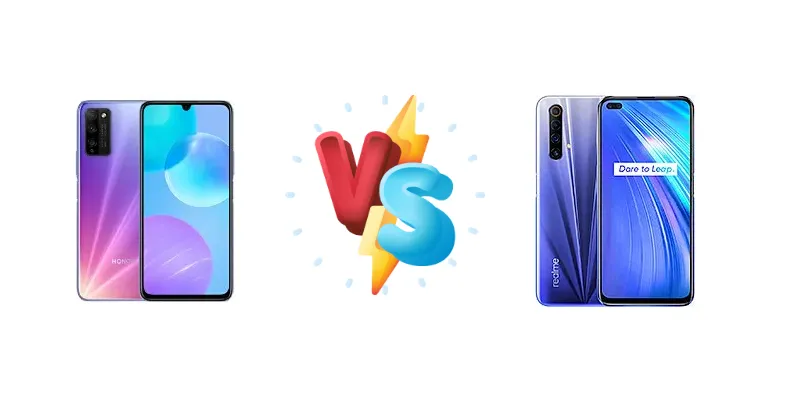
The Honor 30 Youth and Realme X50m 5G represent compelling options in the increasingly competitive mid-range 5G smartphone market. Both devices aim to deliver a balance of performance and affordability, but they achieve this through different approaches – Honor leveraging MediaTek’s Dimensity 800 and Realme opting for Qualcomm’s Snapdragon 765G. This comparison dissects their key differences to determine which phone best suits your needs.
🏆 Quick Verdict
For the average user prioritizing faster charging and potentially more consistent gaming performance, the Realme X50m 5G emerges as the better choice. Its 30W charging significantly reduces downtime, and the Snapdragon 765G offers a slight edge in sustained performance, despite the Dimensity 800’s strong initial burst.
| Network |
|---|
| 2G bands | GSM 900 / 1800 / 1900 | GSM 850 / 900 / 1800 / 1900 |
| 3G bands | HSDPA 850 / 900 / 1700(AWS) / 1900 / 2100 | HSDPA 850 / 900 / 1700 / 1900 / 2100 |
| 4G bands | LTE | 1, 2, 3, 4, 5, 7, 8, 34, 38, 39, 40, 41 |
| 5G bands | 1, 38, 41, 77, 78, 79 SA/NSA | 1, 3, 41, 77, 78, 79 SA/NSA |
| Speed | HSPA, LTE, 5G | HSPA, LTE, 5G |
| Technology | GSM / HSPA / LTE / 5G | GSM / CDMA / HSPA / EVDO / LTE / 5G |
| | - | CDMA2000 1xEV-DO |
| Launch |
|---|
| Announced | 2020, July 02. Released 2020, July 08 | 2020, April 23. Released 2020, April 29 |
| Status | Discontinued | Discontinued |
| Body |
|---|
| Dimensions | 160 x 75.3 x 8.4 mm (6.30 x 2.96 x 0.33 in) | 163.8 x 75.8 x 8.9 mm (6.45 x 2.98 x 0.35 in) |
| SIM | Nano-SIM + Nano-SIM | Nano-SIM + Nano-SIM |
| Weight | 192 g (6.77 oz) | 194 g (6.84 oz) |
| Display |
|---|
| Resolution | 1080 x 2400 pixels, 20:9 ratio (~405 ppi density) | 1080 x 2400 pixels, 20:9 ratio (~399 ppi density) |
| Size | 6.5 inches, 102.0 cm2 (~84.7% screen-to-body ratio) | 6.57 inches, 105.3 cm2 (~84.8% screen-to-body ratio) |
| Type | IPS LCD, 90Hz | IPS LCD, 120Hz |
| Platform |
|---|
| CPU | Octa-core (4x2.0 GHz Cortex-A76 & 4x2.0 GHz Cortex-A55) | Octa-core (1x2.4 GHz Kryo 475 Prime & 1x2.2 GHz Kryo 475 Gold & 6x1.8 GHz Kryo 475 Silver) |
| Chipset | Mediatek Dimensity 800 (7 nm) | Qualcomm SM7250 Snapdragon 765G 5G (7 nm) |
| GPU | Mali-G57MP4 | Adreno 620 |
| OS | Android 10, Magic UI 3.1, no Google Play Services | Android 10, Realme UI |
| Memory |
|---|
| Card slot | Nano Memory (uses shared SIM slot) | No |
| Internal | 64GB 6GB RAM, 128GB 6GB RAM, 128GB 8GB RAM | 128GB 6GB RAM, 128GB 8GB RAM |
| | - | UFS 2.1 |
| Main Camera |
|---|
| Features | LED flash, HDR, panorama | LED flash, HDR, panorama |
| Quad | - | 48 MP, f/1.8, 25mm (wide), 1/2.0", 0.8µm, PDAF
8 MP, f/2.3, 16mm (ultrawide), 1/4.0", 1.12µm
2 MP (macro)
Auxiliary lens |
| Triple | 48 MP, f/1.8, 26mm (wide), 1/2.0", 0.8µm, PDAF
8 MP, f/2.4, 120˚ (ultrawide)
2 MP (macro) | - |
| Video | 4K@30fps, 1080p@30fps | 4K@30fps, 1080p@30/60fps; gyro-EIS |
| Selfie camera |
|---|
| Dual | - | 16 MP, f/2.0, 26mm (wide), 1/3.06", 1.0µm
2 MP, f/2.4, (depth) |
| Features | HDR | HDR |
| Single | 16 MP, f/2.0 | - |
| Video | 1080p@30fps | 1080p@30/120fps |
| Sound |
|---|
| 3.5mm jack | Yes | No |
| 35mm jack | Yes | No |
| Loudspeaker | Yes | Yes |
| | - | 24-bit/192kHz audio |
| Comms |
|---|
| Bluetooth | 5.1, A2DP, LE | 5.0, A2DP, LE |
| NFC | No | Yes |
| Positioning | GPS, GLONASS, BDS | GPS, GLONASS, BDS |
| Radio | No | No |
| USB | USB Type-C 2.0, OTG | USB Type-C 2.0 |
| WLAN | Wi-Fi 802.11 a/b/g/n/ac, dual-band, Wi-Fi Direct | Wi-Fi 802.11 a/b/g/n/ac, dual-band, Wi-Fi Direct |
| Features |
|---|
| Sensors | Fingerprint (side-mounted), accelerometer, gyro, proximity, compass | Fingerprint (side-mounted), accelerometer, gyro, proximity, compass |
| Battery |
|---|
| Charging | 22.5W wired | 30W wired, 70% in 30 min |
| Type | Li-Po 4000 mAh | 4200 mAh |
| Misc |
|---|
| Colors | Magic Night Black, Dark Blue, Galaxy Silver | Starry Blue, Galaxy White |
| Models | MXW-AN00 | - |
| Price | About 220 EUR | About 260 EUR |
Honor 30 Youth
- Potentially more efficient chipset for everyday tasks.
- MediaTek Dimensity 800 offers strong initial performance.
- Likely a competitive price point.
- Slower 22.5W charging.
- May experience more throttling under sustained load.
Realme X50m 5G
- Faster 30W charging with 70% in 30 minutes.
- Snapdragon 765G offers better sustained performance.
- Qualcomm’s Adreno 620 GPU provides a graphics advantage.
- May be slightly less power efficient in idle scenarios.
- Potentially higher price compared to the Honor 30 Youth.
Display Comparison
Neither device boasts a standout display. Both likely utilize IPS LCD panels, common in this price bracket. While specific details like peak brightness and color gamut coverage are unavailable, the focus here is on processing power, not visual fidelity. Bezels are expected to be similar, prioritizing affordability over an edge-to-edge experience. Color accuracy will likely be adequate for general use, but not geared towards professional content creation.
Camera Comparison
Without detailed camera specs beyond the presence of cameras, a direct comparison is difficult. However, the Realme brand generally emphasizes camera capabilities, suggesting potentially more refined image processing algorithms. Both phones likely feature a multi-camera setup, but the quality will heavily depend on sensor size and lens apertures – information not provided. The inclusion of a 2MP macro camera on either device is largely a marketing tactic, offering limited practical benefit due to the small sensor size and lack of optical image stabilization (OIS).
Performance
The core difference lies in the chipsets. The Realme X50m 5G’s Snapdragon 765G (7nm) features a Kryo 475 Prime core clocked at 2.4GHz, designed for peak performance, alongside a Kryo 475 Gold and six Silver cores for efficiency. This contrasts with the Honor 30 Youth’s Dimensity 800 (7nm) which employs four Cortex-A76 cores at 2.0GHz and four Cortex-A55 cores, also at 2.0GHz. While the Dimensity 800 can initially deliver impressive performance, the Snapdragon 765G’s architecture is generally better optimized for sustained loads, meaning less throttling during extended gaming sessions. The Snapdragon 765G also benefits from Qualcomm’s Adreno 620 GPU, likely offering a slight advantage in graphics-intensive tasks. Both devices likely utilize LPDDR4X RAM, a standard for this segment.
Battery Life
The Realme X50m 5G’s 30W wired charging is a significant advantage. Realme claims a 70% charge in 30 minutes, drastically reducing downtime compared to the Honor 30 Youth’s 22.5W charging. While battery capacity isn’t specified, the faster charging speed effectively mitigates any potential difference in mAh. The Snapdragon 765G’s power efficiency may also contribute to slightly better battery life under heavy use, but the charging speed is the defining factor here.
Buying Guide
Buy the Honor 30 Youth if you prioritize a potentially more efficient chipset for everyday tasks and are comfortable with slightly slower charging speeds. Buy the Realme X50m 5G if you are a mobile gamer or frequently find yourself needing to quickly top up your battery, valuing the Snapdragon 765G’s performance and 30W fast charging.
Frequently Asked Questions
❓ Will the Snapdragon 765G in the Realme X50m 5G handle demanding games like PUBG Mobile at high settings?
Yes, the Snapdragon 765G is capable of running PUBG Mobile at high settings with stable frame rates. Its Adreno 620 GPU provides sufficient graphical power, and the chipset’s architecture is designed to minimize throttling during extended gaming sessions, offering a smoother experience than the Dimensity 800 might provide over longer playtimes.
❓ How much faster is the 30W charging on the Realme X50m 5G compared to the 22.5W charging on the Honor 30 Youth in real-world use?
The Realme X50m 5G’s 30W charging can realistically add around 50% battery life in approximately 20-25 minutes, while the Honor 30 Youth’s 22.5W charging will take closer to 45-60 minutes to achieve the same level of charge. This difference is substantial for users who frequently need to quickly top up their battery throughout the day.
❓ Does either phone support carrier aggregation for improved 5G speeds?
While not explicitly stated, both the Snapdragon 765G and Dimensity 800 support carrier aggregation, a crucial feature for maximizing 5G speeds. However, the specific 5G bands supported will vary depending on the region and carrier, so it’s essential to check compatibility with your local network.