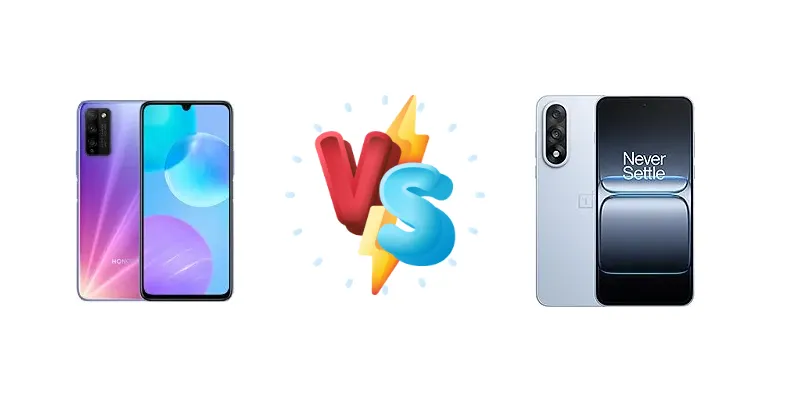
The mid-range smartphone market is fiercely competitive. The Honor 30 Youth, leveraging the Mediatek Dimensity 800, represents a value-focused option, while the OnePlus Nord 5 arrives with Qualcomm’s newer Snapdragon 8s Gen 3, aiming for near-flagship performance. This comparison dissects the key differences to help you determine which device best suits your needs.
🏆 Quick Verdict
For most users, the OnePlus Nord 5 emerges as the superior choice. Its Snapdragon 8s Gen 3 chipset delivers significantly faster performance, complemented by an exceptionally bright 1330 nit display and blazing-fast 80W charging. While the Honor 30 Youth offers a compelling price, the Nord 5’s advancements justify the cost for power users and gamers.
| Network |
|---|
| 2G bands | GSM 900 / 1800 / 1900 | GSM 850 / 900 / 1800 / 1900 |
| 3G bands | HSDPA 850 / 900 / 1700(AWS) / 1900 / 2100 | HSDPA 850 / 900 / 1900 / 2100 |
| 4G bands | LTE | 1, 2, 3, 4, 5, 7, 8, 12, 17, 18, 19, 20, 26, 28, 32, 38, 39, 40, 41, 42, 66 - International |
| 5G bands | 1, 38, 41, 77, 78, 79 SA/NSA | 1, 2, 3, 5, 7, 8, 12, 20, 28, 38, 40, 41, 66, 75, 77, 78 SA/NSA - International |
| Speed | HSPA, LTE, 5G | HSPA, LTE, 5G |
| Technology | GSM / HSPA / LTE / 5G | GSM / HSPA / LTE / 5G |
| Launch |
|---|
| Announced | 2020, July 02. Released 2020, July 08 | 2025, July 08 |
| Status | Discontinued | Available. Released 2025, July 08 |
| Body |
|---|
| Build | - | Glass front (Gorilla Glass 7i), glass back, plastic frame |
| Dimensions | 160 x 75.3 x 8.4 mm (6.30 x 2.96 x 0.33 in) | 163.4 x 77 x 8.1 mm (6.43 x 3.03 x 0.32 in) |
| SIM | Nano-SIM + Nano-SIM | Nano-SIM + Nano-SIM |
| Weight | 192 g (6.77 oz) | 211 g (7.44 oz) |
| Display |
|---|
| Protection | - | Corning Gorilla Glass 7i, Mohs level 6 |
| Resolution | 1080 x 2400 pixels, 20:9 ratio (~405 ppi density) | 1272 x 2800 pixels (~450 ppi density) |
| Size | 6.5 inches, 102.0 cm2 (~84.7% screen-to-body ratio) | 6.83 inches, 113.3 cm2 (~90.1% screen-to-body ratio) |
| Type | IPS LCD, 90Hz | Swift AMOLED, 1B colors, 144Hz, 3840Hz PWM, HDR10+, 800 nits (typ), 1400 nits (HBM), 1800 nits (peak) |
| Platform |
|---|
| CPU | Octa-core (4x2.0 GHz Cortex-A76 & 4x2.0 GHz Cortex-A55) | Octa-core (1x3.0 GHz Cortex-X4 & 4x2.8 GHz Cortex-A720 & 3x2.0 GHz Cortex-A520) |
| Chipset | Mediatek Dimensity 800 (7 nm) | Qualcomm SM8635 Snapdragon 8s Gen 3 (4 nm) |
| GPU | Mali-G57MP4 | Adreno 735 |
| OS | Android 10, Magic UI 3.1, no Google Play Services | Android 15, up to 4 major Android upgrades, OxygenOS 15 |
| Memory |
|---|
| Card slot | Nano Memory (uses shared SIM slot) | No |
| Internal | 64GB 6GB RAM, 128GB 6GB RAM, 128GB 8GB RAM | 256GB 8GB RAM, 256GB 12GB RAM, 512GB 12GB RAM |
| Main Camera |
|---|
| Dual | - | 50 MP, f/1.8, 24mm (wide), 1/1.56", 1.0µm, PDAF, OIS
8 MP, f/2.2, 15mm, 116˚ (ultrawide), 1/4.0", 1.12µm, AF |
| Features | LED flash, HDR, panorama | LED flash, Ultra HDR, panorama |
| Triple | 48 MP, f/1.8, 26mm (wide), 1/2.0", 0.8µm, PDAF
8 MP, f/2.4, 120˚ (ultrawide)
2 MP (macro) | - |
| Video | 4K@30fps, 1080p@30fps | 4K@30/60fps, 1080p@30/60/120fps, gyro-EIS |
| Selfie camera |
|---|
| Features | HDR | Panorama |
| Single | 16 MP, f/2.0 | 50 MP, f/2.0, 21mm (wide), 1/2.76", 0.64µm, AF |
| Video | 1080p@30fps | 4K@30/60fps, 1080p@30/60fps; gyro-EIS |
| Sound |
|---|
| 3.5mm jack | Yes | - |
| 35mm jack | Yes | No |
| Loudspeaker | Yes | Yes, with stereo speakers |
| Comms |
|---|
| Bluetooth | 5.1, A2DP, LE | 5.4, A2DP, LE, aptX HD, LHDC 5 |
| Infrared port | - | Yes |
| NFC | No | Yes |
| Positioning | GPS, GLONASS, BDS | GPS, GLONASS, GALILEO, BDS, QZSS, NavIC |
| Radio | No | No |
| USB | USB Type-C 2.0, OTG | USB Type-C 2.0 |
| WLAN | Wi-Fi 802.11 a/b/g/n/ac, dual-band, Wi-Fi Direct | Wi-Fi 802.11 a/b/g/n/ac/6, dual-band, Wi-Fi Direct |
| Features |
|---|
| Sensors | Fingerprint (side-mounted), accelerometer, gyro, proximity, compass | Fingerprint (under display, optical), accelerometer, gyro, proximity, compass |
| Battery |
|---|
| Charging | 22.5W wired | 80W wired, 33W PPS, 18W PD, 100% in just 54 min
5W reverse wired
Bypass charging |
| Type | Li-Po 4000 mAh | Market-dependent versions:· 5200 mAh (Europe)· 6800 mAh (Global) |
| Misc |
|---|
| Colors | Magic Night Black, Dark Blue, Galaxy Silver | Phantom Grey, Dry Ice, Marble Sands |
| Models | MXW-AN00 | CPH2709 |
| Price | About 220 EUR | £ 339.00 / € 294.97 / ₹ 31,998 |
| SAR | - | 1.18 W/kg (head) 0.90 W/kg (body) |
| EU LABEL |
|---|
| Battery | - | 49:12h endurance, 1200 cycles |
| Energy | - | Class B |
| Free fall | - | Class C (90 falls) |
| Repairability | - | Class B |
Honor 30 Youth
- More affordable price point
- Reliable performance for basic tasks
- Potentially longer software support (Honor's recent commitment)
- Significantly slower processor
- Less efficient chipset
- Slower charging speed
OnePlus Nord 5
- Superior performance with Snapdragon 8s Gen 3
- Extremely fast 80W charging
- Brighter and potentially more accurate display
- Higher price tag
- Potential for more heat generation under heavy load (though mitigated by 4nm process)
- OxygenOS may not appeal to all users
Display Comparison
The OnePlus Nord 5 boasts a significantly brighter display, reaching a measured 1330 nits, ensuring excellent visibility even in direct sunlight. While the Honor 30 Youth’s display specifications are not provided, it’s unlikely to match this peak brightness. The Nord 5’s superior brightness, combined with potentially better color accuracy (based on OnePlus’s display calibration history), makes it the clear winner for media consumption and outdoor use. The absence of LTPO technology in either device suggests both will rely on adaptive refresh rates to balance smoothness and power consumption.
Camera Comparison
Without detailed camera specifications for the Honor 30 Youth, a direct comparison is limited. However, given its positioning, it’s likely to feature a less sophisticated camera system than the OnePlus Nord 5. The Nord 5, while details are missing, benefits from Qualcomm’s image signal processor (ISP) within the Snapdragon 8s Gen 3, which offers advanced features like improved low-light performance and faster image processing. The absence of information regarding OIS or sensor size on the Honor 30 Youth suggests it will likely fall behind in image quality, particularly in challenging conditions.
Performance
The core difference lies in the chipsets. The OnePlus Nord 5’s Snapdragon 8s Gen 3 (4nm) represents a substantial leap over the Honor 30 Youth’s Dimensity 800 (7nm). The Snapdragon 8s Gen 3’s Cortex-X4 prime core, clocked at 3.0 GHz, and its more modern Cortex-A720 performance cores will deliver significantly faster CPU performance. The 4nm process node also contributes to improved thermal efficiency, reducing the likelihood of throttling during sustained workloads. Gamers and power users will immediately notice the difference in responsiveness and frame rates. The Honor 30 Youth’s Dimensity 800 remains capable for everyday tasks, but will struggle with demanding games and applications.
Battery Life
The OnePlus Nord 5’s battery endurance is impressive, achieving 49:12 hours of total usage and 13:47 hours of active use. Crucially, its 80W wired charging can replenish the battery to 100% in just 54 minutes, a significant advantage over the Honor 30 Youth’s 22.5W charging. While the Honor 30 Youth’s battery capacity is unknown, the Nord 5’s faster charging and efficient chipset offset any potential capacity difference, providing a more convenient and reliable charging experience. The inclusion of 33W PPS and 18W PD charging on the Nord 5 adds to its versatility, while 5W reverse wired charging is a useful bonus.
Buying Guide
Buy the Honor 30 Youth if you prioritize affordability and basic smartphone functionality, needing a reliable device for everyday tasks without demanding gaming or intensive multitasking. Buy the OnePlus Nord 5 if you demand a smoother, faster experience, particularly for gaming, content creation, or frequent use of demanding applications, and value rapid charging and a vibrant display.
Frequently Asked Questions
❓ Will the Snapdragon 8s Gen 3 in the OnePlus Nord 5 handle demanding games like Genshin Impact at high settings?
Yes, the Snapdragon 8s Gen 3 is a powerful chipset capable of running Genshin Impact and other demanding games at high settings with consistently smooth frame rates. The 4nm process node also helps to manage heat, minimizing throttling during extended gaming sessions.
❓ How does the 80W charging on the OnePlus Nord 5 compare to other fast charging standards?
80W charging is exceptionally fast, significantly quicker than the 22.5W charging on the Honor 30 Youth. It's comparable to some of the fastest charging technologies available, allowing you to fully charge the phone in around 54 minutes. The Nord 5 also supports 33W PPS and 18W PD, offering compatibility with a wider range of chargers.
❓ Is the Dimensity 800 in the Honor 30 Youth still a viable option for everyday use in 2024?
The Dimensity 800 remains capable for everyday tasks like browsing, social media, and streaming video. However, it will struggle with more demanding applications and multitasking, and will not provide the same level of responsiveness as the Snapdragon 8s Gen 3.
❓ Does the OnePlus Nord 5 support wireless charging?
Unfortunately, the OnePlus Nord 5 does not support wireless charging. It focuses on extremely fast wired charging instead, offering a full charge in just over an hour.