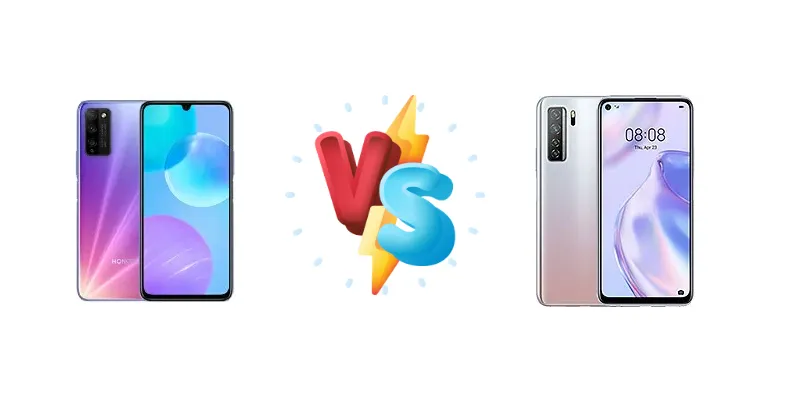
Both the Honor 30 Youth and Huawei nova 7 SE 5G Youth represent compelling options in the increasingly competitive mid-range 5G smartphone market. While sharing a similar price bracket and Mediatek Dimensity chipset family, key differences in CPU configuration and charging technology create distinct user experiences. This comparison dissects these nuances to determine which device offers the best value.
🏆 Quick Verdict
For the average user prioritizing faster charging and slightly improved CPU performance, the Huawei nova 7 SE 5G Youth is the better choice. Its 40W charging significantly reduces downtime, and the higher-clocked Cortex-A76 cores offer a modest but noticeable performance boost in demanding tasks. However, the Honor 30 Youth remains a strong contender for those on a tighter budget.
| Network |
|---|
| 2G bands | GSM 900 / 1800 / 1900 | GSM 850 / 900 / 1800 / 1900 |
| 3G bands | HSDPA 850 / 900 / 1700(AWS) / 1900 / 2100 | HSDPA 800 / 850 / 900 / 1700(AWS) / 1900 / 2100 |
| 4G bands | LTE | 1, 2, 3, 4, 5, 8, 18, 19, 26, 34, 38, 39, 40, 41 |
| 5G bands | 1, 38, 41, 77, 78, 79 SA/NSA | 1, 41, 77, 78 SA/NSA |
| Speed | HSPA, LTE, 5G | HSPA, LTE, 5G |
| Technology | GSM / HSPA / LTE / 5G | GSM / CDMA / HSPA / LTE / 5G |
| | - | CDMA 800 & TD-SCDMA |
| Launch |
|---|
| Announced | 2020, July 02. Released 2020, July 08 | 2020, October 16. Released 2020, October 16 |
| Status | Discontinued | Discontinued |
| Body |
|---|
| Dimensions | 160 x 75.3 x 8.4 mm (6.30 x 2.96 x 0.33 in) | 162.3 x 75 x 8.6 mm (6.39 x 2.95 x 0.34 in) |
| SIM | Nano-SIM + Nano-SIM | Nano-SIM + Nano-SIM |
| Weight | 192 g (6.77 oz) | 189 g (6.67 oz) |
| Display |
|---|
| Resolution | 1080 x 2400 pixels, 20:9 ratio (~405 ppi density) | 1080 x 2400 pixels, 20:9 ratio (~405 ppi density) |
| Size | 6.5 inches, 102.0 cm2 (~84.7% screen-to-body ratio) | 6.5 inches, 102.0 cm2 (~83.8% screen-to-body ratio) |
| Type | IPS LCD, 90Hz | IPS LCD, HDR10 |
| Platform |
|---|
| CPU | Octa-core (4x2.0 GHz Cortex-A76 & 4x2.0 GHz Cortex-A55) | Octa-core (2x2.4 GHz Cortex-A76 & 6x2.0 GHz Cortex-A55) |
| Chipset | Mediatek Dimensity 800 (7 nm) | Mediatek Dimensity 800U (7 nm) |
| GPU | Mali-G57MP4 | Mali-G57 MC3 |
| OS | Android 10, Magic UI 3.1, no Google Play Services | Android 10, EMUI 10.1, no Google Play Services |
| Memory |
|---|
| Card slot | Nano Memory (uses shared SIM slot) | No |
| Internal | 64GB 6GB RAM, 128GB 6GB RAM, 128GB 8GB RAM | 128GB 8GB RAM |
| Main Camera |
|---|
| Features | LED flash, HDR, panorama | LED flash, Panorama, HDR |
| Quad | - | 64 MP, f/1.8, 26mm (wide), PDAF
8 MP, f/2.4, 17mm (ultrawide)
2 MP (macro)
Auxiliary lens |
| Triple | 48 MP, f/1.8, 26mm (wide), 1/2.0", 0.8µm, PDAF
8 MP, f/2.4, 120˚ (ultrawide)
2 MP (macro) | - |
| Video | 4K@30fps, 1080p@30fps | 4K@30fps, 1080p@30fps |
| Selfie camera |
|---|
| Features | HDR | HDR |
| Single | 16 MP, f/2.0 | 16 MP, f/2.0, (wide) |
| Video | 1080p@30fps | 1080p@30fps |
| Sound |
|---|
| 3.5mm jack | Yes | Yes |
| 35mm jack | Yes | Yes |
| Loudspeaker | Yes | Yes |
| Comms |
|---|
| Bluetooth | 5.1, A2DP, LE | 5.1, A2DP, LE |
| NFC | No | No |
| Positioning | GPS, GLONASS, BDS | GPS, GLONASS, GALILEO, BDS, QZSS |
| Radio | No | No |
| USB | USB Type-C 2.0, OTG | USB Type-C 2.0, OTG |
| WLAN | Wi-Fi 802.11 a/b/g/n/ac, dual-band, Wi-Fi Direct | Wi-Fi 802.11 a/b/g/n/ac, dual-band, Wi-Fi Direct |
| Features |
|---|
| Sensors | Fingerprint (side-mounted), accelerometer, gyro, proximity, compass | Fingerprint (side-mounted), accelerometer, proximity, compass |
| Battery |
|---|
| Charging | 22.5W wired | 40W wired, 70% in 30 min
5W reverse wired |
| Type | Li-Po 4000 mAh | Li-Po 4000 mAh |
| Misc |
|---|
| Colors | Magic Night Black, Dark Blue, Galaxy Silver | Crush Green, Space Silver, Midnight Black, Purple |
| Models | MXW-AN00 | CND-AN00 |
| Price | About 220 EUR | About 290 EUR |
Honor 30 Youth
- Potentially lower price point
- Reliable Mediatek Dimensity 800 performance
- Clean software experience (depending on Honor's Magic UI version)
- Slower 22.5W charging
- Less powerful CPU compared to the 800U
- No reverse wireless charging
Huawei nova 7 SE 5G Youth
- Faster 40W charging with 70% in 30 minutes
- More powerful Mediatek Dimensity 800U CPU
- 5W reverse wired charging
- Potentially higher price
- Software experience may include more pre-installed apps
- Slightly higher potential for thermal throttling
Display Comparison
Neither device’s display specifications are provided, so a direct comparison is limited. However, given their market positioning, both likely feature LCD panels with FHD+ resolution. The absence of high refresh rate or advanced panel technologies like LTPO suggests a focus on cost optimization. Bezels are likely comparable, and color accuracy will depend on software calibration, a known strength of Huawei’s EMUI (though the nova 7 SE 5G Youth runs a different version).
Camera Comparison
Without detailed camera specifications, a comprehensive comparison is difficult. Both phones likely feature a multi-camera setup with a primary sensor, ultrawide, and potentially a macro or depth sensor. The image processing algorithms will differ between Honor and Huawei, influencing color science and dynamic range. The absence of Optical Image Stabilization (OIS) is probable in this price segment. The quality of the primary sensor and lens aperture will be the most significant factors determining image quality, but this information is unavailable.
Performance
The core difference lies in the chipset: the Honor 30 Youth utilizes the Mediatek Dimensity 800, while the nova 7 SE 5G Youth features the Dimensity 800U. While both are 7nm chips, the 800U boasts a more refined CPU configuration with 2x2.4 GHz Cortex-A76 cores versus the 4x2.0 GHz Cortex-A76 cores in the 800. This translates to a potential 20% performance increase in single-core tasks. The 6x2.0 GHz Cortex-A55 efficiency cores on the 800U are identical to the 800. Both devices likely pair the chipset with 6GB or 8GB of RAM, but the RAM speed (LPDDR4x vs LPDDR5) is unknown. Thermal management will be crucial; the 800U’s slightly higher clock speeds could generate more heat under sustained load.
Battery Life
Battery capacity is not specified for either device. However, the Huawei nova 7 SE 5G Youth’s 40W wired charging is a significant advantage over the Honor 30 Youth’s 22.5W charging. Huawei claims a 70% charge in 30 minutes, drastically reducing downtime. The nova 7 SE 5G Youth also includes 5W reverse wired charging, allowing it to top up other devices – a feature absent on the Honor 30 Youth. Even with a slightly smaller battery, the faster charging speed of the nova 7 SE 5G Youth will likely result in a more convenient user experience.
Buying Guide
Buy the Honor 30 Youth if you prioritize maximizing value and are comfortable with slower charging speeds. It’s ideal for users who primarily browse, use social media, and engage in light gaming. Buy the Huawei nova 7 SE 5G Youth if you need quicker top-ups and appreciate a slight edge in CPU performance for multitasking or more intensive applications. This phone caters to users who demand more from their device throughout the day.
Frequently Asked Questions
❓ Will the Dimensity 800U in the nova 7 SE 5G Youth handle demanding games like PUBG Mobile at high settings?
The Dimensity 800U is capable of running PUBG Mobile at high settings, but sustained performance may be limited by thermal throttling. Expect playable frame rates, but not necessarily consistently high FPS over extended gaming sessions. The Honor 30 Youth will perform similarly, but with slightly lower peak performance.
❓ How much faster is the 40W charging on the Huawei nova 7 SE 5G Youth compared to the 22.5W charging on the Honor 30 Youth in real-world use?
The 40W charging on the nova 7 SE 5G Youth can realistically shave off 30-45 minutes of charging time for a full charge compared to the Honor 30 Youth. Huawei's claim of 70% in 30 minutes is achievable, meaning a significant top-up can be achieved during a short break.
❓ Does either phone support expandable storage via microSD card?
This information is not provided in the specifications. However, given the market segment, it's likely that at least one of the phones offers microSD card support, but it's not guaranteed. Check the official product pages for confirmation.