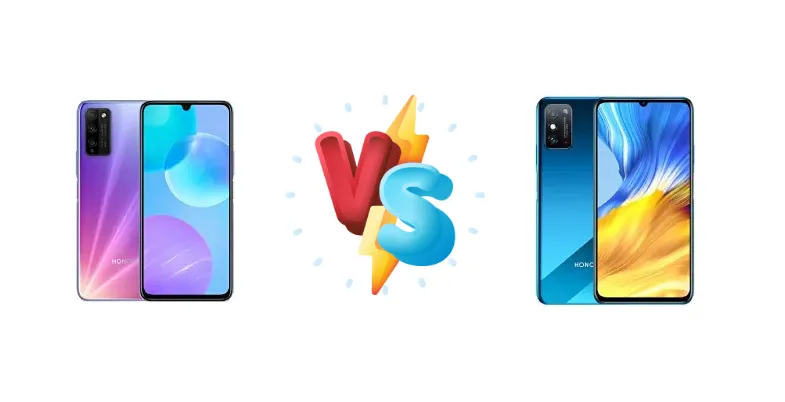
Honor's mid-range offerings, the 30 Youth and X10 Max 5G, both leverage the MediaTek Dimensity 800 chipset, creating a fascinating head-to-head. While sharing core processing power, these devices target slightly different users, with the X10 Max 5G emphasizing a larger display and potentially broader appeal, while the 30 Youth aims for a more streamlined experience. This comparison dives deep to reveal which phone delivers the best value.
🏆 Quick Verdict
For the average user prioritizing a larger screen and potentially better multimedia consumption, the Honor X10 Max 5G is the stronger choice. However, the Honor 30 Youth remains a compelling option for those seeking a more compact form factor and a potentially more focused software experience, all while offering identical core performance.
| Network |
|---|
| 2G bands | GSM 900 / 1800 / 1900 | GSM 850 / 900 / 1800 / 1900 |
| 3G bands | HSDPA 850 / 900 / 1700(AWS) / 1900 / 2100 | HSDPA 800 / 850 / 900 / 1700(AWS) / 1900 / 2100 |
| 4G bands | LTE | 1, 2, 3, 4, 5, 8, 18, 19, 26, 34, 38, 39, 40, 41 |
| 5G bands | 1, 38, 41, 77, 78, 79 SA/NSA | 1, 3, 38, 41, 77, 78, 79, 80, 84 SA/NSA |
| Speed | HSPA, LTE, 5G | HSPA, LTE, 5G |
| Technology | GSM / HSPA / LTE / 5G | GSM / HSPA / LTE / 5G |
| Launch |
|---|
| Announced | 2020, July 02. Released 2020, July 08 | 2020, July 02. Released 2020, July 03 |
| Status | Discontinued | Discontinued |
| Body |
|---|
| Dimensions | 160 x 75.3 x 8.4 mm (6.30 x 2.96 x 0.33 in) | 174.4 x 84.9 x 8.3 mm (6.87 x 3.34 x 0.33 in) |
| SIM | Nano-SIM + Nano-SIM | Nano-SIM + Nano-SIM |
| Weight | 192 g (6.77 oz) | 232 g (8.18 oz) |
| Display |
|---|
| Resolution | 1080 x 2400 pixels, 20:9 ratio (~405 ppi density) | 1080 x 2280 pixels, 19:9 ratio (~356 ppi density) |
| Size | 6.5 inches, 102.0 cm2 (~84.7% screen-to-body ratio) | 7.09 inches, 125.5 cm2 (~84.7% screen-to-body ratio) |
| Type | IPS LCD, 90Hz | IPS LCD, HDR10 |
| Platform |
|---|
| CPU | Octa-core (4x2.0 GHz Cortex-A76 & 4x2.0 GHz Cortex-A55) | Octa-core (4x2.0 GHz Cortex-A76 & 4x2.0 GHz Cortex-A55) |
| Chipset | Mediatek Dimensity 800 (7 nm) | Mediatek Dimensity 800 (7 nm) |
| GPU | Mali-G57MP4 | Mali-G57MP4 |
| OS | Android 10, Magic UI 3.1, no Google Play Services | Android 10, Magic UI 3.1, no Google Play Services |
| Memory |
|---|
| Card slot | Nano Memory (uses shared SIM slot) | Nano Memory (uses shared SIM slot) |
| Internal | 64GB 6GB RAM, 128GB 6GB RAM, 128GB 8GB RAM | 64GB 6GB RAM, 128GB 6GB RAM, 128GB 8GB RAM |
| Main Camera |
|---|
| Dual | - | 48 MP, f/1.8, 26mm (wide), 1/2.0", 0.8µm, PDAF
Auxiliary lens |
| Features | LED flash, HDR, panorama | LED flash, panorama, HDR |
| Triple | 48 MP, f/1.8, 26mm (wide), 1/2.0", 0.8µm, PDAF
8 MP, f/2.4, 120˚ (ultrawide)
2 MP (macro) | - |
| Video | 4K@30fps, 1080p@30fps | 4K@30fps, 1080p@30fps, gyro-EIS |
| Selfie camera |
|---|
| Features | HDR | HDR |
| Single | 16 MP, f/2.0 | 8 MP |
| Video | 1080p@30fps | 1080p@30fps |
| Sound |
|---|
| 3.5mm jack | Yes | Yes |
| 35mm jack | Yes | Yes |
| Loudspeaker | Yes | Yes, with dual speakers |
| Comms |
|---|
| Bluetooth | 5.1, A2DP, LE | 5.1, A2DP, LE |
| NFC | No | Yes |
| Positioning | GPS, GLONASS, BDS | GPS, GLONASS, BDS |
| Radio | No | No |
| USB | USB Type-C 2.0, OTG | USB Type-C 2.0, OTG |
| WLAN | Wi-Fi 802.11 a/b/g/n/ac, dual-band, Wi-Fi Direct | Wi-Fi 802.11 a/b/g/n/ac, dual-band, Wi-Fi Direct |
| Features |
|---|
| Sensors | Fingerprint (side-mounted), accelerometer, gyro, proximity, compass | Fingerprint (side-mounted), accelerometer, gyro, proximity, compass |
| Battery |
|---|
| Charging | 22.5W wired | 22.5W wired |
| Type | Li-Po 4000 mAh | Li-Po 5000 mAh |
| Misc |
|---|
| Colors | Magic Night Black, Dark Blue, Galaxy Silver | Black, Blue, Silver |
| Models | MXW-AN00 | KKG-AN00 |
| Price | About 220 EUR | About 240 EUR |
Honor 30 Youth
- Potentially more compact and easier to handle.
- Likely a more focused software experience.
- Identical processing power to the X10 Max 5G.
- Likely a smaller display, less ideal for media consumption.
- Potentially less versatile camera system.
- Unknown battery capacity may limit endurance.
Honor X10 Max 5G
- Larger display for immersive viewing and gaming.
- Potentially larger battery for extended usage.
- Likely a more feature-rich camera system.
- Larger size may be less comfortable for one-handed use.
- Potentially more bloatware or pre-installed apps.
- Larger display may impact battery life.
Display Comparison
Both the Honor 30 Youth and X10 Max 5G lack detailed display specifications in the provided data. However, given the X10 Max 5G's name, it's reasonable to assume a significantly larger display, likely exceeding 6.6 inches, geared towards media consumption. The 30 Youth likely features a more standard 6.3-6.5 inch panel. Without knowing panel type (IPS vs AMOLED) or refresh rate, it's difficult to assess color accuracy or smoothness. The larger screen of the X10 Max 5G will benefit video watchers and gamers, while the 30 Youth's potentially smaller size will appeal to those who prefer portability.
Camera Comparison
Camera details are absent beyond the fact that both phones have cameras. Given the market positioning, the X10 Max 5G likely features a more versatile camera system, potentially including a higher-resolution main sensor and additional lenses. The 30 Youth may prioritize a simpler, more streamlined camera experience. Without knowing sensor sizes, apertures, or image processing algorithms, it's impossible to definitively declare a winner. The presence or absence of Optical Image Stabilization (OIS) on the X10 Max 5G would be a significant advantage for low-light photography.
Performance
Both devices are powered by the MediaTek Dimensity 800 (7nm), featuring an octa-core CPU configuration with 4x2.0 GHz Cortex-A76 and 4x2.0 GHz Cortex-A55 cores. This means CPU performance will be virtually identical in day-to-day tasks and most gaming scenarios. The GPU performance will also be the same. The key difference will likely lie in thermal management. A larger chassis, like that of the X10 Max 5G, *could* allow for better heat dissipation, potentially preventing throttling during extended gaming sessions, but this is speculative without testing. RAM configurations are unknown, but faster LPDDR4X or LPDDR5 RAM would further enhance performance.
Battery Life
Both phones utilize 22.5W wired charging, suggesting similar charging speeds – approximately 60-90 minutes for a full charge. Battery capacity is unknown, but the larger form factor of the X10 Max 5G suggests a potentially larger battery, offering longer screen-on time. However, the larger display also consumes more power. The actual battery life will depend on usage patterns and display settings. The 22.5W charging speed is relatively standard for this price range and won't be a standout feature for either device.
Buying Guide
Buy the Honor 30 Youth if you need a more manageable phone size for one-handed use and prefer a potentially cleaner software experience. Buy the Honor X10 Max 5G if you prioritize a large display for immersive video playback, gaming, and multitasking, and don't mind a larger device footprint. Both offer 5G connectivity and similar processing capabilities, making the screen size the key differentiator.
Frequently Asked Questions
❓ Will the Dimensity 800 in either phone struggle with demanding games like Genshin Impact?
The Dimensity 800 is capable of running Genshin Impact, but you'll likely need to lower graphics settings to achieve a consistently smooth frame rate. Both phones share the same chipset, so gaming performance will be very similar. Thermal throttling could become a factor during extended gaming sessions, potentially favoring the X10 Max 5G due to its larger size.
❓ Does either phone support expandable storage via microSD card?
This information is not provided. However, many Honor devices in this price range *do* include a microSD card slot. Checking official specifications or user reviews is crucial to confirm storage expandability before purchasing.
❓ What version of Android do these phones run, and will they receive software updates?
The Android version is not specified. Honor's software update track record has been inconsistent. It's important to research the current software support situation for these specific models before making a purchase, as long-term software updates are not guaranteed.