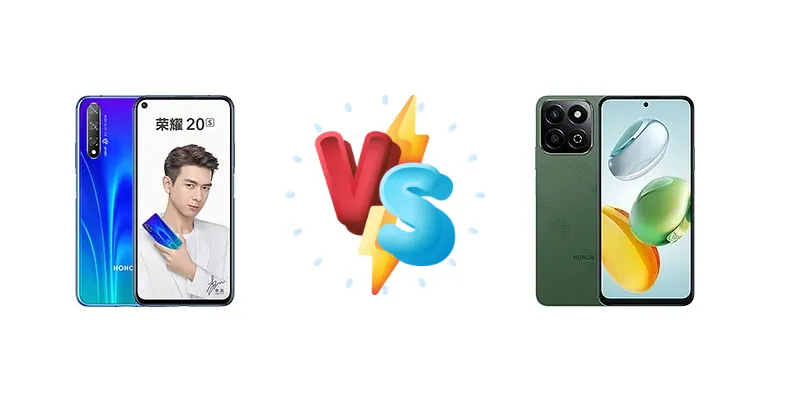
The Honor 20S, released in 2019, represented a strong mid-range offering. Now, the Honor 200 Smart enters the scene, aiming to disrupt the budget segment with a newer chipset and faster charging. This comparison dissects the key differences between these two devices, helping you determine which best suits your needs and budget.
🏆 Quick Verdict
For most users, the Honor 200 Smart emerges as the better choice. Its Snapdragon 4 Gen 2 (4nm) offers improved efficiency and potentially better sustained performance compared to the Kirin 810 (7nm) in the 20S, coupled with significantly faster 35W charging. While the 20S remains a capable device, the 200 Smart provides a more modern experience.
| Network |
|---|
| 2G bands | GSM 850 / 900 / 1800 / 1900 | GSM 850 / 900 / 1800 / 1900 |
| 3G bands | HSDPA 800 / 850 / 900 / 1700(AWS) / 2100 | HSDPA 850 / 900 / 1700(AWS) / 1900 / 2100 |
| 4G bands | 1, 3, 4, 5, 8, 19, 34, 38, 39, 40, 41 | LTE |
| 5G bands | - | SA/NSA |
| Speed | HSPA, LTE | HSPA, LTE, 5G |
| Technology | GSM / CDMA / HSPA / LTE | GSM / HSPA / LTE / 5G |
| | CDMA 800 & TD-SCDMA | - |
| Launch |
|---|
| Announced | 2019, September. Released 2019, October | 2024, September 17 |
| Status | Discontinued | Available. Released 2024, September 23 |
| Body |
|---|
| Build | Glass front, glass back, aluminum frame | - |
| Dimensions | 154.3 x 74 x 7.9 mm (6.07 x 2.91 x 0.31 in) | 166.9 x 76.8 x 8.1 mm (6.57 x 3.02 x 0.32 in) |
| SIM | Nano-SIM + Nano-SIM | Nano-SIM + Nano-SIM |
| Weight | 172 g (6.07 oz) | 191 g or 193 g (6.74 oz) |
| Display |
|---|
| Protection | - | Aluminosilicate glass |
| Resolution | 1080 x 2340 pixels, 19.5:9 ratio (~412 ppi density) | 1080 x 2412 pixels, 20:9 ratio (~389 ppi density) |
| Size | 6.26 inches, 96.2 cm2 (~84.2% screen-to-body ratio) | 6.8 inches, 111.3 cm2 (~86.8% screen-to-body ratio) |
| Type | IPS LCD | TFT LCD, 120Hz, 850 nits (peak) |
| Platform |
|---|
| CPU | Octa-core (2x2.27 GHz Cortex-A76 & 6x1.88 GHz Cortex-A55) | Octa-core (2x2.2 GHz Cortex-A78 & 6x1.95 GHz Cortex-A55) |
| Chipset | Kirin 810 (7 nm) | Qualcomm SM4450 Snapdragon 4 Gen 2 (4 nm) |
| GPU | Mali-G52 MP6 | Adreno 613 |
| OS | Android 9.0 (Pie), Magic 2.1 | Android 14, Magic OS 8 |
| Memory |
|---|
| Card slot | No | No |
| Internal | 128GB 6GB RAM, 128GB 8GB RAM | 256GB 4GB RAM, 256GB 8GB RAM |
| Main Camera |
|---|
| Dual | - | 50 MP, f/1.8, (wide), PDAF
Auxiliary lens |
| Features | LED flash, HDR, panorama | LED flash, HDR |
| Triple | 48 MP, f/1.8, 28mm (wide), 1/2.0", 0.8µm, PDAF
8 MP, f/2.4, 13mm (ultrawide)
2 MP (macro) | - |
| Video | 1080p@30fps | 1080p@30fps |
| Selfie camera |
|---|
| Features | HDR | - |
| Single | 32 MP, f/2.0, 26mm (wide), 1/2.8", 0.8µm | 5 MP, f/2.2, (wide) |
| Video | 1080p@30fps | 1080p@30fps |
| Sound |
|---|
| 3.5mm jack | No | - |
| 35mm jack | No | Yes |
| Loudspeaker | Yes | Yes, with stereo speakers |
| |
32-bit/192kHz audio | - |
| Comms |
|---|
| Bluetooth | 5.0, A2DP, aptX HD, LE | 5.0, A2DP, LE |
| NFC | No | No |
| Positioning | GPS, GLONASS, BDS, GALILEO, QZSS | GPS, GLONASS, GALILEO, BDS |
| Radio | No | No |
| USB | USB Type-C 2.0, OTG | USB Type-C 2.0, OTG |
| WLAN | Wi-Fi 802.11 a/b/g/n/ac, dual-band, Wi-Fi Direct | Wi-Fi 802.11 a/b/g/n/ac, dual-band, Wi-Fi Direct |
| Features |
|---|
| Sensors | Fingerprint (side-mounted), accelerometer, gyro, proximity, compass | Fingerprint (side-mounted), accelerometer, proximity, compass |
| Battery |
|---|
| Charging | 20W wired | 35W wired |
| Type | Li-Po 3750 mAh, non-removable | Li-Po 5200 mAh |
| Misc |
|---|
| Colors | Black, Blue, White | Midnight Black, Forest Green |
| Models | YAL-AL50 | ALT-NX1 |
| Price | About 250 EUR | € 109.99 / £ 114.99 |
Honor 20S
- Proven reliability and software stability.
- Potentially lower price point due to age.
- Capable performance for everyday tasks.
- Older chipset with less efficient manufacturing process.
- Slower 20W charging.
- Likely outdated software support.
Honor 200 Smart
- More efficient Snapdragon 4 Gen 2 (4nm) chipset.
- Significantly faster 35W charging.
- Likely better long-term software support.
- May be slightly more expensive than the aging 20S.
- Snapdragon 4 Gen 2 is still an entry-level chipset.
- Potential for software bloat (typical of Honor).
Display Comparison
Neither device is known for a standout display. Both likely feature LCD panels, typical for their price brackets. However, detailed display specs (resolution, brightness, color gamut) are unavailable. The 200 Smart’s newer manufacturing process *could* translate to slightly improved panel quality, but this is speculative. Bezels are likely comparable, reflecting the design trends of their respective release years.
Camera Comparison
Without detailed camera specs, a direct comparison is difficult. However, the market positioning suggests the 200 Smart likely benefits from more advanced image processing algorithms. The 20S’s camera performance was respectable for its time, but the 200 Smart’s ISP (Image Signal Processor) within the Snapdragon 4 Gen 2 should deliver improved dynamic range and low-light performance. We can assume both devices include standard features like HDR and portrait modes, but the 200 Smart is likely to offer a more refined experience.
Performance
The core difference lies in the chipsets. The Honor 200 Smart’s Qualcomm Snapdragon 4 Gen 2 (4nm) is built on a more efficient node than the Honor 20S’s Kirin 810 (7nm). This 4nm process allows for better thermal management and potentially higher sustained performance under load. While the Kirin 810’s Cortex-A76 cores have a slightly higher clock speed (2.27 GHz vs 2.2 GHz on the 200 Smart’s Cortex-A78), the architectural improvements in the A78 and the process node advantage favor the Snapdragon. The 200 Smart’s CPU should offer a noticeable improvement in multi-core tasks. Both devices utilize a 6x Cortex-A55 configuration, so efficiency in background tasks should be similar.
Battery Life
The Honor 20S supports 20W wired charging, while the Honor 200 Smart boasts 35W wired charging. This is a significant advantage for the 200 Smart, translating to considerably faster charging times. While battery capacity isn’t specified, the faster charging speed mitigates any potential disadvantage if the 200 Smart has a slightly smaller battery. A full charge on the 200 Smart is likely to take under an hour, while the 20S will require considerably longer.
Buying Guide
Buy the Honor 20S if you prioritize a proven track record and can find it at a significantly discounted price. It's a solid option for everyday tasks and light gaming. Buy the Honor 200 Smart if you value faster charging, potentially better long-term performance due to the newer 4nm process, and a more up-to-date software experience. It’s ideal for users who want a reliable daily driver with a bit more future-proofing.
Frequently Asked Questions
❓ Will the Snapdragon 4 Gen 2 in the Honor 200 Smart handle demanding games like PUBG Mobile?
The Snapdragon 4 Gen 2 is an entry-level chipset, so don't expect flagship-level gaming performance. However, it should be capable of running PUBG Mobile at medium settings with reasonable frame rates. Sustained performance may be limited due to thermal constraints, but it's a step up from the Kirin 810 in terms of efficiency.
❓ How much faster is the 35W charging on the Honor 200 Smart compared to the 20S's 20W charging?
The 35W charging on the 200 Smart will significantly reduce charging times. While exact figures depend on battery capacity, you can expect a full charge in under an hour, compared to potentially over 90 minutes or even two hours with the 20S's 20W charger. This is a major convenience factor.
❓ Is the Kirin 810 still a viable chipset in 2024?
The Kirin 810 remains a capable chipset for basic tasks like browsing, social media, and calling. However, its age and less efficient 7nm process mean it will struggle with demanding applications and may exhibit throttling under sustained load. The Snapdragon 4 Gen 2 offers a more modern and efficient experience.