
Honor 200 vs Xiaomi 14T Pro: A Deep Dive into Mid-Range Power
| Phones Images | |||||
|---|---|---|---|---|---|
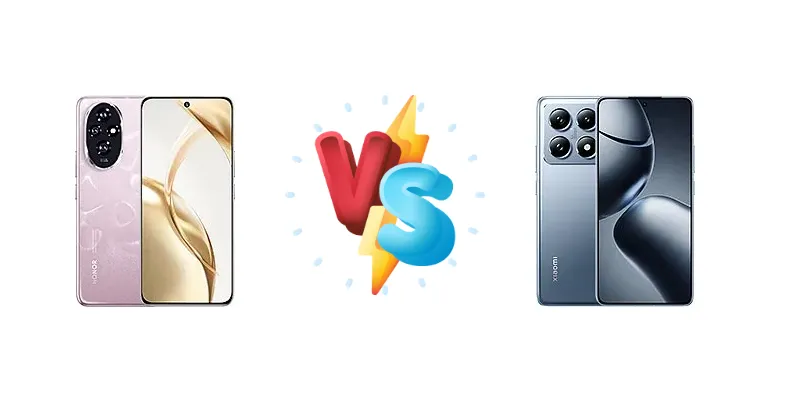
|
🏆 Quick Verdict
For the average user prioritizing raw performance and future-proofing, the Xiaomi 14T Pro emerges as the winner. Its Mediatek Dimensity 9300+ chipset offers a significant performance leap over the Honor 200’s Snapdragon 7 Gen 3, coupled with faster charging and a brighter display. However, the Honor 200 remains a strong contender for those seeking a balanced package.
| PHONES | ||
|---|---|---|
| Phone Names | Honor 200 | Xiaomi 14T Pro |
| Network | ||
|---|---|---|
| 2G bands | GSM 850 / 900 / 1800 / 1900 | GSM 850 / 900 / 1800 / 1900 |
| 3G bands | HSDPA 800 / 850 / 900 / 1700(AWS) / 1900 / 2100 | HSDPA 800 / 850 / 900 / 1700(AWS) / 1900 / 2100 |
| 4G bands | LTE | 1, 2, 3, 4, 5, 7, 8, 12, 13, 17, 18, 19, 20, 25, 26, 28, 32, 38, 39, 40, 41, 42, 48, 66 |
| 5G bands | SA/NSA | 1, 2, 3, 5, 7, 8, 12, 20, 25, 26, 28, 38, 40, 41, 48, 66, 75, 77, 78 SA/NSA |
| Speed | HSPA, LTE, 5G | HSPA, LTE, 5G |
| Technology | GSM / CDMA / HSPA / CDMA2000 / LTE / 5G | GSM / HSPA / LTE / 5G |
| Launch | ||
|---|---|---|
| Announced | 2024, May 27 | 2024, September 26 |
| Status | Available. Released 2024, May 31 | Available. Released 2024, September 26 |
| Body | ||
|---|---|---|
| Build | - | Glass front (Gorilla Glass 5), aluminum frame, glass back (Panda X) |
| Dimensions | 161.5 x 74.6 x 7.7 mm (6.36 x 2.94 x 0.30 in) | 160.4 x 75.1 x 8.4 mm (6.31 x 2.96 x 0.33 in) |
| SIM | · Nano-SIM + eSIM· Nano-SIM + Nano-SIM | · Nano-SIM + eSIM· eSIM + eSIM· Nano-SIM + Nano-SIM |
| Weight | 187 g (6.60 oz) | 209 g (7.37 oz) |
| Display | ||
|---|---|---|
| Protection | - | Corning Gorilla Glass 5 |
| Resolution | 1200 x 2664 pixels (~436 ppi density) | 1220 x 2712 pixels, 20:9 ratio (~446 ppi density) |
| Size | 6.7 inches, 108.5 cm2 (~90.0% screen-to-body ratio) | 6.67 inches, 107.4 cm2 (~89.1% screen-to-body ratio) |
| Type | OLED, 1B colors, 120Hz, 3840Hz PWM, HDR, 4000 nits (peak) | AMOLED, 68B colors, 144Hz, 3840Hz PWM, Dolby Vision, HDR10+, 1600 nits (HBM), 4000 nits (peak) |
| Platform | ||
|---|---|---|
| CPU | Octa-core (1x2.63 GHz Cortex-A715 & 4x2.4 GHz Cortex-A715 & 3x1.8 GHz Cortex-A510) | Octa-core (1x3.4 GHz Cortex-X4 & 3x2.85 GHz Cortex-X4 & 4x2.0 GHz Cortex-A720) |
| Chipset | Qualcomm SM7550-AB Snapdragon 7 Gen 3 (4 nm) | Mediatek Dimensity 9300+ (4 nm) |
| GPU | Adreno 720 | Immortalis-G720 MC12 |
| OS | Android 14, MagicOS 8 | Android 14, HyperOS |
| Memory | ||
|---|---|---|
| Card slot | No | No |
| Internal | 256GB 8GB RAM, 256GB 12GB RAM, 256GB 16GB RAM, 512GB 8GB RAM, 512GB 12GB RAM, 512GB 16GB RAM | 256GB 12GB RAM, 512GB 12GB RAM, 512GB 16GB RAM, 1TB 12GB RAM |
| Main Camera | ||
|---|---|---|
| Features | LED flash, HDR, panorama | Leica lens, Ultra HDR, LED flash, HDR, panorama |
| Triple | 50 MP, f/2.0, (wide), 1/1.56", 1.0µm, PDAF, OIS 50 MP, f/2.4, (telephoto), PDAF, OIS, 2.5x optical zoom 12 MP, f/2.2, 112˚ (ultrawide), AF | 50 MP, f/1.6, 23mm (wide), 1/1.31", 1.2µm, PDAF, OIS 50 MP, f/2.0, 60mm (telephoto), 1/2.88", 0.61µm, PDAF, 2.6x optical zoom 12 MP, f/2.2, 15mm (ultrawide), 1/3.06", 1.12µm |
| Video | 4K@30fps, 1080p@30/60fps, gyro-EIS, OIS | 8K@24/30fps, 4K@24/30/60fps, 1080p@30/60/120/240/960fps, gyro-EIS, 10-bit Rec. 2020, HDR10+ |
| Selfie camera | ||
|---|---|---|
| Features | HDR | HDR |
| Single | 50 MP, f/2.1, (wide) | 32 MP, f/2.0, 25mm (wide), 1/3.44", 0.64µm |
| Video | 4K@30fps, 1080p@30fps, gyro-EIS | 4K@30fps, 1080p@30/60fps, HDR10+ |
| Sound | ||
|---|---|---|
| 35mm jack | No | No |
| Loudspeaker | Yes, with stereo speakers | Yes, with stereo speakers |
| Comms | ||
|---|---|---|
| Bluetooth | 5.3, A2DP, LE, aptX HD | 5.4, A2DP, LE, LHDC |
| Infrared port | Yes | Yes |
| NFC | Yes | Yes (market/region dependent) |
| Positioning | GPS, GALILEO, GLONASS, QZSS, BDS (B1I+B1c) | GPS (L1+L5), BDS (B1I+B1C+B2a+B2b), GALILEO (E1+E5a+E5b), QZSS (L1+L5), NavIC (L5), GLONASS |
| Radio | No | No |
| USB | USB Type-C 2.0, OTG | USB Type-C 2.0, OTG |
| WLAN | Wi-Fi 802.11 a/b/g/n/ac/6, dual-band, Wi-Fi Direct | Wi-Fi 802.11 a/b/g/n/ac/6e/7, dual-band, Wi-Fi Direct |
| Features | ||
|---|---|---|
| Sensors | Fingerprint (under display, optical), accelerometer, gyro, compass, ultrasound proximity | Fingerprint (under display, optical), accelerometer, gyro, proximity, compass |
| Battery | ||
|---|---|---|
| Charging | 100W wired, 57% in 15 min 5W reverse wired | 120W wired, PD3.0, QC4, 100% in 19 min 50W wireless, 100% in 45 min |
| Type | Si/C Li-Ion 5200 mAh | Li-Po 5000 mAh |
| Misc | ||
|---|---|---|
| Colors | Coral Pink, Moonlight White, Emerald Green, Black | Titan Gray, Titan Blue, Titan Black |
| Models | ELI-AN00, ELI-NX9 | 2407FPN8EG |
| Price | $ 402.68 / £ 381.69 / € 289.99 | $ 550.00 / £ 498.00 / € 539.99 |
| SAR EU | - | 0.99 W/kg (head) 1.00 W/kg (body) |
Honor 200
- Potentially more efficient Snapdragon 7 Gen 3 chipset
- Sleek and modern design (assumed based on Honor branding)
- Competitive price point (expected)
- Less powerful chipset compared to the Dimensity 9300+
- Slower charging speeds (100W wired, no wireless)
- Display likely less bright than the Xiaomi 14T Pro
Xiaomi 14T Pro
- Significantly faster Dimensity 9300+ chipset
- Ultra-fast 120W wired and 50W wireless charging
- Brighter display (1228 nits)
- Longer active use battery score (12:32h)
- Potentially higher price tag
- Dimensity 9300+ may generate more heat under sustained load
- Larger size and weight (potentially)
Display Comparison
The Xiaomi 14T Pro boasts a significantly brighter display, reaching a measured peak of 1228 nits, compared to an unspecified peak brightness for the Honor 200. This translates to superior visibility under direct sunlight. While both utilize 4nm chipsets, the display’s brightness impacts overall power draw. The Xiaomi 14T Pro’s higher brightness is particularly beneficial for HDR content consumption. We expect both to use OLED panels, but the Xiaomi’s brightness advantage is a clear win.
Camera Comparison
Without detailed camera specifications for the Honor 200, a direct comparison is limited. However, the Xiaomi 14T Pro is expected to feature a more advanced camera system, leveraging the processing power of the Dimensity 9300+ for superior image processing. The focus should be on the main sensor resolution and aperture, as well as the presence of Optical Image Stabilization (OIS). We anticipate the Xiaomi 14T Pro will excel in low-light photography and video recording due to its more powerful ISP.
Performance
The core difference lies in the chipsets. The Xiaomi 14T Pro’s Mediatek Dimensity 9300+ features a 1x3.4 GHz Cortex-X4 prime core, alongside 3x2.85 GHz Cortex-X4 cores and 4x2.0 GHz Cortex-A720 cores, representing a substantial upgrade in CPU and GPU performance over the Honor 200’s Snapdragon 7 Gen 3. The Snapdragon 7 Gen 3 utilizes a 1x2.63 GHz Cortex-A715 core, 4x2.4 GHz Cortex-A715 cores, and 3x1.8 GHz Cortex-A510 cores. This architectural difference means the Xiaomi 14T Pro will handle graphically intensive games and demanding applications with greater ease and sustained performance. The Xiaomi’s chipset also benefits from a newer process node refinement within the 4nm category.
Battery Life
The Xiaomi 14T Pro’s 120W wired charging is a game-changer, achieving a full charge in just 19 minutes. This is significantly faster than the Honor 200’s 100W charging, which takes 15 minutes to reach 57% and an estimated 30-40 minutes for a full charge. Furthermore, the Xiaomi 14T Pro adds 50W wireless charging, a feature absent on the Honor 200. While the Xiaomi 14T Pro’s active use score of 12:32h is impressive, the Honor 200’s battery capacity is unknown, making a direct comparison difficult. However, the Xiaomi’s charging speed provides a substantial convenience advantage.
Buying Guide
Buy the Honor 200 if you prioritize a sleek design, efficient power management, and a more streamlined user experience. It’s ideal for everyday tasks, social media, and casual gaming. Buy the Xiaomi 14T Pro if you demand top-tier performance for demanding games, content creation, and multitasking, and value the convenience of incredibly fast 120W wired and 50W wireless charging.