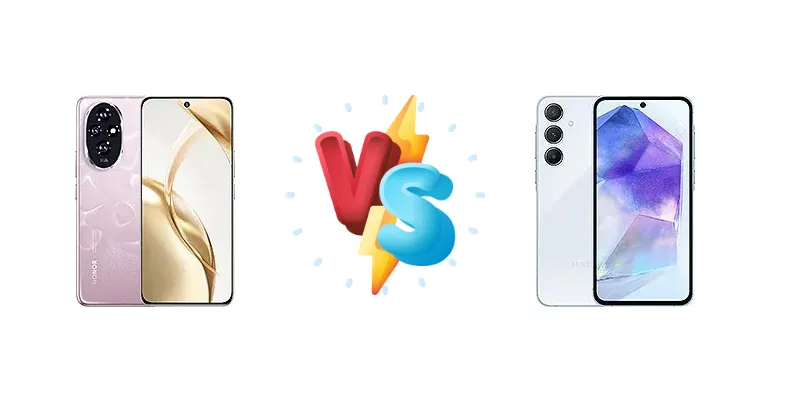
The Honor 200 and Samsung Galaxy A55 represent compelling options in the increasingly competitive mid-range smartphone market. The Honor 200 arrives with a focus on rapid charging and a newer Snapdragon chipset, while the Galaxy A55 prioritizes battery endurance and Samsung’s established software ecosystem. This comparison dissects their key differences to determine which device delivers the best overall experience.
🏆 Quick Verdict
For users prioritizing raw speed and charging convenience, the Honor 200 emerges as the winner. Its Snapdragon 7 Gen 3 chipset and 100W charging significantly outperform the Galaxy A55’s Exynos 1480 and 25W charging. However, the Galaxy A55’s superior battery life and brighter display make it a strong contender for those valuing longevity and outdoor visibility.
| Network |
|---|
| 2G bands | GSM 850 / 900 / 1800 / 1900 | GSM 850 / 900 / 1800 / 1900 |
| 3G bands | HSDPA 800 / 850 / 900 / 1700(AWS) / 1900 / 2100 | HSDPA 850 / 900 / 1700(AWS) / 1900 / 2100 |
| 4G bands | LTE | 1, 2, 3, 4, 5, 7, 8, 12, 17, 20, 25, 26, 28, 32, 38, 40, 41, 66 |
| 5G bands | SA/NSA | 1, 3, 5, 7, 8, 20, 28, 38, 40, 41, 66, 77, 78 SA/NSA/Sub6 |
| Speed | HSPA, LTE, 5G | HSPA, LTE, 5G |
| Technology | GSM / CDMA / HSPA / CDMA2000 / LTE / 5G | GSM / HSPA / LTE / 5G |
| Launch |
|---|
| Announced | 2024, May 27 | 2024, March 11 |
| Status | Available. Released 2024, May 31 | Available. Released 2024, March 15 |
| Body |
|---|
| Build | - | Glass front (Gorilla Glass Victus+), glass back (Gorilla Glass), aluminum frame |
| Dimensions | 161.5 x 74.6 x 7.7 mm (6.36 x 2.94 x 0.30 in) | 161.1 x 77.4 x 8.2 mm (6.34 x 3.05 x 0.32 in) |
| SIM | · Nano-SIM + eSIM· Nano-SIM + Nano-SIM | · Nano-SIM· Nano-SIM + eSIM· Nano-SIM + Nano-SIM· Nano-SIM + Nano-SIM + eSIM (max 2 at a time) |
| Weight | 187 g (6.60 oz) | 213 g (7.51 oz) |
| Display |
|---|
| Protection | - | Corning Gorilla Glass Victus+ |
| Resolution | 1200 x 2664 pixels (~436 ppi density) | 1080 x 2340 pixels, 19.5:9 ratio (~390 ppi density) |
| Size | 6.7 inches, 108.5 cm2 (~90.0% screen-to-body ratio) | 6.6 inches, 106.9 cm2 (~85.8% screen-to-body ratio) |
| Type | OLED, 1B colors, 120Hz, 3840Hz PWM, HDR, 4000 nits (peak) | Super AMOLED, 120Hz, HDR10+, 1000 nits (HBM) |
| Platform |
|---|
| CPU | Octa-core (1x2.63 GHz Cortex-A715 & 4x2.4 GHz Cortex-A715 & 3x1.8 GHz Cortex-A510) | Octa-core (4x2.75 GHz Cortex-A78 & 4x2.0 GHz Cortex-A55) |
| Chipset | Qualcomm SM7550-AB Snapdragon 7 Gen 3 (4 nm) | Exynos 1480 (4 nm) |
| GPU | Adreno 720 | Xclipse 530 |
| OS | Android 14, MagicOS 8 | Android 14, up to 4 major Android upgrades, One UI 6.1 |
| Memory |
|---|
| Card slot | No | microSDXC (uses shared SIM slot) |
| Internal | 256GB 8GB RAM, 256GB 12GB RAM, 256GB 16GB RAM, 512GB 8GB RAM, 512GB 12GB RAM, 512GB 16GB RAM | 128GB 6GB RAM, 128GB 8GB RAM, 256GB 6GB RAM, 256GB 8GB RAM, 256GB 12GB RAM |
| Main Camera |
|---|
| Features | LED flash, HDR, panorama | LED flash, panorama, HDR |
| Triple | 50 MP, f/2.0, (wide), 1/1.56", 1.0µm, PDAF, OIS
50 MP, f/2.4, (telephoto), PDAF, OIS, 2.5x optical zoom
12 MP, f/2.2, 112˚ (ultrawide), AF | 50 MP, f/1.8, (wide), 1/1.56", 1.0µm, PDAF, OIS
12 MP, f/2.2, 123˚ (ultrawide), 1/3.06", 1.12µm
5 MP (macro) |
| Video | 4K@30fps, 1080p@30/60fps, gyro-EIS, OIS | 4K@30fps, 1080p@30/60fps, gyro-EIS |
| Selfie camera |
|---|
| Features | HDR | - |
| Single | 50 MP, f/2.1, (wide) | 32 MP, f/2.2, 26mm (wide), 1/2.74", 0.8µm |
| Video | 4K@30fps, 1080p@30fps, gyro-EIS | 4K@30fps, 1080p@30/60fps |
| Sound |
|---|
| 35mm jack | No | No |
| Loudspeaker | Yes, with stereo speakers | Yes, with stereo speakers |
| Comms |
|---|
| Bluetooth | 5.3, A2DP, LE, aptX HD | 5.3, A2DP, LE |
| Infrared port | Yes | - |
| NFC | Yes | Yes (market/region dependent) |
| Positioning | GPS, GALILEO, GLONASS, QZSS, BDS (B1I+B1c) | GPS, GALILEO, GLONASS, BDS, QZSS |
| Radio | No | No |
| USB | USB Type-C 2.0, OTG | USB Type-C 2.0, OTG |
| WLAN | Wi-Fi 802.11 a/b/g/n/ac/6, dual-band, Wi-Fi Direct | Wi-Fi 802.11 a/b/g/n/ac/6, dual-band, Wi-Fi Direct |
| Features |
|---|
| Sensors | Fingerprint (under display, optical), accelerometer, gyro, compass, ultrasound proximity | Fingerprint (under display, optical), accelerometer, gyro, compass |
| Battery |
|---|
| Charging | 100W wired, 57% in 15 min
5W reverse wired | 25W wired |
| Type | Si/C Li-Ion 5200 mAh | Li-Ion 5000 mAh |
| Misc |
|---|
| Colors | Coral Pink, Moonlight White, Emerald Green, Black | Iceblue, Lilac, Navy, Lemon |
| Models | ELI-AN00, ELI-NX9 | SM-A556V, SM-A556B, SM-A556B/DS, SM-A556E, SM-A556E/DS, SM-A5560 |
| Price | $ 402.68 / £ 381.69 / € 289.99 | $ 324.99 / £ 251.50 / € 319.99 / ₹ 23,998 |
| SAR EU | - | 0.68 W/kg (head) 1.04 W/kg (body) |
Honor 200
- Significantly faster 100W charging
- More modern Snapdragon 7 Gen 3 chipset
- Potentially better gaming performance
- Battery life likely shorter than Galaxy A55
- Battery capacity unspecified
Samsung Galaxy A55
- Excellent 13:27h battery life
- Brighter 1010 nit display
- Samsung’s established software ecosystem
- Slower 25W charging
- Older Exynos 1480 chipset
Display Comparison
The Samsung Galaxy A55 boasts a significantly brighter display, reaching a measured 1010 nits. This is crucial for outdoor usability, where the Honor 200’s brightness remains unspecified. While both utilize 4nm chipsets, the display power draw will impact overall efficiency. Samsung’s display technology is known for its color accuracy, and while the Honor 200’s panel quality isn’t detailed, it’s likely to be a strong performer given Honor’s recent focus on display quality. The absence of LTPO on either device suggests neither will dynamically adjust refresh rates for optimal power saving.
Camera Comparison
Without detailed camera specs beyond the main sensors, a direct comparison is difficult. However, the Honor 200’s potential for a higher-resolution main sensor (implied by the '200' in the name, though not confirmed in the provided data) could offer greater detail and flexibility in post-processing. Both phones likely employ similar image processing techniques for their respective price brackets. The absence of information regarding OIS (Optical Image Stabilization) is a key omission; its presence on either device would significantly improve low-light photography and video stabilization. The 2MP macro cameras on both devices are likely to offer limited practical benefit.
Performance
The core architectural difference lies in the CPUs. The Galaxy A55’s Exynos 1480 utilizes four Cortex-A78 cores clocked at 2.75 GHz, while the Honor 200’s Snapdragon 7 Gen 3 features a single Cortex-A715 core at 2.63 GHz alongside four more A715 cores at 2.4 GHz and three A510 cores at 1.8 GHz. While the A78 cores in the Exynos are individually faster, the Snapdragon’s more efficient 4nm process and potentially better core allocation could lead to sustained performance advantages. The Snapdragon 7 Gen 3 is also likely to have a more capable GPU, benefiting gaming performance. The Snapdragon’s architecture is newer, suggesting better efficiency and future-proofing.
Battery Life
The Samsung Galaxy A55 clearly wins in battery endurance, achieving 13 hours and 27 minutes of active use. The Honor 200’s battery capacity is not specified, but its 100W charging capability is a game-changer. Achieving 57% charge in just 15 minutes provides a significant convenience advantage. The A55’s 25W charging is comparatively slow. While the A55’s larger battery provides longer runtimes, the Honor 200’s rapid charging mitigates downtime, making it ideal for users who frequently need to top up their battery.
Buying Guide
Buy the Honor 200 if you need blazing-fast charging, a more modern chipset for demanding apps and games, and don’t mind potentially shorter battery life. Buy the Samsung Galaxy A55 if you prefer all-day battery life, a brighter and more visible display in direct sunlight, and the familiarity of Samsung’s One UI software experience.
Frequently Asked Questions
❓ Does the Exynos 1480 in the Galaxy A55 tend to overheat during prolonged gaming sessions?
While the Exynos 1480 is a capable chip, it's known to exhibit some thermal throttling under sustained load. The Galaxy A55’s cooling system may limit peak performance during extended gaming, potentially leading to frame drops. The Snapdragon 7 Gen 3 in the Honor 200, with its more efficient 4nm process, is likely to manage heat better.
❓ Is the 100W charging on the Honor 200 compatible with Power Delivery (PD) chargers?
The Honor 200 utilizes its own proprietary 100W charging standard. While it may work with some PD chargers, you’ll achieve the full 100W speed only with the included charger or a compatible Honor SuperCharge adapter. Using a standard PD charger will result in significantly slower charging speeds.
❓ How does the software experience differ between Samsung’s One UI and Honor’s MagicOS?
Samsung’s One UI is a mature and feature-rich software experience, known for its customization options and extensive ecosystem integration. Honor’s MagicOS is a more streamlined interface, focusing on performance and efficiency. MagicOS has been improving rapidly, but One UI generally offers a wider range of features and a more polished user experience.
❓ Will the Honor 200 receive long-term software support and updates?
Honor’s software update commitment has improved in recent years, but it generally lags behind Samsung in terms of guaranteed updates. Samsung typically provides four years of OS updates and five years of security patches for its A-series devices, while Honor’s commitment is typically shorter. This is an important consideration for users who prioritize long-term software support.