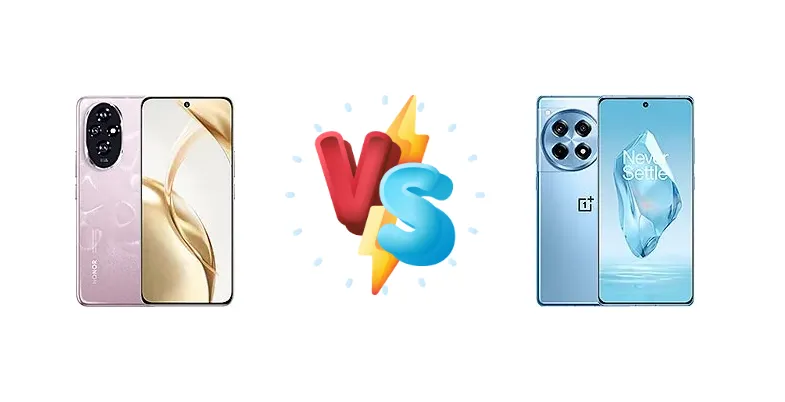
The Honor 200 and OnePlus 12R represent compelling options in the increasingly competitive mid-range smartphone market. The Honor 200 arrives as a fresh contender, boasting rapid 100W charging, while the OnePlus 12R leverages the proven power of the Snapdragon 8 Gen 2. This comparison dissects their key differences to help you determine which device best suits your needs.
🏆 Quick Verdict
For most users, the OnePlus 12R emerges as the stronger choice. Its Snapdragon 8 Gen 2 chipset delivers significantly superior performance, and its impressive 14:32 hour active use battery life provides all-day endurance. While the Honor 200’s 100W charging is faster on paper, the 12R’s overall package offers a more balanced and powerful experience.
| Network |
|---|
| 2G bands | GSM 850 / 900 / 1800 / 1900 | GSM 850 / 900 / 1800 / 1900 |
| 3G bands | HSDPA 800 / 850 / 900 / 1700(AWS) / 1900 / 2100 | HSDPA 850 / 900 / 1700(AWS) / 1900 / 2100 |
| 4G bands | LTE | 1, 2, 3, 4, 5, 7, 8, 12, 17, 18, 19, 20, 26, 28, 32, 38, 39, 40, 41, 66 |
| 5G bands | SA/NSA | 1, 2, 3, 5, 7, 8, 12, 20, 28, 38, 40, 41, 66, 77, 78 SA/NSA |
| Speed | HSPA, LTE, 5G | HSPA, LTE, 5G |
| Technology | GSM / CDMA / HSPA / CDMA2000 / LTE / 5G | GSM / CDMA / HSPA / LTE / 5G |
| Launch |
|---|
| Announced | 2024, May 27 | 2024, January 23 |
| Status | Available. Released 2024, May 31 | Available. Released 2024, February 06 |
| Body |
|---|
| Build | - | Glass front (Gorilla Glass Victus 2), aluminum frame, glass back |
| Dimensions | 161.5 x 74.6 x 7.7 mm (6.36 x 2.94 x 0.30 in) | 163.3 x 75.3 x 8.8 mm (6.43 x 2.96 x 0.35 in) |
| SIM | · Nano-SIM + eSIM· Nano-SIM + Nano-SIM | · Nano-SIM + Nano-SIM + eSIM (max 2 at a time)· Nano-SIM + Nano-SIM |
| Weight | 187 g (6.60 oz) | 207 g (7.30 oz) |
| Display |
|---|
| Protection | - | Corning Gorilla Glass Victus 2 |
| Resolution | 1200 x 2664 pixels (~436 ppi density) | 1264 x 2780 pixels (~450 ppi density) |
| Size | 6.7 inches, 108.5 cm2 (~90.0% screen-to-body ratio) | 6.78 inches, 111.7 cm2 (~90.9% screen-to-body ratio) |
| Type | OLED, 1B colors, 120Hz, 3840Hz PWM, HDR, 4000 nits (peak) | LTPO4 AMOLED, 1B colors, 120Hz, HDR10+, Dolby Vision, 1600 nits (HBM), 4500 nits (peak) |
| Platform |
|---|
| CPU | Octa-core (1x2.63 GHz Cortex-A715 & 4x2.4 GHz Cortex-A715 & 3x1.8 GHz Cortex-A510) | Octa-core (1x3.2 GHz Cortex-X3 & 2x2.8 GHz Cortex-A715 & 2x2.8 GHz Cortex-A710 & 3x2.0 GHz Cortex-A510) |
| Chipset | Qualcomm SM7550-AB Snapdragon 7 Gen 3 (4 nm) | Qualcomm SM8550-AB Snapdragon 8 Gen 2 (4 nm) |
| GPU | Adreno 720 | Adreno 740 |
| OS | Android 14, MagicOS 8 | Android 14, up to 3 major Android upgrades, OxygenOS 15 |
| Memory |
|---|
| Card slot | No | No |
| Internal | 256GB 8GB RAM, 256GB 12GB RAM, 256GB 16GB RAM, 512GB 8GB RAM, 512GB 12GB RAM, 512GB 16GB RAM | 128GB 8GB RAM, 256GB 8GB RAM, 256GB 12GB RAM, 256GB 16GB RAM |
| Main Camera |
|---|
| Features | LED flash, HDR, panorama | Laser AF, color spectrum sensor, LED flash, HDR, panorama |
| Triple | 50 MP, f/2.0, (wide), 1/1.56", 1.0µm, PDAF, OIS
50 MP, f/2.4, (telephoto), PDAF, OIS, 2.5x optical zoom
12 MP, f/2.2, 112˚ (ultrawide), AF | 50 MP, f/1.8, 24mm (wide), 1/1.56", 1.0µm, multi-directional PDAF, OIS
8 MP, f/2.2, 16mm, 112˚ (ultrawide), 1/4.0", 1.12µm
2 MP (macro) |
| Video | 4K@30fps, 1080p@30/60fps, gyro-EIS, OIS | 4K@30/60fps, 1080p@30/60/120/240fps, gyro-EIS, OIS |
| Selfie camera |
|---|
| Features | HDR | HDR, panorama |
| Single | 50 MP, f/2.1, (wide) | 16 MP, f/2.4, 26mm (wide), 1/3", 1.0µm |
| Video | 4K@30fps, 1080p@30fps, gyro-EIS | 1080p@30fps, gyro-EIS |
| Sound |
|---|
| 35mm jack | No | No |
| Loudspeaker | Yes, with stereo speakers | Yes, with stereo speakers |
| Comms |
|---|
| Bluetooth | 5.3, A2DP, LE, aptX HD | 5.3, A2DP, LE, aptX HD |
| Infrared port | Yes | Yes |
| NFC | Yes | Yes |
| Positioning | GPS, GALILEO, GLONASS, QZSS, BDS (B1I+B1c) | GPS, GALILEO, GLONASS, BDS, QZSS |
| Radio | No | No |
| USB | USB Type-C 2.0, OTG | USB Type-C 2.0 |
| WLAN | Wi-Fi 802.11 a/b/g/n/ac/6, dual-band, Wi-Fi Direct | Wi-Fi 802.11 a/b/g/n/ac/6/7, dual-band |
| Features |
|---|
| Sensors | Fingerprint (under display, optical), accelerometer, gyro, compass, ultrasound proximity | Fingerprint (under display, optical), accelerometer, gyro, proximity, compass |
| Battery |
|---|
| Charging | 100W wired, 57% in 15 min
5W reverse wired | 100W wired, 100% in 26 min |
| Type | Si/C Li-Ion 5200 mAh | Li-Ion 5500 mAh |
| Misc |
|---|
| Colors | Coral Pink, Moonlight White, Emerald Green, Black | Iron Gray, Cool Blue, Electric Violet, Sunset Dune |
| Models | ELI-AN00, ELI-NX9 | CPH2609, CPH2585, CPH2611 |
| Price | $ 402.68 / £ 381.69 / € 289.99 | € 410.84 / $ 399.95 / £ 649.00 |
| SAR | - | 1.19 W/kg (head) 0.82 W/kg (body) |
Honor 200
- Extremely fast 100W charging (0-57% in 15 min)
- Potentially more stylish design (brand dependent)
- Competitive price point (likely)
- Less powerful Snapdragon 7 Gen 3 chipset
- Likely shorter battery life compared to 12R
- Limited camera information available
OnePlus 12R
- Flagship-level Snapdragon 8 Gen 2 performance
- Excellent 14:32 hour active use battery life
- Bright 1181 nit display for outdoor visibility
- Slightly slower full charge time (26 minutes)
- May be slightly more expensive than Honor 200
- OnePlus’s OxygenOS can be polarizing for some users
Display Comparison
The OnePlus 12R boasts a brighter display, reaching a measured peak of 1181 nits, which translates to better visibility outdoors. While the Honor 200’s display specifications are not provided, OnePlus’s panel offers a significant advantage in direct sunlight. Both devices likely utilize AMOLED technology, but the 12R’s brightness and potential for higher refresh rates (not specified for either) contribute to a more immersive viewing experience. The absence of LTPO information for the Honor 200 suggests the 12R may offer more efficient variable refresh rate capabilities.
Camera Comparison
Without detailed camera specifications for the Honor 200, a direct comparison is limited. However, the OnePlus 12R likely benefits from the Snapdragon 8 Gen 2’s superior image signal processor (ISP). This translates to better noise reduction, dynamic range, and overall image quality, particularly in challenging lighting conditions. The absence of information regarding OIS (Optical Image Stabilization) on the Honor 200 is a concern, as the 12R’s OIS will provide sharper images and smoother video recording. We can assume both phones will feature a multi-camera setup, but the 12R’s processing power gives it an edge.
Performance
The core difference lies in the chipsets. The OnePlus 12R’s Snapdragon 8 Gen 2 (4nm) is a flagship-level processor, featuring a prime Cortex-X3 core clocked at 3.2 GHz. This contrasts sharply with the Honor 200’s Snapdragon 7 Gen 3 (4nm), which utilizes a Cortex-A715 based core configuration. The 8 Gen 2’s architectural advantages, including a more powerful GPU and improved AI engine, will result in noticeably faster app loading, smoother gaming, and more responsive multitasking. The 12R’s CPU configuration (1x3.2 GHz Cortex-X3, 2x2.8 GHz Cortex-A715, 2x2.8 GHz Cortex-A710, 3x2.0 GHz Cortex-A510) is demonstrably more potent than the Honor 200’s (1x2.63 GHz Cortex-A715, 4x2.4 GHz Cortex-A715, 3x1.8 GHz Cortex-A510).
Battery Life
The OnePlus 12R shines in battery endurance, achieving an impressive 14:32 hours of active use. While the Honor 200 boasts 100W wired charging, reaching 57% in 15 minutes, the 12R’s 100W charging completes a full charge in 26 minutes. The 12R’s longer battery life mitigates the slightly slower full charge time. The Honor 200’s 5W reverse wired charging is a niche feature, while the 12R’s larger battery capacity (not specified, but likely in the 5000mAh range) contributes to its superior stamina.
Buying Guide
Buy the Honor 200 if you prioritize extremely fast charging and a potentially more stylish design (based on brand aesthetic). Its 100W charging gets you from 0 to 57% in just 15 minutes, ideal for users who frequently need a quick power boost. Buy the OnePlus 12R if you value raw performance, extended battery life, and a proven track record of software support. The Snapdragon 8 Gen 2 ensures smooth multitasking, demanding gaming, and future-proofed performance.
Frequently Asked Questions
❓ Does the Snapdragon 7 Gen 3 in the Honor 200 struggle with demanding games like Genshin Impact?
While the Snapdragon 7 Gen 3 is a capable chip, it will likely require reduced graphics settings and may exhibit frame drops in graphically intensive games like Genshin Impact. The OnePlus 12R’s Snapdragon 8 Gen 2 offers a significantly smoother gaming experience at higher settings.
❓ How does the 100W charging on the Honor 200 compare to the OnePlus 12R in real-world usage?
The Honor 200 charges faster initially, reaching 57% in 15 minutes. However, the OnePlus 12R completes a full charge in 26 minutes, while the Honor 200’s full charge time is not specified. The 12R’s larger battery and efficient charging system provide a more practical solution for all-day use.
❓ Is the difference in performance between the Snapdragon 7 Gen 3 and 8 Gen 2 noticeable for everyday tasks?
Yes, the difference is noticeable. While both chips handle basic tasks like browsing and social media well, the Snapdragon 8 Gen 2 in the OnePlus 12R offers significantly faster app loading times, smoother multitasking, and a more responsive user experience overall.