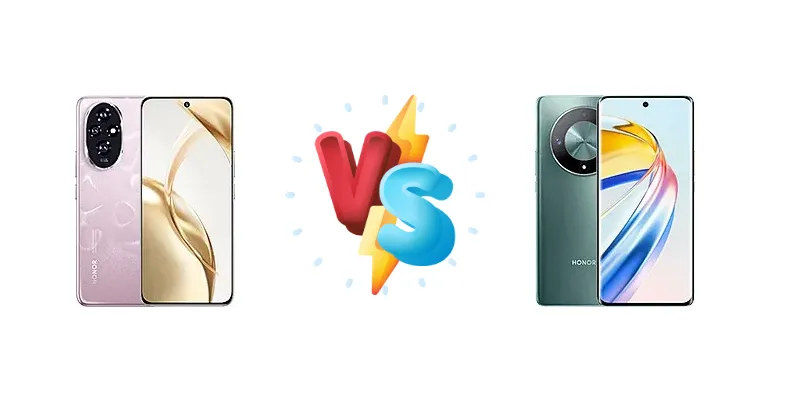
Honor's mid-range lineup is heating up with the release of the Honor 200, positioned as a step up from the already capable X9b. This comparison dissects the core differences – from the Snapdragon chipsets powering each device to the charging speeds and overall user experience – to determine which phone best suits your needs and budget.
🏆 Quick Verdict
For most users, the Honor 200 emerges as the stronger choice. Its Snapdragon 7 Gen 3 chipset delivers a noticeable performance boost over the X9b’s Snapdragon 6 Gen 1, and the 100W charging is a game-changer for convenience. While the X9b offers excellent value, the 200’s added power justifies the price difference.
| Network |
|---|
| 2G bands | GSM 850 / 900 / 1800 / 1900 | GSM 850 / 900 / 1800 / 1900 |
| 3G bands | HSDPA 800 / 850 / 900 / 1700(AWS) / 1900 / 2100 | HSDPA 850 / 900 / 1900 / 2100 |
| 4G bands | LTE | 1, 2, 3, 4, 5, 7, 8, 20, 28, 32, 38, 40, 41 |
| 5G bands | SA/NSA | 1, 3, 7, 8, 20, 28, 38, 40, 41, 77, 78 SA/NSA |
| Speed | HSPA, LTE, 5G | HSPA, LTE, 5G |
| Technology | GSM / CDMA / HSPA / CDMA2000 / LTE / 5G | GSM / HSPA / LTE / 5G |
| Launch |
|---|
| Announced | 2024, May 27 | 2023, October 18 |
| Status | Available. Released 2024, May 31 | Available. Released 2023, October |
| Body |
|---|
| Dimensions | 161.5 x 74.6 x 7.7 mm (6.36 x 2.94 x 0.30 in) | 163.6 x 75.5 x 8 mm (6.44 x 2.97 x 0.31 in) |
| SIM | · Nano-SIM + eSIM· Nano-SIM + Nano-SIM | Nano-SIM + Nano-SIM |
| Weight | 187 g (6.60 oz) | 185 g (6.53 oz) |
| Display |
|---|
| Resolution | 1200 x 2664 pixels (~436 ppi density) | 1220 x 2652 pixels, 19.5:9 ratio (~431 ppi density) |
| Size | 6.7 inches, 108.5 cm2 (~90.0% screen-to-body ratio) | 6.78 inches, 112.6 cm2 (~91.2% screen-to-body ratio) |
| Type | OLED, 1B colors, 120Hz, 3840Hz PWM, HDR, 4000 nits (peak) | AMOLED, 1B colors, 120Hz, 1200 nits (peak) |
| Platform |
|---|
| CPU | Octa-core (1x2.63 GHz Cortex-A715 & 4x2.4 GHz Cortex-A715 & 3x1.8 GHz Cortex-A510) | Octa-core (4x2.2 GHz Cortex-A78 & 4x1.8 GHz Cortex-A55) |
| Chipset | Qualcomm SM7550-AB Snapdragon 7 Gen 3 (4 nm) | Qualcomm SM6450 Snapdragon 6 Gen 1 (4 nm) |
| GPU | Adreno 720 | Adreno 710 |
| OS | Android 14, MagicOS 8 | Android 13, Magic OS 7.2 |
| Memory |
|---|
| Card slot | No | No |
| Internal | 256GB 8GB RAM, 256GB 12GB RAM, 256GB 16GB RAM, 512GB 8GB RAM, 512GB 12GB RAM, 512GB 16GB RAM | 256GB 8GB RAM, 256GB 12GB RAM, 512GB 8GB RAM, 512GB 12GB RAM |
| Main Camera |
|---|
| Features | LED flash, HDR, panorama | LED flash, panorama, HDR |
| Triple | 50 MP, f/2.0, (wide), 1/1.56", 1.0µm, PDAF, OIS
50 MP, f/2.4, (telephoto), PDAF, OIS, 2.5x optical zoom
12 MP, f/2.2, 112˚ (ultrawide), AF | 108 MP, f/1.8, (wide), 1/1.67", PDAF
5 MP, f/2.2, (ultrawide)
2 MP (macro) |
| Video | 4K@30fps, 1080p@30/60fps, gyro-EIS, OIS | 4K@30fps, 1080p@30fps |
| Selfie camera |
|---|
| Features | HDR | - |
| Single | 50 MP, f/2.1, (wide) | 16 MP, f/2.5, (wide) |
| Video | 4K@30fps, 1080p@30fps, gyro-EIS | 1080p@30fps |
| Sound |
|---|
| 35mm jack | No | No |
| Loudspeaker | Yes, with stereo speakers | Yes |
| Comms |
|---|
| Bluetooth | 5.3, A2DP, LE, aptX HD | 5.1, A2DP, LE |
| Infrared port | Yes | Yes |
| NFC | Yes | Yes (market/region dependent) |
| Positioning | GPS, GALILEO, GLONASS, QZSS, BDS (B1I+B1c) | GPS, GLONASS, GALILEO, BDS |
| Radio | No | No |
| USB | USB Type-C 2.0, OTG | USB Type-C 2.0, OTG |
| WLAN | Wi-Fi 802.11 a/b/g/n/ac/6, dual-band, Wi-Fi Direct | Wi-Fi 802.11 a/b/g/n/ac, dual-band, Wi-Fi Direct |
| Features |
|---|
| Sensors | Fingerprint (under display, optical), accelerometer, gyro, compass, ultrasound proximity | Fingerprint (under display, optical), accelerometer, gyro, proximity, compass |
| Battery |
|---|
| Charging | 100W wired, 57% in 15 min
5W reverse wired | 35W wired
Reverse wired |
| Type | Si/C Li-Ion 5200 mAh | Li-Po 5800 mAh |
| Misc |
|---|
| Colors | Coral Pink, Moonlight White, Emerald Green, Black | Sunrise Orange, Midnight Black, Emerald Green |
| Models | ELI-AN00, ELI-NX9 | ALI-NX1 |
| Price | $ 402.68 / £ 381.69 / € 289.99 | About 970 EUR |
Honor 200
- Significantly faster Snapdragon 7 Gen 3 processor
- Ultra-fast 100W wired charging
- Improved image processing capabilities
- Likely higher price point
- May have slightly less battery capacity (unconfirmed)
Honor X9b
- More affordable price
- Decent Snapdragon 6 Gen 1 performance for everyday tasks
- Solid battery life with 35W charging
- Slower processor for demanding apps and games
- Significantly slower charging speed
Display Comparison
While both phones likely feature LCD panels (data not provided), the core difference lies in the processing power driving them. The Honor 200’s Snapdragon 7 Gen 3 will contribute to smoother animations and faster app loading, enhancing the perceived visual experience. The X9b’s Snapdragon 6 Gen 1, while efficient, will exhibit a slight lag in comparison. Without specific display specs like resolution and refresh rate, it's difficult to assess further, but the chipset difference is a key factor.
Camera Comparison
Without detailed camera specifications, it’s challenging to make a definitive comparison. However, the chipset difference indirectly impacts camera performance. The Honor 200’s Snapdragon 7 Gen 3 features a more powerful ISP (Image Signal Processor), enabling faster image processing, improved noise reduction, and potentially better dynamic range. While both phones likely employ similar sensor configurations, the 200’s ISP will likely deliver superior image quality, especially in low-light conditions. We can assume both phones will have a primary camera, but the 200 will likely have more advanced computational photography capabilities.
Performance
The Honor 200’s Qualcomm SM7550-AB Snapdragon 7 Gen 3 (4nm) represents a significant leap in performance over the X9b’s Snapdragon 6 Gen 1 (4nm). The 7 Gen 3 utilizes a tri-cluster architecture with a Cortex-A715 prime core clocked at 2.63 GHz, alongside additional A715 performance cores, offering substantially improved CPU and GPU performance. The X9b’s Snapdragon 6 Gen 1, with its Cortex-A78 cores at 2.2 GHz, is geared towards efficiency but lacks the raw power for demanding tasks. This translates to faster gaming frame rates, quicker video editing, and a more responsive overall experience on the Honor 200.
Battery Life
The Honor 200’s 100W wired charging is a standout feature, capable of charging the battery to 57% in just 15 minutes. This dramatically reduces downtime compared to the X9b’s 35W charging. While battery capacity isn’t specified, the faster charging speed of the 200 effectively mitigates any potential disadvantage from a slightly smaller battery. The X9b’s 35W charging is still respectable, but it requires significantly more time to reach a full charge. The 5W reverse wired charging on both devices is a convenient feature for topping up accessories.
Buying Guide
Buy the Honor 200 if you prioritize performance for gaming, multitasking, and demanding apps, and if rapid charging is a must-have feature. You'll benefit from a smoother, more responsive experience. Buy the Honor X9b if you're on a tighter budget and primarily need a reliable phone for everyday tasks like browsing, social media, and light media consumption. It provides a solid foundation without breaking the bank.
Frequently Asked Questions
❓ Will the Snapdragon 6 Gen 1 in the Honor X9b struggle with graphically intensive games like Genshin Impact?
Yes, the Snapdragon 6 Gen 1 is likely to struggle with Genshin Impact and similar titles at higher settings. You'll likely need to reduce graphics settings to medium or low to achieve playable frame rates. The Honor 200’s Snapdragon 7 Gen 3 will provide a much smoother gaming experience.
❓ How much faster is the 100W charging on the Honor 200 compared to the 35W charging on the X9b in a real-world scenario?
The 100W charging on the Honor 200 can add approximately 57% charge in 15 minutes, while the X9b’s 35W charging will add significantly less in the same timeframe – likely around 20-30%. This means you can get a substantial boost in battery life with the 200 during a quick coffee break.
❓ Is the difference in performance between the Snapdragon 7 Gen 3 and 6 Gen 1 noticeable for everyday tasks like browsing and social media?
For basic tasks like browsing and social media, the difference may not be immediately apparent. However, the Snapdragon 7 Gen 3 in the Honor 200 will provide a smoother and more responsive experience when switching between apps, opening heavy webpages, and multitasking.