
Honor 200 vs. Honor 200 Pro: A Deep Dive into Honor's Mid-Range Lineup
| Phones Images | |||||
|---|---|---|---|---|---|
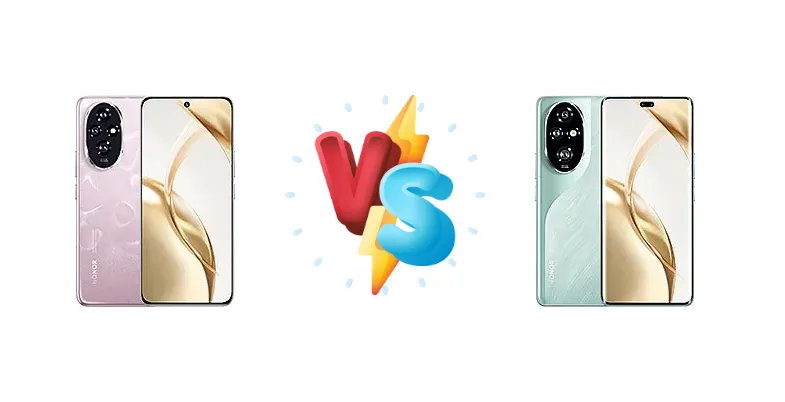
|
🏆 Quick Verdict
For most users, the Honor 200 Pro is the clear winner. Its Snapdragon 8s Gen 3 chipset delivers a substantial performance boost over the 200’s Snapdragon 7 Gen 3, and the addition of 66W wireless charging adds significant convenience. However, the Honor 200 remains a compelling option for budget-conscious buyers who prioritize efficiency.
| PHONES | ||
|---|---|---|
| Phone Names | Honor 200 | Honor 200 Pro |
| Network | ||
|---|---|---|
| 2G bands | GSM 850 / 900 / 1800 / 1900 | GSM 850 / 900 / 1800 / 1900 |
| 3G bands | HSDPA 800 / 850 / 900 / 1700(AWS) / 1900 / 2100 | HSDPA 800 / 850 / 900 / 1700(AWS) / 1900 / 2100 |
| 4G bands | LTE | LTE |
| 5G bands | SA/NSA | SA/NSA |
| Speed | HSPA, LTE, 5G | HSPA, LTE, 5G |
| Technology | GSM / CDMA / HSPA / CDMA2000 / LTE / 5G | GSM / CDMA / HSPA / CDMA2000 / LTE / 5G |
| Launch | ||
|---|---|---|
| Announced | 2024, May 27 | 2024, May 27 |
| Status | Available. Released 2024, May 31 | Available. Released 2024, May 31 |
| Body | ||
|---|---|---|
| Dimensions | 161.5 x 74.6 x 7.7 mm (6.36 x 2.94 x 0.30 in) | 163.3 x 75.2 x 8.2 mm (6.43 x 2.96 x 0.32 in) |
| SIM | · Nano-SIM + eSIM· Nano-SIM + Nano-SIM | · Nano-SIM + eSIM· Nano-SIM + Nano-SIM |
| Weight | 187 g (6.60 oz) | 199 g (7.02 oz) |
| Display | ||
|---|---|---|
| Resolution | 1200 x 2664 pixels (~436 ppi density) | 1224 x 2700 pixels (~437 ppi density) |
| Size | 6.7 inches, 108.5 cm2 (~90.0% screen-to-body ratio) | 6.78 inches, 111.5 cm2 (~90.8% screen-to-body ratio) |
| Type | OLED, 1B colors, 120Hz, 3840Hz PWM, HDR, 4000 nits (peak) | OLED, 1B colors, 120Hz, 3840Hz PWM, HDR, 4000 nits (peak) |
| Platform | ||
|---|---|---|
| CPU | Octa-core (1x2.63 GHz Cortex-A715 & 4x2.4 GHz Cortex-A715 & 3x1.8 GHz Cortex-A510) | Octa-core (1x3.0 GHz Cortex-X4 & 4x2.8 GHz Cortex-A720 & 3x2.0 GHz Cortex-A520) |
| Chipset | Qualcomm SM7550-AB Snapdragon 7 Gen 3 (4 nm) | Qualcomm SM8635 Snapdragon 8s Gen 3 (4 nm) |
| GPU | Adreno 720 | Adreno 735 |
| OS | Android 14, MagicOS 8 | Android 14, up to 4 major Android upgrades, MagicOS 8 |
| Memory | ||
|---|---|---|
| Card slot | No | No |
| Internal | 256GB 8GB RAM, 256GB 12GB RAM, 256GB 16GB RAM, 512GB 8GB RAM, 512GB 12GB RAM, 512GB 16GB RAM | 256GB 12GB RAM, 512GB 12GB RAM, 512GB 16GB RAM, 1TB 16GB RAM |
| Main Camera | ||
|---|---|---|
| Features | LED flash, HDR, panorama | LED flash, HDR, panorama |
| Triple | 50 MP, f/2.0, (wide), 1/1.56", 1.0µm, PDAF, OIS 50 MP, f/2.4, (telephoto), PDAF, OIS, 2.5x optical zoom 12 MP, f/2.2, 112˚ (ultrawide), AF | 50 MP, f/1.9, (wide), 1/1.3", 1.2µm, PDAF, OIS 50 MP, f/2.4, (telephoto), PDAF, OIS, 2.5x optical zoom 12 MP, f/2.2, 112˚ (ultrawide), AF |
| Video | 4K@30fps, 1080p@30/60fps, gyro-EIS, OIS | 4K@30fps, 1080p@30/60fps, gyro-EIS, OIS |
| Selfie camera | ||
|---|---|---|
| Dual | - | 50 MP, f/2.1, (wide) 2 MP, f/2.4, (depth) |
| Features | HDR | HDR |
| Single | 50 MP, f/2.1, (wide) | - |
| Video | 4K@30fps, 1080p@30fps, gyro-EIS | 4K@30fps, 1080p@30fps, gyro-EIS |
| Sound | ||
|---|---|---|
| 35mm jack | No | No |
| Loudspeaker | Yes, with stereo speakers | Yes, with stereo speakers |
| Comms | ||
|---|---|---|
| Bluetooth | 5.3, A2DP, LE, aptX HD | 5.3, A2DP, LE, aptX HD |
| Infrared port | Yes | Yes |
| NFC | Yes | Yes |
| Positioning | GPS, GALILEO, GLONASS, QZSS, BDS (B1I+B1c) | GPS, GALILEO, GLONASS, QZSS, BDS (B1I+B1c) |
| Radio | No | No |
| USB | USB Type-C 2.0, OTG | USB Type-C 2.0, OTG |
| WLAN | Wi-Fi 802.11 a/b/g/n/ac/6, dual-band, Wi-Fi Direct | Wi-Fi 802.11 a/b/g/n/ac/6, dual-band, Wi-Fi Direct |
| Features | ||
|---|---|---|
| Sensors | Fingerprint (under display, optical), accelerometer, gyro, compass, ultrasound proximity | Fingerprint (under display, optical), accelerometer, gyro, compass, ultrasound proximity |
| Battery | ||
|---|---|---|
| Charging | 100W wired, 57% in 15 min 5W reverse wired | 100W wired, 60% in 15 min, 100% in 41 min 66W wireless, 64% in 30 min 5W reverse wired Reverse wireless |
| Type | Si/C Li-Ion 5200 mAh | Si/C Li-Ion 5200 mAh |
| Misc | ||
|---|---|---|
| Colors | Coral Pink, Moonlight White, Emerald Green, Black | Moonlight White, Black, Ocean Cyan, Pink |
| Models | ELI-AN00, ELI-NX9 | ELP-AN00, ELP-NX9 |
| Price | $ 402.68 / £ 381.69 / € 289.99 | $ 164.67 / € 459.99 |
Honor 200
- More affordable price point
- Fast 100W wired charging
- Efficient Snapdragon 7 Gen 3 chipset
- Less powerful processor than the Pro
- No wireless charging support
Honor 200 Pro
- Significantly faster Snapdragon 8s Gen 3 processor
- 66W wireless charging support
- Brighter display (1110 nits)
- Higher price tag
- Potentially more heat generation under load
Display Comparison
Both phones likely share a similar OLED panel, but the Honor 200 Pro boasts a significantly brighter display, reaching a measured peak of 1110 nits. This higher brightness translates to improved visibility outdoors under direct sunlight. While both likely feature high refresh rates, the Pro’s superior brightness is a key differentiator for users who consume a lot of content on the go. The Honor 200’s display specs are not provided, so we can only assume it’s a standard high-quality OLED.
Camera Comparison
Unfortunately, detailed camera specifications are absent. However, given the Pro designation, it’s reasonable to expect the Honor 200 Pro to feature a more sophisticated camera system, potentially with a larger main sensor and improved image stabilization (OIS). The focus should be on the primary sensor and its aperture, as these are the biggest determinants of low-light performance. The 2MP macro cameras found on many phones in this price range are largely superfluous and shouldn’t be a deciding factor.
Performance
The core difference lies in the chipsets. The Honor 200 utilizes the Qualcomm SM7550-AB Snapdragon 7 Gen 3 (4nm), featuring an octa-core configuration with a Cortex-A715 prime core clocked at 2.63 GHz. The Honor 200 Pro, however, steps up to the Qualcomm SM8635 Snapdragon 8s Gen 3 (4nm), sporting a faster Cortex-X4 prime core at 3.0 GHz. This architectural shift, combined with higher clock speeds on the A720 performance cores, results in a noticeable performance advantage for the Pro, particularly in sustained workloads. The 8s Gen 3 also benefits from a more powerful GPU, making it the better choice for mobile gaming. Both phones utilize a 4nm process, ensuring reasonable thermal efficiency, but the 8s Gen 3 will likely generate more heat under load.
Battery Life
The Honor 200 offers 100W wired charging, reaching 57% charge in just 15 minutes. The Honor 200 Pro also supports 100W wired charging, but is faster, hitting 60% in the same timeframe and achieving a full charge in 41 minutes. More significantly, the Pro adds 66W wireless charging, reaching 64% in 30 minutes – a feature absent on the standard 200. While the Honor 200 Pro’s active use score of 11:08h provides a concrete benchmark, the Honor 200’s battery capacity and endurance remain unknown. The Pro’s faster charging and wireless charging capabilities offer a significant convenience advantage.
Buying Guide
Buy the Honor 200 if you need a capable daily driver with fast 100W wired charging and prioritize value for money. It’s ideal for social media users, casual gamers, and those who don’t demand the absolute highest performance. Buy the Honor 200 Pro if you prefer a smoother, more responsive experience for demanding tasks like gaming and video editing, and if wireless charging is a must-have feature. It’s geared towards power users and those who want a phone that will stay relevant for longer.