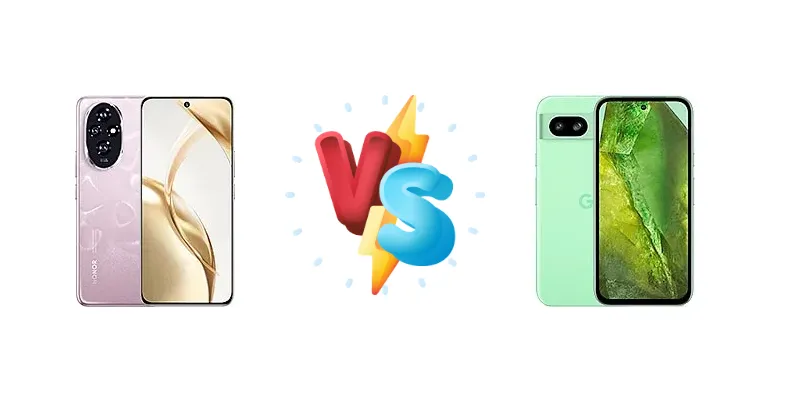
The mid-range smartphone market is fiercely competitive, and the Honor 200 and Google Pixel 8a represent compelling options. The Honor 200 prioritizes charging speed and a modern chipset, while the Pixel 8a leverages Google’s Tensor G3 processor and renowned computational photography. This comparison dissects their strengths and weaknesses to determine which device best suits your needs.
🏆 Quick Verdict
For the average user prioritizing all-day battery life and Google’s AI-powered features, the Pixel 8a emerges as the stronger choice. Its impressive 40:06h endurance and sophisticated image processing outweigh the Honor 200’s faster charging, though the Honor 200 is a strong contender for those who value speed.
| Network |
|---|
| 2G bands | GSM 850 / 900 / 1800 / 1900 | GSM 850 / 900 / 1800 / 1900 |
| 3G bands | HSDPA 800 / 850 / 900 / 1700(AWS) / 1900 / 2100 | HSDPA 800 / 850 / 900 / 1700(AWS) / 1900 / 2100 |
| 4G bands | LTE | 1, 2, 3, 4, 5, 7, 8, 12, 17, 18, 19, 20, 26, 28, 32, 38, 40, 41, 42, 66 - G6GPR (International) |
| 5G bands | SA/NSA | 1, 2, 3, 5, 7, 8, 12, 20, 26, 28, 38, 40, 41, 66, 75, 76, 77, 78 SA/NSA/Sub6 - G6GPR (International) |
| Speed | HSPA, LTE, 5G | HSPA, LTE, 5G |
| Technology | GSM / CDMA / HSPA / CDMA2000 / LTE / 5G | GSM / HSPA / LTE / 5G |
| Launch |
|---|
| Announced | 2024, May 27 | 2024, May 07 |
| Status | Available. Released 2024, May 31 | Available. Released 2024, May 14 |
| Body |
|---|
| Build | - | Glass front (Gorilla Glass 3), aluminum frame, plastic back |
| Dimensions | 161.5 x 74.6 x 7.7 mm (6.36 x 2.94 x 0.30 in) | 152.1 x 72.7 x 8.9 mm (5.99 x 2.86 x 0.35 in) |
| SIM | · Nano-SIM + eSIM· Nano-SIM + Nano-SIM | Nano-SIM + eSIM |
| Weight | 187 g (6.60 oz) | 188 g (6.63 oz) |
| Display |
|---|
| Protection | - | Corning Gorilla Glass 3, Mohs level 5 |
| Resolution | 1200 x 2664 pixels (~436 ppi density) | 1080 x 2400 pixels, 20:9 ratio (~430 ppi density) |
| Size | 6.7 inches, 108.5 cm2 (~90.0% screen-to-body ratio) | 6.1 inches, 90.3 cm2 (~81.6% screen-to-body ratio) |
| Type | OLED, 1B colors, 120Hz, 3840Hz PWM, HDR, 4000 nits (peak) | OLED, HDR, 120Hz, 2000 nits (peak) |
| Platform |
|---|
| CPU | Octa-core (1x2.63 GHz Cortex-A715 & 4x2.4 GHz Cortex-A715 & 3x1.8 GHz Cortex-A510) | Nona-core (1x3.0 GHz Cortex-X3 & 4x2.45 GHz Cortex-A715 & 4x2.15 GHz Cortex-A510) |
| Chipset | Qualcomm SM7550-AB Snapdragon 7 Gen 3 (4 nm) | Google Tensor G3 (4 nm) |
| GPU | Adreno 720 | Immortalis-G715s MC10 |
| OS | Android 14, MagicOS 8 | Android 14, upgradable to Android 16, up to 7 major Android upgrades |
| Memory |
|---|
| Card slot | No | No |
| Internal | 256GB 8GB RAM, 256GB 12GB RAM, 256GB 16GB RAM, 512GB 8GB RAM, 512GB 12GB RAM, 512GB 16GB RAM | 128GB 8GB RAM, 256GB 8GB RAM |
| Main Camera |
|---|
| Dual | - | 64 MP (16 MP eff.), f/1.9, 26mm (wide), 1/1.73", 0.8µm, dual pixel PDAF, OIS
13 MP, f/2.2, 120˚ (ultrawide), 1.12µm |
| Features | LED flash, HDR, panorama | Dual-LED flash, Pixel Shift, Ultra HDR, panorama, Best Take |
| Triple | 50 MP, f/2.0, (wide), 1/1.56", 1.0µm, PDAF, OIS
50 MP, f/2.4, (telephoto), PDAF, OIS, 2.5x optical zoom
12 MP, f/2.2, 112˚ (ultrawide), AF | - |
| Video | 4K@30fps, 1080p@30/60fps, gyro-EIS, OIS | 4K@30/60fps, 1080p@30/60/120/240fps, OIS |
| Selfie camera |
|---|
| Features | HDR | HDR, panorama |
| Single | 50 MP, f/2.1, (wide) | 13 MP, f/2.2, 20mm (ultrawide), 1.12µm |
| Video | 4K@30fps, 1080p@30fps, gyro-EIS | 4K@30fps, 1080p@30/60fps |
| Sound |
|---|
| 35mm jack | No | No |
| Loudspeaker | Yes, with stereo speakers | Yes, with stereo speakers |
| Comms |
|---|
| Bluetooth | 5.3, A2DP, LE, aptX HD | 5.3, A2DP, LE |
| Infrared port | Yes | - |
| NFC | Yes | Yes |
| Positioning | GPS, GALILEO, GLONASS, QZSS, BDS (B1I+B1c) | GPS, GLONASS, GALILEO, BDS, QZSS, NavIC |
| Radio | No | No |
| USB | USB Type-C 2.0, OTG | USB Type-C 3.2 |
| WLAN | Wi-Fi 802.11 a/b/g/n/ac/6, dual-band, Wi-Fi Direct | Wi-Fi 802.11 a/b/g/n/ac/6e, dual/tri-band (market/region dependent) |
| Features |
|---|
| Sensors | Fingerprint (under display, optical), accelerometer, gyro, compass, ultrasound proximity | Fingerprint (under display, optical), accelerometer, gyro, proximity, compass, barometer |
| Battery |
|---|
| Charging | 100W wired, 57% in 15 min
5W reverse wired | 18W wired, PD3.0
7.5W wireless
Bypass charging |
| Type | Si/C Li-Ion 5200 mAh | Li-Po 4492 mAh |
| Misc |
|---|
| Colors | Coral Pink, Moonlight White, Emerald Green, Black | Obsidian, Porcelain, Bay, Aloe |
| Models | ELI-AN00, ELI-NX9 | GKV4X, G6GPR, G8HHN, G576D |
| Price | $ 402.68 / £ 381.69 / € 289.99 | $ 229.98 / C$ 417.99 / £ 279.00 / € 299.99 / ₹ 33,300 |
| EU LABEL |
|---|
| Battery | - | 40:06h endurance, 1000 cycles |
| Energy | - | Class B |
| Free fall | - | Class A (270 falls) |
| Repairability | - | Class B |
Honor 200
- Blazing-fast 100W wired charging
- Modern Snapdragon 7 Gen 3 chipset
- 5W Reverse Wired Charging
- Battery endurance data unavailable
- Camera performance unknown without sensor details
Google Pixel 8a
- Exceptional 40:06h battery endurance
- Google Tensor G3 with AI capabilities
- Bright 1508 nits display
- Slower 18W wired charging
- May throttle under sustained heavy load
Display Comparison
The Pixel 8a boasts a significantly brighter display, reaching a measured peak of 1508 nits, making it far more usable in direct sunlight than the Honor 200 (brightness data unavailable). While both utilize OLED panels, the Pixel 8a’s brightness advantage is a key differentiator. We expect the Honor 200 to have a standard refresh rate, while the Pixel 8a’s panel is likely to support a variable refresh rate for smoother scrolling and animations, though this is not explicitly stated in the provided data. Bezels and color accuracy are unknown for the Honor 200, but Google typically delivers excellent color calibration on its Pixel devices.
Camera Comparison
The provided data doesn’t detail camera specs beyond the processors’ image signal processing capabilities. However, Google’s Tensor G3 is renowned for its computational photography prowess, offering features like Magic Eraser and Photo Unblur. The Pixel 8a will likely excel in dynamic range and low-light performance due to Google’s software optimizations. The Honor 200’s camera performance will depend heavily on its sensor size and lens apertures, which are currently unknown. Without this information, it’s difficult to assess its capabilities relative to the Pixel 8a’s AI-driven camera system.
Performance
Both phones employ 4nm chipsets, but their architectures differ significantly. The Google Pixel 8a’s Tensor G3 utilizes a nona-core configuration with a high-performance Cortex-X3 core clocked at 3.0 GHz, designed for AI tasks and demanding applications. The Honor 200’s Snapdragon 7 Gen 3 is an octa-core processor, with a Cortex-A715 prime core at 2.63 GHz. While the Tensor G3’s X3 core offers a theoretical performance advantage, the Snapdragon 7 Gen 3 is known for its efficiency. The Pixel 8a’s CPU configuration suggests a stronger focus on peak performance, while the Honor 200 aims for a balance between power and efficiency. RAM speeds are unknown for both devices, but LPDDR5x is likely on the Pixel 8a, potentially giving it a memory bandwidth edge.
Battery Life
The Pixel 8a’s battery endurance of 40:06h is a standout feature, demonstrating exceptional efficiency. Its active use score of 11:25h further reinforces its long-lasting battery life. The Honor 200, while lacking specific endurance data, compensates with its 100W wired charging, capable of adding 57% charge in just 15 minutes. The Pixel 8a’s 18W charging is considerably slower, though it does offer 7.5W wireless charging and bypass charging, allowing the phone to remain cool while charging. The Honor 200 also offers 5W reverse wired charging, a useful feature for topping up accessories.
Buying Guide
Buy the Honor 200 if you need incredibly fast charging – its 100W capability is a game-changer for minimizing downtime. It’s ideal for users who frequently find themselves needing a quick power boost. Buy the Google Pixel 8a if you prefer a seamless software experience, exceptional camera performance driven by AI, and long-lasting battery life, even if it means sacrificing the fastest possible charging speeds.
Frequently Asked Questions
❓ Does the Snapdragon 7 Gen 3 in the Honor 200 get hot during extended gaming sessions?
While the Snapdragon 7 Gen 3 is an efficient chip, sustained gaming can generate heat. The Honor 200’s thermal management system (details unavailable) will determine how well it handles this. The Pixel 8a’s Tensor G3 is known to throttle under heavy load, so both phones may experience performance dips during prolonged gaming.
❓ How does the Pixel 8a’s 'Magic Eraser' feature work, and is it truly effective?
Magic Eraser uses Google’s AI to identify and remove unwanted objects from photos. It’s surprisingly effective in many scenarios, intelligently filling in the background to create a seamless result. However, complex backgrounds or large objects can sometimes lead to noticeable artifacts.
❓ Can the Honor 200 fully charge from 0% to 100% in under 30 minutes with the 100W charging?
Yes, the Honor 200 can reach 57% charge in just 15 minutes with its 100W charging. Extrapolating from this, a full 0-100% charge is highly likely to be achievable in under 30 minutes, making it one of the fastest-charging phones in its class.
❓ Does the Pixel 8a support software updates for an extended period, similar to other Pixel phones?
Yes, Google guarantees at least 7 years of software updates for the Pixel 8a, including security patches and OS upgrades. This is a significant advantage over many Android phones, ensuring your device remains secure and up-to-date for years to come.