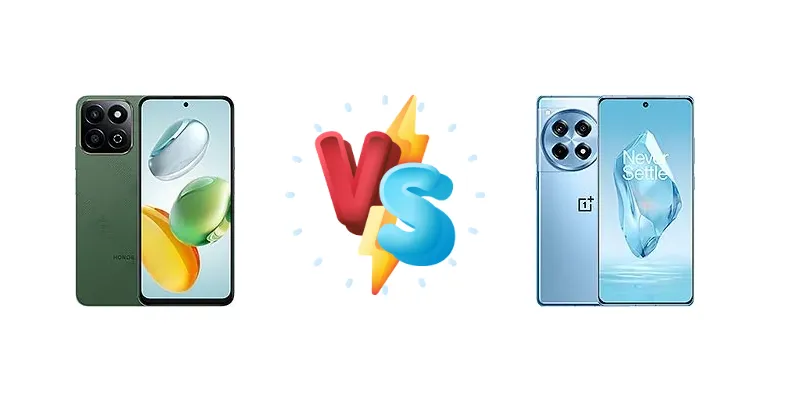
The mid-range smartphone market is fiercely competitive, and the Honor 200 Smart and OnePlus 12R represent compelling options at different price points. The Honor 200 Smart aims for affordability with a focus on everyday usability, while the OnePlus 12R brings flagship-level processing power to a more accessible price bracket. This comparison dissects their key differences to help you determine which device best suits your needs.
🏆 Quick Verdict
For the average user prioritizing raw performance and fast charging, the OnePlus 12R is the clear winner. Its Snapdragon 8 Gen 2 chipset and 100W charging significantly outperform the Honor 200 Smart’s Snapdragon 4 Gen 2 and 35W charging. However, the Honor 200 Smart offers a viable alternative for budget-conscious users who don't demand top-tier specs.
| Network |
|---|
| 2G bands | GSM 850 / 900 / 1800 / 1900 | GSM 850 / 900 / 1800 / 1900 |
| 3G bands | HSDPA 850 / 900 / 1700(AWS) / 1900 / 2100 | HSDPA 850 / 900 / 1700(AWS) / 1900 / 2100 |
| 4G bands | LTE | 1, 2, 3, 4, 5, 7, 8, 12, 17, 18, 19, 20, 26, 28, 32, 38, 39, 40, 41, 66 |
| 5G bands | SA/NSA | 1, 2, 3, 5, 7, 8, 12, 20, 28, 38, 40, 41, 66, 77, 78 SA/NSA |
| Speed | HSPA, LTE, 5G | HSPA, LTE, 5G |
| Technology | GSM / HSPA / LTE / 5G | GSM / CDMA / HSPA / LTE / 5G |
| Launch |
|---|
| Announced | 2024, September 17 | 2024, January 23 |
| Status | Available. Released 2024, September 23 | Available. Released 2024, February 06 |
| Body |
|---|
| Build | - | Glass front (Gorilla Glass Victus 2), aluminum frame, glass back |
| Dimensions | 166.9 x 76.8 x 8.1 mm (6.57 x 3.02 x 0.32 in) | 163.3 x 75.3 x 8.8 mm (6.43 x 2.96 x 0.35 in) |
| SIM | Nano-SIM + Nano-SIM | · Nano-SIM + Nano-SIM + eSIM (max 2 at a time)· Nano-SIM + Nano-SIM |
| Weight | 191 g or 193 g (6.74 oz) | 207 g (7.30 oz) |
| Display |
|---|
| Protection | Aluminosilicate glass | Corning Gorilla Glass Victus 2 |
| Resolution | 1080 x 2412 pixels, 20:9 ratio (~389 ppi density) | 1264 x 2780 pixels (~450 ppi density) |
| Size | 6.8 inches, 111.3 cm2 (~86.8% screen-to-body ratio) | 6.78 inches, 111.7 cm2 (~90.9% screen-to-body ratio) |
| Type | TFT LCD, 120Hz, 850 nits (peak) | LTPO4 AMOLED, 1B colors, 120Hz, HDR10+, Dolby Vision, 1600 nits (HBM), 4500 nits (peak) |
| Platform |
|---|
| CPU | Octa-core (2x2.2 GHz Cortex-A78 & 6x1.95 GHz Cortex-A55) | Octa-core (1x3.2 GHz Cortex-X3 & 2x2.8 GHz Cortex-A715 & 2x2.8 GHz Cortex-A710 & 3x2.0 GHz Cortex-A510) |
| Chipset | Qualcomm SM4450 Snapdragon 4 Gen 2 (4 nm) | Qualcomm SM8550-AB Snapdragon 8 Gen 2 (4 nm) |
| GPU | Adreno 613 | Adreno 740 |
| OS | Android 14, Magic OS 8 | Android 14, up to 3 major Android upgrades, OxygenOS 15 |
| Memory |
|---|
| Card slot | No | No |
| Internal | 256GB 4GB RAM, 256GB 8GB RAM | 128GB 8GB RAM, 256GB 8GB RAM, 256GB 12GB RAM, 256GB 16GB RAM |
| Main Camera |
|---|
| Dual | 50 MP, f/1.8, (wide), PDAF
Auxiliary lens | - |
| Features | LED flash, HDR | Laser AF, color spectrum sensor, LED flash, HDR, panorama |
| Triple | - | 50 MP, f/1.8, 24mm (wide), 1/1.56", 1.0µm, multi-directional PDAF, OIS
8 MP, f/2.2, 16mm, 112˚ (ultrawide), 1/4.0", 1.12µm
2 MP (macro) |
| Video | 1080p@30fps | 4K@30/60fps, 1080p@30/60/120/240fps, gyro-EIS, OIS |
| Selfie camera |
|---|
| Features | - | HDR, panorama |
| Single | 5 MP, f/2.2, (wide) | 16 MP, f/2.4, 26mm (wide), 1/3", 1.0µm |
| Video | 1080p@30fps | 1080p@30fps, gyro-EIS |
| Sound |
|---|
| 35mm jack | Yes | No |
| Loudspeaker | Yes, with stereo speakers | Yes, with stereo speakers |
| Comms |
|---|
| Bluetooth | 5.0, A2DP, LE | 5.3, A2DP, LE, aptX HD |
| Infrared port | - | Yes |
| NFC | No | Yes |
| Positioning | GPS, GLONASS, GALILEO, BDS | GPS, GALILEO, GLONASS, BDS, QZSS |
| Radio | No | No |
| USB | USB Type-C 2.0, OTG | USB Type-C 2.0 |
| WLAN | Wi-Fi 802.11 a/b/g/n/ac, dual-band, Wi-Fi Direct | Wi-Fi 802.11 a/b/g/n/ac/6/7, dual-band |
| Features |
|---|
| Sensors | Fingerprint (side-mounted), accelerometer, proximity, compass | Fingerprint (under display, optical), accelerometer, gyro, proximity, compass |
| Battery |
|---|
| Charging | 35W wired | 100W wired, 100% in 26 min |
| Type | Li-Po 5200 mAh | Li-Ion 5500 mAh |
| Misc |
|---|
| Colors | Midnight Black, Forest Green | Iron Gray, Cool Blue, Electric Violet, Sunset Dune |
| Models | ALT-NX1 | CPH2609, CPH2585, CPH2611 |
| Price | € 109.99 / £ 114.99 | € 410.84 / $ 399.95 / £ 649.00 |
| SAR | - | 1.19 W/kg (head) 0.82 W/kg (body) |
Honor 200 Smart
- More affordable price point
- Potentially more compact design (speculation)
- Efficient Snapdragon 4 Gen 2 chipset for basic tasks
- Significantly slower performance compared to the OnePlus 12R
- Slower 35W charging
- Likely lower display brightness and quality
OnePlus 12R
- Flagship-level Snapdragon 8 Gen 2 performance
- Ultra-fast 100W charging (0-100% in 26 minutes)
- Brighter and potentially higher-quality display
- Higher price tag
- Potentially larger and heavier design
- May require more frequent software updates to optimize performance
Display Comparison
The OnePlus 12R boasts a significantly brighter display, reaching a measured peak of 1181 nits, ensuring excellent visibility even in direct sunlight. While the Honor 200 Smart’s display specifications are not provided, it’s likely to be considerably dimmer. The OnePlus 12R’s panel likely utilizes LTPO technology, enabling adaptive refresh rates for improved power efficiency, a feature likely absent in the Honor 200 Smart. Bezels are expected to be slimmer on the OnePlus 12R, contributing to a more immersive viewing experience.
Camera Comparison
Without detailed camera specifications for the Honor 200 Smart, a direct comparison is limited. However, the OnePlus 12R is expected to feature a more capable primary sensor and image processing pipeline. The OnePlus 12R likely benefits from Optical Image Stabilization (OIS), reducing blur in photos and videos, a feature that may or may not be present on the Honor 200 Smart. While both phones may include multiple lenses, the quality of those additional lenses (especially the often-underwhelming 2MP macro sensors) is unlikely to match the primary sensor's capabilities. Image processing algorithms on the OnePlus 12R will likely prioritize detail and dynamic range.
Performance
The core difference lies in the chipsets. The OnePlus 12R’s Snapdragon 8 Gen 2 (4nm) is a flagship-tier processor featuring a 1x3.2 GHz Cortex-X3 prime core, paired with high-performance Cortex-A715 and A710 cores, and efficient A510 cores. This contrasts sharply with the Honor 200 Smart’s Snapdragon 4 Gen 2 (4nm), which utilizes less powerful Cortex-A78 and A55 cores. The Snapdragon 8 Gen 2 offers substantially higher CPU and GPU performance, translating to faster app loading times, smoother multitasking, and a superior gaming experience. The OnePlus 12R likely benefits from faster LPDDR5x RAM, further enhancing performance. Thermal management will also favor the OnePlus 12R due to the more efficient 4nm node and larger thermal dissipation area typically found in higher-end devices.
Battery Life
The OnePlus 12R shines in battery and charging. Its 100W wired charging can fully charge the battery in just 26 minutes, a significant advantage over the Honor 200 Smart’s 35W charging. While the Honor 200 Smart’s battery capacity isn’t specified, the OnePlus 12R’s active use score of 14:32h demonstrates excellent real-world endurance. The faster charging speed of the OnePlus 12R mitigates any potential disadvantage from a slightly smaller battery capacity, offering more convenient top-ups throughout the day.
Buying Guide
Buy the Honor 200 Smart if you need a reliable daily driver for basic tasks, social media, and light multimedia consumption, and prioritize affordability above all else. Buy the OnePlus 12R if you prefer a smoother, more responsive experience for demanding apps, gaming, and content creation, and value incredibly fast charging speeds and longer sustained performance.
Frequently Asked Questions
❓ Is the Snapdragon 4 Gen 2 in the Honor 200 Smart powerful enough for demanding games like Genshin Impact?
While the Snapdragon 4 Gen 2 is capable of running Genshin Impact, you'll likely need to lower the graphics settings to achieve a playable frame rate. The OnePlus 12R’s Snapdragon 8 Gen 2 will provide a much smoother and more consistent gaming experience at higher settings.
❓ How much faster is the 100W charging on the OnePlus 12R compared to the 35W charging on the Honor 200 Smart in real-world use?
The OnePlus 12R can fully charge from 0-100% in approximately 26 minutes. The Honor 200 Smart, with its 35W charging, will likely take well over an hour to achieve a full charge. This difference is significant for users who frequently need to quickly top up their battery.
❓ Does the OnePlus 12R get noticeably hot during extended gaming sessions?
The Snapdragon 8 Gen 2 is a thermally efficient chip, and the OnePlus 12R typically incorporates robust cooling solutions. While some heat is expected during prolonged gaming, it's unlikely to cause significant throttling or discomfort. The Honor 200 Smart, with its less powerful chipset, may also experience heat, but likely to a lesser extent.