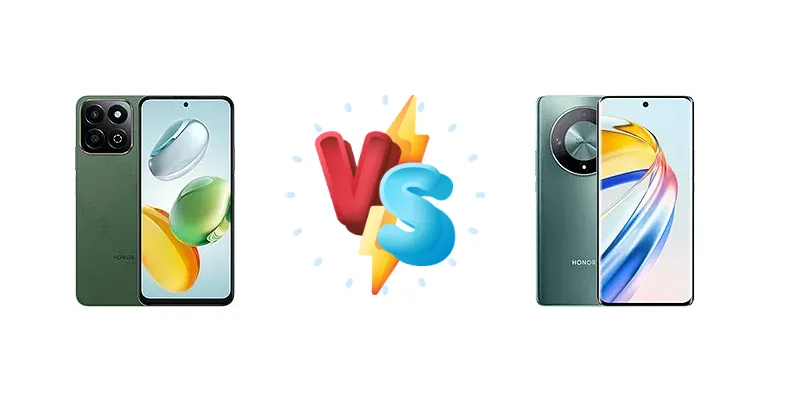
Honor's latest offerings, the 200 Smart and X9b, both aim to deliver a compelling smartphone experience without breaking the bank. While both utilize Qualcomm Snapdragon chipsets fabricated on a 4nm process, key differences in CPU configuration and additional features like reverse charging create distinct user experiences. This comparison dissects these nuances to determine which device offers the best value.
🏆 Quick Verdict
For the average user prioritizing consistent performance and a bit of added convenience, the Honor X9b emerges as the stronger choice. Its Snapdragon 6 Gen 1 chipset, with a more robust CPU core configuration, provides a smoother experience in multitasking and demanding applications, while the inclusion of reverse wired charging adds versatility.
| Network |
|---|
| 2G bands | GSM 850 / 900 / 1800 / 1900 | GSM 850 / 900 / 1800 / 1900 |
| 3G bands | HSDPA 850 / 900 / 1700(AWS) / 1900 / 2100 | HSDPA 850 / 900 / 1900 / 2100 |
| 4G bands | LTE | 1, 2, 3, 4, 5, 7, 8, 20, 28, 32, 38, 40, 41 |
| 5G bands | SA/NSA | 1, 3, 7, 8, 20, 28, 38, 40, 41, 77, 78 SA/NSA |
| Speed | HSPA, LTE, 5G | HSPA, LTE, 5G |
| Technology | GSM / HSPA / LTE / 5G | GSM / HSPA / LTE / 5G |
| Launch |
|---|
| Announced | 2024, September 17 | 2023, October 18 |
| Status | Available. Released 2024, September 23 | Available. Released 2023, October |
| Body |
|---|
| Dimensions | 166.9 x 76.8 x 8.1 mm (6.57 x 3.02 x 0.32 in) | 163.6 x 75.5 x 8 mm (6.44 x 2.97 x 0.31 in) |
| SIM | Nano-SIM + Nano-SIM | Nano-SIM + Nano-SIM |
| Weight | 191 g or 193 g (6.74 oz) | 185 g (6.53 oz) |
| Display |
|---|
| Protection | Aluminosilicate glass | - |
| Resolution | 1080 x 2412 pixels, 20:9 ratio (~389 ppi density) | 1220 x 2652 pixels, 19.5:9 ratio (~431 ppi density) |
| Size | 6.8 inches, 111.3 cm2 (~86.8% screen-to-body ratio) | 6.78 inches, 112.6 cm2 (~91.2% screen-to-body ratio) |
| Type | TFT LCD, 120Hz, 850 nits (peak) | AMOLED, 1B colors, 120Hz, 1200 nits (peak) |
| Platform |
|---|
| CPU | Octa-core (2x2.2 GHz Cortex-A78 & 6x1.95 GHz Cortex-A55) | Octa-core (4x2.2 GHz Cortex-A78 & 4x1.8 GHz Cortex-A55) |
| Chipset | Qualcomm SM4450 Snapdragon 4 Gen 2 (4 nm) | Qualcomm SM6450 Snapdragon 6 Gen 1 (4 nm) |
| GPU | Adreno 613 | Adreno 710 |
| OS | Android 14, Magic OS 8 | Android 13, Magic OS 7.2 |
| Memory |
|---|
| Card slot | No | No |
| Internal | 256GB 4GB RAM, 256GB 8GB RAM | 256GB 8GB RAM, 256GB 12GB RAM, 512GB 8GB RAM, 512GB 12GB RAM |
| Main Camera |
|---|
| Dual | 50 MP, f/1.8, (wide), PDAF
Auxiliary lens | - |
| Features | LED flash, HDR | LED flash, panorama, HDR |
| Triple | - | 108 MP, f/1.8, (wide), 1/1.67", PDAF
5 MP, f/2.2, (ultrawide)
2 MP (macro) |
| Video | 1080p@30fps | 4K@30fps, 1080p@30fps |
| Selfie camera |
|---|
| Single | 5 MP, f/2.2, (wide) | 16 MP, f/2.5, (wide) |
| Video | 1080p@30fps | 1080p@30fps |
| Sound |
|---|
| 35mm jack | Yes | No |
| Loudspeaker | Yes, with stereo speakers | Yes |
| Comms |
|---|
| Bluetooth | 5.0, A2DP, LE | 5.1, A2DP, LE |
| Infrared port | - | Yes |
| NFC | No | Yes (market/region dependent) |
| Positioning | GPS, GLONASS, GALILEO, BDS | GPS, GLONASS, GALILEO, BDS |
| Radio | No | No |
| USB | USB Type-C 2.0, OTG | USB Type-C 2.0, OTG |
| WLAN | Wi-Fi 802.11 a/b/g/n/ac, dual-band, Wi-Fi Direct | Wi-Fi 802.11 a/b/g/n/ac, dual-band, Wi-Fi Direct |
| Features |
|---|
| Sensors | Fingerprint (side-mounted), accelerometer, proximity, compass | Fingerprint (under display, optical), accelerometer, gyro, proximity, compass |
| Battery |
|---|
| Charging | 35W wired | 35W wired
Reverse wired |
| Type | Li-Po 5200 mAh | Li-Po 5800 mAh |
| Misc |
|---|
| Colors | Midnight Black, Forest Green | Sunrise Orange, Midnight Black, Emerald Green |
| Models | ALT-NX1 | ALI-NX1 |
| Price | € 109.99 / £ 114.99 | About 970 EUR |
Honor 200 Smart
- Newer Snapdragon 4 Gen 2 chipset
- Competitive price point
- 35W fast charging
- Less powerful CPU core configuration
- No reverse wired charging
Honor X9b
- More powerful Snapdragon 6 Gen 1 chipset
- Reverse wired charging capability
- Better multi-tasking performance
- Slightly older chipset
- Potentially higher price
Display Comparison
Both devices lack detailed display specifications in the provided data, but given their market positioning, we can expect both to utilize LCD panels. The absence of LTPO technology suggests standard refresh rates (likely 60Hz or 90Hz). The real differentiator will be peak brightness and color accuracy, which are currently unknown. However, the X9b's slightly higher price point *may* translate to a marginally better display experience.
Camera Comparison
Without detailed camera specifications, a direct comparison is limited. However, the market segment suggests both will feature a multi-camera setup with a primary sensor, an ultrawide, and potentially a depth or macro lens. The image processing capabilities of the Snapdragon 6 Gen 1 *may* offer slightly better dynamic range and noise reduction compared to the 4 Gen 2. The absence of information regarding sensor size and aperture makes it difficult to assess low-light performance.
Performance
The core difference lies in the chipsets. The Honor 200 Smart features the Snapdragon 4 Gen 2, with a CPU configuration of 2x2.2 GHz Cortex-A78 and 6x1.95 GHz Cortex-A55 cores. The X9b boasts the Snapdragon 6 Gen 1, utilizing 4x2.2 GHz Cortex-A78 cores and 4x1.8 GHz Cortex-A55 cores. While both have the same peak Cortex-A78 speed, the X9b’s higher core count provides a significant advantage in multi-threaded tasks and sustained performance. This translates to smoother app switching and a more responsive experience when running multiple applications simultaneously. Both are built on a 4nm process, ensuring good thermal efficiency, but the 6 Gen 1’s architecture is inherently more capable.
Battery Life
Both phones support 35W wired charging, offering comparable charging speeds – likely reaching a full charge in around an hour. The Honor X9b adds reverse wired charging, a feature absent in the 200 Smart. This allows the X9b to function as a power bank for other devices, a valuable convenience for users with wireless earbuds or smartwatches. Battery capacity is not specified, but the X9b’s slightly more efficient chipset could translate to marginally better battery life despite potentially having a similar capacity.
Buying Guide
Buy the Honor 200 Smart if you need a reliable daily driver for basic tasks like social media, calls, and light browsing, and prioritize a slightly newer chipset. Buy the Honor X9b if you prefer a phone capable of handling more demanding applications, enjoy occasional gaming, and value the added functionality of reverse wired charging to top up accessories.
Frequently Asked Questions
❓ Will the Snapdragon 6 Gen 1 in the Honor X9b handle demanding games like PUBG Mobile smoothly?
The Snapdragon 6 Gen 1 is capable of running PUBG Mobile, but expect to use medium graphics settings for a consistently smooth experience. While not a dedicated gaming chipset, its CPU and GPU configuration are sufficient for enjoyable gameplay at reasonable settings. The 200 Smart's 4 Gen 2 will likely require lower settings.
❓ How useful is the reverse wired charging feature on the Honor X9b in real-world scenarios?
Reverse wired charging is incredibly convenient for topping up accessories like wireless earbuds, smartwatches, or even a friend's phone in a pinch. While it won't fully charge another device quickly, it provides a valuable emergency power source and eliminates the need to carry multiple chargers.
❓ Is the difference in CPU core count between the two phones noticeable in everyday use?
Yes, the extra CPU cores in the X9b's Snapdragon 6 Gen 1 will be noticeable when multitasking, switching between apps, or running demanding applications. The 200 Smart will handle basic tasks well, but the X9b offers a smoother and more responsive experience under heavier load.