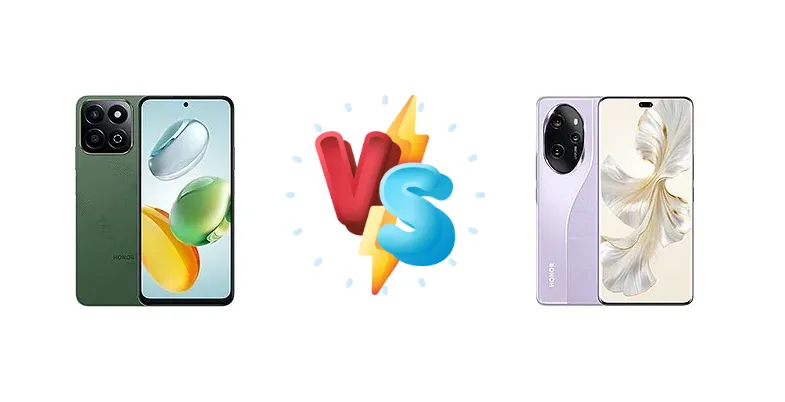
Honor has positioned the 100 Pro as a premium offering, leveraging flagship silicon, while the 200 Smart aims for a compelling balance of features and affordability. This comparison dissects the core differences between these two devices, focusing on how their contrasting chipsets and charging capabilities impact the user experience.
🏆 Quick Verdict
For most users, the Honor 100 Pro is the superior choice, offering significantly faster performance thanks to the Snapdragon 8 Gen 2 and blazing-fast 100W charging. However, the Honor 200 Smart presents a strong value proposition for budget-conscious buyers who prioritize efficiency over raw power.
| Network |
|---|
| 2G bands | GSM 850 / 900 / 1800 / 1900 | GSM 850 / 900 / 1800 / 1900 |
| 3G bands | HSDPA 850 / 900 / 1700(AWS) / 1900 / 2100 | HSDPA 800 / 850 / 900 / 1700(AWS) / 1900 / 2100 |
| 4G bands | LTE | LTE |
| 5G bands | SA/NSA | SA/NSA |
| Speed | HSPA, LTE, 5G | HSPA, LTE, 5G |
| Technology | GSM / HSPA / LTE / 5G | GSM / CDMA / HSPA / CDMA2000 / LTE / 5G |
| Launch |
|---|
| Announced | 2024, September 17 | 2023, November 23 |
| Status | Available. Released 2024, September 23 | Available. Released 2023, November 23 |
| Body |
|---|
| Dimensions | 166.9 x 76.8 x 8.1 mm (6.57 x 3.02 x 0.32 in) | 163.7 x 74.7 x 8.2 mm or 8.5 mm |
| SIM | Nano-SIM + Nano-SIM | Nano-SIM + Nano-SIM |
| Weight | 191 g or 193 g (6.74 oz) | 195 g (6.88 oz) |
| Display |
|---|
| Protection | Aluminosilicate glass | - |
| Resolution | 1080 x 2412 pixels, 20:9 ratio (~389 ppi density) | 1224 x 2700 pixels (~437 ppi density) |
| Size | 6.8 inches, 111.3 cm2 (~86.8% screen-to-body ratio) | 6.78 inches, 111.5 cm2 (~91.2% screen-to-body ratio) |
| Type | TFT LCD, 120Hz, 850 nits (peak) | OLED, 1B colors, 120Hz, HDR, 2600 nits (peak) |
| Platform |
|---|
| CPU | Octa-core (2x2.2 GHz Cortex-A78 & 6x1.95 GHz Cortex-A55) | Octa-core (1x3.2 GHz Cortex-X3 & 2x2.8 GHz Cortex-A715 & 2x2.8 GHz Cortex-A710 & 3x2.0 GHz Cortex-A510) |
| Chipset | Qualcomm SM4450 Snapdragon 4 Gen 2 (4 nm) | Qualcomm SM8550-AB Snapdragon 8 Gen 2 (4 nm) |
| GPU | Adreno 613 | Adreno 740 |
| OS | Android 14, Magic OS 8 | Android 13, MagicOS 7.2 |
| Memory |
|---|
| Card slot | No | No |
| Internal | 256GB 4GB RAM, 256GB 8GB RAM | 256GB 12GB RAM, 256GB 16GB RAM, 512GB 16GB RAM, 1TB 16GB RAM |
| Main Camera |
|---|
| Dual | 50 MP, f/1.8, (wide), PDAF
Auxiliary lens | - |
| Features | LED flash, HDR | LED flash, HDR, panorama |
| Triple | - | 50 MP, f/2.0, 27mm (wide), 1/1.56", 1.0µm, PDAF, OIS
32 MP, f/2.4, (telephoto), PDAF, OIS, 2.5x optical zoom
12 MP, f/2.2, 112˚ (ultrawide), AF |
| Video | 1080p@30fps | 4K@30fps, 1080p@30/60fps, gyro-EIS, OIS |
| Selfie camera |
|---|
| Dual | - | 50 MP, f/2.0
2 MP, f/2.4, (depth) |
| Features | - | HDR |
| Single | 5 MP, f/2.2, (wide) | - |
| Video | 1080p@30fps | 4K@30fps, 1080p@30fps, gyro-EIS |
| Sound |
|---|
| 35mm jack | Yes | No |
| Loudspeaker | Yes, with stereo speakers | Yes, with stereo speakers |
| Comms |
|---|
| Bluetooth | 5.0, A2DP, LE | 5.3, A2DP, LE, aptX HD |
| NFC | No | Yes |
| Positioning | GPS, GLONASS, GALILEO, BDS | GPS, GALILEO, GLONASS, BDS, QZSS |
| Radio | No | No |
| USB | USB Type-C 2.0, OTG | USB Type-C 2.0, OTG |
| WLAN | Wi-Fi 802.11 a/b/g/n/ac, dual-band, Wi-Fi Direct | Wi-Fi 802.11 a/b/g/n/ac/6, dual-band, Wi-Fi Direct |
| Features |
|---|
| Sensors | Fingerprint (side-mounted), accelerometer, proximity, compass | Fingerprint (under display, optical), accelerometer, gyro, compass, ultrasound proximity |
| Battery |
|---|
| Charging | 35W wired | 100W wired, 50% in 10 min
66W wireless, 100% in 42 min
5W reverse wired
Reverse wireless |
| Type | Li-Po 5200 mAh | Li-Po 5000 mAh |
| Misc |
|---|
| Colors | Midnight Black, Forest Green | Black, Silver, Blue, Violet |
| Models | ALT-NX1 | MAA-AN10 |
| Price | € 109.99 / £ 114.99 | About 440 EUR |
Honor 200 Smart
- Excellent value for money
- Efficient Snapdragon 4 Gen 2 chipset
- Decent performance for everyday tasks
- Significantly slower charging
- Limited performance for demanding games
- Potentially lower camera quality
Honor 100 Pro
- Flagship Snapdragon 8 Gen 2 performance
- Ultra-fast 100W wired and 66W wireless charging
- Superior image processing capabilities
- Higher price point
- Potentially higher power consumption
- May require more frequent charging if heavily used
Display Comparison
While both devices likely feature OLED panels (based on Honor's typical offerings), the specifics are not provided. The core difference lies in the processing power driving them. The Snapdragon 8 Gen 2 in the 100 Pro will enable smoother animations and faster response times, particularly noticeable in fast-paced games. The 200 Smart's display, while adequate, will be limited by the Snapdragon 4 Gen 2's graphical capabilities. We anticipate the 100 Pro will have a higher peak brightness and potentially a higher refresh rate, though this is speculative without further data.
Camera Comparison
Without detailed camera specifications, a direct comparison is limited. However, the 100 Pro’s flagship chipset enables more sophisticated image signal processing (ISP), resulting in better dynamic range, noise reduction, and overall image quality. The 8 Gen 2’s ISP is capable of handling higher resolution sensors and more complex computational photography algorithms. While the 200 Smart will likely produce acceptable images in good lighting conditions, it will struggle in low-light scenarios compared to the 100 Pro. The absence of details regarding sensor sizes and OIS makes a definitive statement impossible, but the chipset advantage heavily favors the 100 Pro.
Performance
The performance gap is substantial. The Honor 100 Pro’s Snapdragon 8 Gen 2 (4nm) boasts a prime Cortex-X3 core clocked at 3.2 GHz, alongside high-performance Cortex-A715 and A710 cores. This contrasts sharply with the 200 Smart’s Snapdragon 4 Gen 2 (4nm), which utilizes Cortex-A78 and A55 cores. The 8 Gen 2’s architecture is designed for sustained peak performance, crucial for demanding games and applications, while the 4 Gen 2 prioritizes efficiency. The 100 Pro will exhibit significantly faster app loading times, smoother multitasking, and a more responsive overall experience. The 4nm process node is shared, but the architectural differences are paramount.
Battery Life
The Honor 100 Pro’s 100W wired charging is a game-changer, promising a 50% charge in just 10 minutes and a full charge in under 30. The addition of 66W wireless charging and reverse charging capabilities further enhances its convenience. The 200 Smart’s 35W charging is considerably slower, requiring significantly longer to reach a full charge. While battery capacity isn’t specified, the 100 Pro’s more efficient chipset and faster charging mitigate the impact of a potentially smaller battery. The 100 Pro offers a far more flexible and convenient charging experience.
Buying Guide
Buy the Honor 200 Smart if you need a reliable daily driver for basic tasks, social media, and light gaming, and value long-term battery life and affordability. Buy the Honor 100 Pro if you prioritize demanding applications like gaming, video editing, and fast charging, and are willing to pay a premium for a smoother, more responsive experience.
Frequently Asked Questions
❓ Will the Snapdragon 4 Gen 2 in the Honor 200 Smart struggle with graphically intensive games like Genshin Impact?
Yes, the Snapdragon 4 Gen 2 is a mid-range chipset and will likely require significant graphical settings reductions to achieve playable frame rates in demanding titles like Genshin Impact. Expect noticeable frame drops and potentially long loading times.
❓ How much faster is the 100W charging on the Honor 100 Pro compared to the 35W charging on the 200 Smart in a real-world scenario?
The 100W charging on the 100 Pro can add approximately 50% battery life in just 10 minutes, while the 35W charging on the 200 Smart will add significantly less in the same timeframe – likely around 20-25%. A full charge on the 100 Pro takes under 30 minutes, whereas the 200 Smart will take well over an hour.
❓ Does the Honor 100 Pro experience thermal throttling during extended gaming sessions?
The Snapdragon 8 Gen 2 is known for its thermal efficiency, but sustained peak performance can still generate heat. Honor likely incorporates cooling solutions to mitigate throttling, but prolonged, demanding gaming sessions may still result in some performance reduction over time. However, it will be far less pronounced than on the 200 Smart.