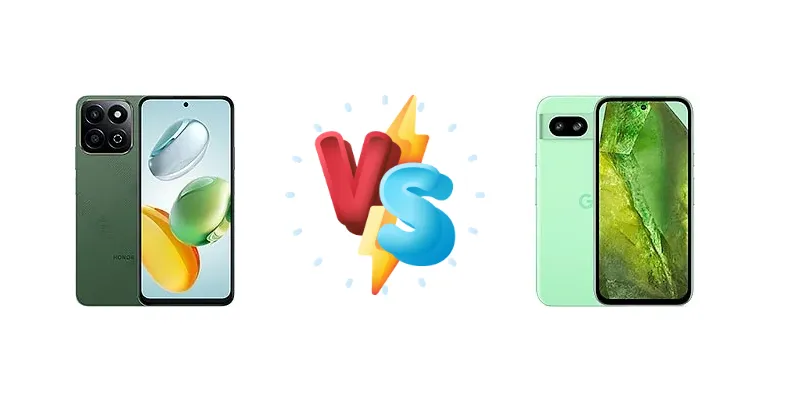
The Honor 200 Smart and Google Pixel 8a represent compelling options in the increasingly competitive mid-range smartphone market. The Honor focuses on delivering rapid charging and a modern chipset at an accessible price, while the Pixel 8a leverages Google’s Tensor G3 chip and renowned camera software for a more refined, albeit slightly more expensive, experience. This comparison dissects their key differences to determine which device best suits your needs.
🏆 Quick Verdict
For the average user prioritizing long-term software support and a consistently smooth experience, the Google Pixel 8a is the better choice. Its Tensor G3 chipset and exceptional battery endurance, boasting 40:06h of endurance, outweigh the Honor 200 Smart’s faster charging, especially considering the Pixel 8a’s superior display brightness.
| Network |
|---|
| 2G bands | GSM 850 / 900 / 1800 / 1900 | GSM 850 / 900 / 1800 / 1900 |
| 3G bands | HSDPA 850 / 900 / 1700(AWS) / 1900 / 2100 | HSDPA 800 / 850 / 900 / 1700(AWS) / 1900 / 2100 |
| 4G bands | LTE | 1, 2, 3, 4, 5, 7, 8, 12, 17, 18, 19, 20, 26, 28, 32, 38, 40, 41, 42, 66 - G6GPR (International) |
| 5G bands | SA/NSA | 1, 2, 3, 5, 7, 8, 12, 20, 26, 28, 38, 40, 41, 66, 75, 76, 77, 78 SA/NSA/Sub6 - G6GPR (International) |
| Speed | HSPA, LTE, 5G | HSPA, LTE, 5G |
| Technology | GSM / HSPA / LTE / 5G | GSM / HSPA / LTE / 5G |
| Launch |
|---|
| Announced | 2024, September 17 | 2024, May 07 |
| Status | Available. Released 2024, September 23 | Available. Released 2024, May 14 |
| Body |
|---|
| Build | - | Glass front (Gorilla Glass 3), aluminum frame, plastic back |
| Dimensions | 166.9 x 76.8 x 8.1 mm (6.57 x 3.02 x 0.32 in) | 152.1 x 72.7 x 8.9 mm (5.99 x 2.86 x 0.35 in) |
| SIM | Nano-SIM + Nano-SIM | Nano-SIM + eSIM |
| Weight | 191 g or 193 g (6.74 oz) | 188 g (6.63 oz) |
| Display |
|---|
| Protection | Aluminosilicate glass | Corning Gorilla Glass 3, Mohs level 5 |
| Resolution | 1080 x 2412 pixels, 20:9 ratio (~389 ppi density) | 1080 x 2400 pixels, 20:9 ratio (~430 ppi density) |
| Size | 6.8 inches, 111.3 cm2 (~86.8% screen-to-body ratio) | 6.1 inches, 90.3 cm2 (~81.6% screen-to-body ratio) |
| Type | TFT LCD, 120Hz, 850 nits (peak) | OLED, HDR, 120Hz, 2000 nits (peak) |
| Platform |
|---|
| CPU | Octa-core (2x2.2 GHz Cortex-A78 & 6x1.95 GHz Cortex-A55) | Nona-core (1x3.0 GHz Cortex-X3 & 4x2.45 GHz Cortex-A715 & 4x2.15 GHz Cortex-A510) |
| Chipset | Qualcomm SM4450 Snapdragon 4 Gen 2 (4 nm) | Google Tensor G3 (4 nm) |
| GPU | Adreno 613 | Immortalis-G715s MC10 |
| OS | Android 14, Magic OS 8 | Android 14, upgradable to Android 16, up to 7 major Android upgrades |
| Memory |
|---|
| Card slot | No | No |
| Internal | 256GB 4GB RAM, 256GB 8GB RAM | 128GB 8GB RAM, 256GB 8GB RAM |
| Main Camera |
|---|
| Dual | 50 MP, f/1.8, (wide), PDAF
Auxiliary lens | 64 MP (16 MP eff.), f/1.9, 26mm (wide), 1/1.73", 0.8µm, dual pixel PDAF, OIS
13 MP, f/2.2, 120˚ (ultrawide), 1.12µm |
| Features | LED flash, HDR | Dual-LED flash, Pixel Shift, Ultra HDR, panorama, Best Take |
| Video | 1080p@30fps | 4K@30/60fps, 1080p@30/60/120/240fps, OIS |
| Selfie camera |
|---|
| Features | - | HDR, panorama |
| Single | 5 MP, f/2.2, (wide) | 13 MP, f/2.2, 20mm (ultrawide), 1.12µm |
| Video | 1080p@30fps | 4K@30fps, 1080p@30/60fps |
| Sound |
|---|
| 35mm jack | Yes | No |
| Loudspeaker | Yes, with stereo speakers | Yes, with stereo speakers |
| Comms |
|---|
| Bluetooth | 5.0, A2DP, LE | 5.3, A2DP, LE |
| NFC | No | Yes |
| Positioning | GPS, GLONASS, GALILEO, BDS | GPS, GLONASS, GALILEO, BDS, QZSS, NavIC |
| Radio | No | No |
| USB | USB Type-C 2.0, OTG | USB Type-C 3.2 |
| WLAN | Wi-Fi 802.11 a/b/g/n/ac, dual-band, Wi-Fi Direct | Wi-Fi 802.11 a/b/g/n/ac/6e, dual/tri-band (market/region dependent) |
| Features |
|---|
| Sensors | Fingerprint (side-mounted), accelerometer, proximity, compass | Fingerprint (under display, optical), accelerometer, gyro, proximity, compass, barometer |
| Battery |
|---|
| Charging | 35W wired | 18W wired, PD3.0
7.5W wireless
Bypass charging |
| Type | Li-Po 5200 mAh | Li-Po 4492 mAh |
| Misc |
|---|
| Colors | Midnight Black, Forest Green | Obsidian, Porcelain, Bay, Aloe |
| Models | ALT-NX1 | GKV4X, G6GPR, G8HHN, G576D |
| Price | € 109.99 / £ 114.99 | $ 229.98 / C$ 417.99 / £ 279.00 / € 299.99 / ₹ 33,300 |
| EU LABEL |
|---|
| Battery | - | 40:06h endurance, 1000 cycles |
| Energy | - | Class B |
| Free fall | - | Class A (270 falls) |
| Repairability | - | Class B |
Honor 200 Smart
- Faster 35W wired charging
- Potentially lower price point
- Modern Snapdragon 4 Gen 2 chipset (4nm)
- Less established software update support
- Likely inferior camera performance
- Display brightness likely lower than Pixel 8a
Google Pixel 8a
- Exceptional battery life (40:06h endurance)
- Superior performance with Google Tensor G3
- Guaranteed software updates and security patches
- Slower 18W wired charging
- Higher price point
- No expandable storage
Display Comparison
The Google Pixel 8a boasts a significantly brighter display, reaching a measured peak of 1508 nits, making it far more usable in direct sunlight compared to the Honor 200 Smart (brightness data unavailable). While both utilize OLED technology, the Pixel 8a’s higher brightness and likely superior color calibration (based on Google’s display tuning) provide a more vibrant and accurate viewing experience. The absence of LTPO technology on either device suggests both will rely on adaptive refresh rates to conserve battery, but the Pixel 8a’s superior brightness is a clear advantage.
Camera Comparison
While detailed camera specs are missing for the Honor 200 Smart, the Pixel 8a’s strength lies in Google’s computational photography. The Pixel 8a leverages Google’s image processing algorithms to deliver consistently excellent photos, even in challenging lighting conditions. The absence of information regarding the Honor’s sensor size and OIS makes a direct comparison difficult, but the Pixel 8a’s software-driven approach often surpasses hardware advantages in this price segment. We can assume the Honor will include a standard set of lenses, but the Pixel 8a’s image quality is likely to be superior due to its advanced processing.
Performance
The core difference lies in the chipsets. The Google Pixel 8a’s Tensor G3, a nona-core processor with a Cortex-X3 prime core clocked at 3.0 GHz, is architecturally more advanced than the Honor 200 Smart’s Qualcomm Snapdragon 4 Gen 2. The Tensor G3’s combination of Cortex-A715 and A510 cores, coupled with Google’s software optimizations, delivers a smoother and more responsive experience, particularly in demanding tasks like video editing and gaming. While the Snapdragon 4 Gen 2 (4nm) is efficient, its Cortex-A78 and A55 cores are older designs. The Pixel 8a’s chipset is designed for on-device AI processing, enhancing features like voice assistant and camera capabilities.
Battery Life
The Google Pixel 8a demonstrates a clear advantage in battery endurance, achieving a remarkable 40:06h of endurance and an active use score of 11:25h. This is significantly better than what is typically seen in this price range. While the Honor 200 Smart offers faster 35W wired charging, the Pixel 8a’s longevity, coupled with 18W charging (PD3.0) and 7.5W wireless charging, provides a more convenient and reliable experience. The Pixel 8a’s battery is also rated for 1000 cycles, suggesting long-term reliability.
Buying Guide
Buy the Honor 200 Smart if you prioritize fast charging and a more affordable price point, and are comfortable with a less established software update track record. This phone is ideal for users who frequently top up their battery throughout the day. Buy the Google Pixel 8a if you value a consistently smooth user experience, exceptional camera performance powered by Google’s computational photography, and guaranteed software updates for years to come. It’s the better choice for users who want a phone that will remain reliable and secure for the long haul.
Frequently Asked Questions
❓ Does the Snapdragon 4 Gen 2 in the Honor 200 Smart struggle with demanding games like Genshin Impact?
While the Snapdragon 4 Gen 2 is a capable chipset, Genshin Impact and other graphically intensive games will likely require reduced graphics settings for a smooth experience. The Pixel 8a’s Tensor G3, with its more powerful GPU, will provide a noticeably better gaming experience at higher settings.
❓ How does the Pixel 8a’s 18W charging compare to the Honor 200 Smart’s 35W charging in real-world use?
Although the Honor 200 Smart charges faster on paper, the Pixel 8a’s superior battery efficiency means you’ll likely find yourself charging less frequently. The convenience of longer battery life often outweighs the benefit of faster charging speeds.
❓ Is the Pixel 8a’s Tensor G3 chip known to overheat during prolonged use?
Early reports indicated some thermal throttling with the Tensor G3 in the Pixel 8 series, but Google has made improvements with the Tensor G3 in the Pixel 8a. While it may get warm during extended gaming sessions, it’s generally well-managed and doesn’t lead to significant performance drops.
❓ What kind of software support can I expect from the Honor 200 Smart compared to the Pixel 8a?
Google guarantees at least 7 years of software updates for the Pixel 8a, including security patches and OS upgrades. Honor’s software support track record is less consistent, typically offering fewer major Android updates and shorter security patch support periods.