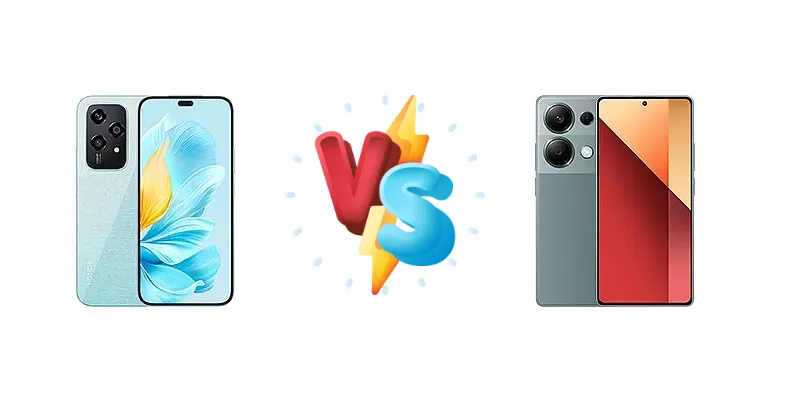
The mid-range smartphone market is fiercely competitive, and the Honor 200 Lite and Xiaomi Redmi Note 13 Pro 4G represent compelling options for budget-conscious buyers. While both aim to deliver a balanced experience, they take different approaches to chipset selection and feature prioritization. This comparison dives deep into the specifics to determine which device offers the best overall package.
🏆 Quick Verdict
For the average user prioritizing fast charging and a brighter display, the Xiaomi Redmi Note 13 Pro 4G emerges as the winner. Its 67W charging significantly outperforms the Honor 200 Lite’s 35W, and the measured 1047 nits brightness provides a superior viewing experience, even outdoors. However, the Honor 200 Lite offers a slightly newer chipset architecture.
| Network |
|---|
| 2G bands | GSM 850 / 900 / 1800 / 1900 | GSM 850 / 900 / 1800 / 1900 |
| 3G bands | HSDPA 850 / 900 / 1900 / 2100 | HSDPA 850 / 900 / 1700(AWS) / 1900 / 2100 |
| 4G bands | LTE | 1, 2, 3, 4, 5, 7, 8, 12, 13, 17, 18, 19, 20, 26, 28, 38, 40, 41, 66 |
| 5G bands | SA/NSA | - |
| Speed | HSPA, LTE, 5G | HSPA, LTE |
| Technology | GSM / HSPA / LTE / 5G | GSM / HSPA / LTE |
| Launch |
|---|
| Announced | 2024, April 25 | 2024, January 15 |
| Status | Available. Released 2024, May 03 | Available. Released 2024, January 15 |
| Body |
|---|
| Build | - | Glass front (Gorilla Glass 5), plastic frame, plastic back |
| Dimensions | 161.1 x 74.6 x 6.8 mm (6.34 x 2.94 x 0.27 in) | 161.1 x 75 x 8 mm (6.34 x 2.95 x 0.31 in) |
| SIM | Nano-SIM + Nano-SIM | Nano-SIM + Nano-SIM |
| Weight | 166 g (5.86 oz) | 188 g (6.63 oz) |
| Display |
|---|
| Protection | - | Corning Gorilla Glass 5 |
| Resolution | 1080 x 2412 pixels, 20:9 ratio (~394 ppi density) | 1080 x 2400 pixels, 20:9 ratio (~395 ppi density) |
| Size | 6.7 inches, 108.0 cm2 (~89.9% screen-to-body ratio) | 6.67 inches, 107.4 cm2 (~88.9% screen-to-body ratio) |
| Type | AMOLED, 90Hz, 3240Hz PWM | AMOLED, 1B colors, 120Hz, 500 nits (typ), 1000 nits (HBM), 1300 nits (peak) |
| Platform |
|---|
| CPU | Octa-core (2x2.4 GHz Cortex-A76 & 6x2.0 GHz Cortex-A55) | Octa-core (2x2.2 GHz Cortex-A76 & 6x2.0 GHz Cortex-A55) |
| Chipset | Mediatek Dimensity 6080 (6 nm) | Mediatek Helio G99 Ultra |
| GPU | Mali-G57 MC2 | Mali-G57 MC2 |
| OS | Android 14, MagicOS 8 | Android 13, up to 3 major Android upgrades, HyperOS |
| Memory |
|---|
| Card slot | No | microSDXC (uses shared SIM slot) |
| Internal | 256GB 8GB RAM, 256GB 12GB RAM | 128GB 8GB RAM, 256GB 8GB RAM, 256GB 12GB RAM, 512GB 8GB RAM, 512GB 12GB RAM |
| Main Camera |
|---|
| Features | LED flash, HDR, panorama | LED flash, HDR, panorama |
| Triple | 108 MP, f/1.8, (wide), PDAF
5 MP, f/2.2, (ultrawide)
2 MP (macro) | 200 MP, f/1.7, 23mm (wide), 1/1.4", 0.56µm, multi-directional PDAF, OIS
8 MP, f/2.2, 15mm, 120˚ (ultrawide), 1/4.4", 1.0µm
2 MP (macro) |
| Video | 1080p@30fps | 1080p@30/60fps |
| Selfie camera |
|---|
| Features | LED flash | - |
| Single | 50 MP, f/2.1, (wide) | 16 MP, f/2.4, (wide), 1/3.0", 1.0µm |
| Video | 1080p@30fps | 1080p@30/60fps |
| Sound |
|---|
| 35mm jack | No | Yes |
| Loudspeaker | Yes | Yes, with dual speakers |
| Comms |
|---|
| Bluetooth | 5.1, A2DP, LE | 5.2, A2DP, LE |
| Infrared port | - | Yes |
| NFC | Yes (market/region dependent) | Yes (market/region dependent) |
| Positioning | GPS, GLONASS, GALILEO, BDS | GPS, GLONASS, GALILEO, BDS |
| Radio | Unspecified | FM radio |
| USB | USB Type-C 2.0, OTG | USB Type-C 2.0, OTG |
| WLAN | Wi-Fi 802.11 a/b/g/n/ac, dual-band, Wi-Fi Direct | Wi-Fi 802.11 a/b/g/n/ac, dual-band |
| Features |
|---|
| Sensors | Fingerprint (side-mounted), accelerometer, proximity, compass | Fingerprint (under display, optical), accelerometer, gyro, compass |
| Battery |
|---|
| Charging | 35W wired | 67W wired, 50% in 16 min, 100% in 46 min |
| Type | Li-Po 4500 mAh | 5000 mAh |
| Misc |
|---|
| Colors | Starry Blue, Cyan Lake, Black | Midnight Black, Lavender Purple, Forest Green |
| Models | LLY-NX1 | 23117RA68G, 2312FPCA6G |
| Price | $ 169.00 / £ 144.99 / € 164.21 | € 92.00 / $ 269.99 / £ 299.99 |
| SAR | - | 1.09 W/kg (head) 1.09 W/kg (body) |
| SAR EU | 0.84 W/kg (head) 1.25 W/kg (body) | 0.99 W/kg (head) 0.99 W/kg (body) |
Honor 200 Lite
- Slightly newer CPU architecture (Dimensity 6080)
- Potentially better power efficiency due to 6nm process
- Competitive price point (likely)
- Slower 35W charging
- Likely lower peak display brightness
- Limited camera feature set (assumed)
Xiaomi Redmi Note 13 Pro 4G
- 67W fast charging (50% in 16 min)
- High peak display brightness (1047 nits)
- Longer active use battery life (11:36h)
- Slightly older CPU architecture (Helio G99 Ultra)
- Potentially less power efficient (compared to 6nm)
- May have more bloatware (typical Xiaomi)
Display Comparison
The Xiaomi Redmi Note 13 Pro 4G boasts a significant advantage in display technology, achieving a measured peak brightness of 1047 nits. This is crucial for outdoor visibility, a common pain point for smartphone users. While the Honor 200 Lite’s display specifications are not provided, it’s unlikely to match this level of brightness. The Redmi Note 13 Pro 4G’s higher brightness translates to a more vibrant and readable experience in direct sunlight. We can assume both devices utilize AMOLED panels given the market segment, but the Redmi’s brightness is a clear differentiator.
Camera Comparison
The context data for both devices is limited regarding camera specifics. However, the Redmi Note 13 Pro 4G’s inclusion of ‘Photo / Video’ suggests a more feature-rich camera experience. Given Xiaomi’s history, it’s likely to include more shooting modes and potentially better image processing algorithms. Without sensor size or aperture information, it’s difficult to make a definitive judgment, but the Redmi’s branding suggests a greater emphasis on camera capabilities. We can safely assume both phones will include a standard set of lenses, but the Redmi is likely to offer more versatility.
Performance
Both phones utilize MediaTek chipsets, but differ in their implementation. The Honor 200 Lite features the Dimensity 6080, built on a 6nm process, while the Redmi Note 13 Pro 4G uses the Helio G99 Ultra. While the Dimensity 6080’s Cortex-A76 cores are clocked slightly higher at 2.4 GHz versus the G99 Ultra’s 2.2 GHz, the 6nm process node of the Dimensity 6080 *should* offer better power efficiency. However, the G99 Ultra is a mature platform, and real-world performance differences will likely be minimal for everyday tasks. The Honor 200 Lite may show a slight edge in sustained CPU-intensive workloads due to the more efficient node.
Battery Life
The Xiaomi Redmi Note 13 Pro 4G shines in the battery department, achieving an impressive 11:36h of active use. This, combined with its 67W wired charging (50% in 16 minutes, 100% in 46 minutes), provides a significant advantage over the Honor 200 Lite’s 35W charging. While the Honor 200 Lite’s battery capacity isn’t specified, the faster charging of the Redmi Note 13 Pro 4G mitigates the impact of any potential capacity difference. The Redmi’s charging speed is a game-changer for users who frequently need to top up their battery quickly.
Buying Guide
Buy the Honor 200 Lite if you prioritize a slightly more modern CPU architecture and are comfortable with slower charging speeds. It’s a good choice for users who primarily browse, use social media, and engage in light gaming. Buy the Xiaomi Redmi Note 13 Pro 4G if you value rapid charging, a brighter and more visible display, and longer battery life during active use, making it ideal for power users and those who frequently consume media on the go.
Frequently Asked Questions
❓ Does the Helio G99 Ultra in the Redmi Note 13 Pro 4G throttle under sustained gaming loads?
The Helio G99 Ultra is a capable chipset, but it's not a flagship performer. While it can handle most mobile games at medium to high settings, prolonged gaming sessions may result in some thermal throttling. However, Xiaomi typically implements thermal management solutions to mitigate this, and the G99 Ultra's efficiency helps to keep temperatures in check.
❓ How does the 35W charging on the Honor 200 Lite compare to typical fast charging standards?
35W charging is considered relatively slow by today's standards. While it's still faster than standard 15W or 18W charging, it will take significantly longer to fully charge the Honor 200 Lite compared to the Redmi Note 13 Pro 4G's 67W charging. Expect a full charge to take well over an hour.
❓ Is the camera on the Redmi Note 13 Pro 4G good for low-light photography?
Without specific sensor details, it's hard to say definitively. However, Xiaomi generally focuses on camera performance, and the Redmi Note 13 Pro 4G likely includes a dedicated night mode and image processing algorithms to improve low-light photos. Expect decent results, but don't expect flagship-level performance.