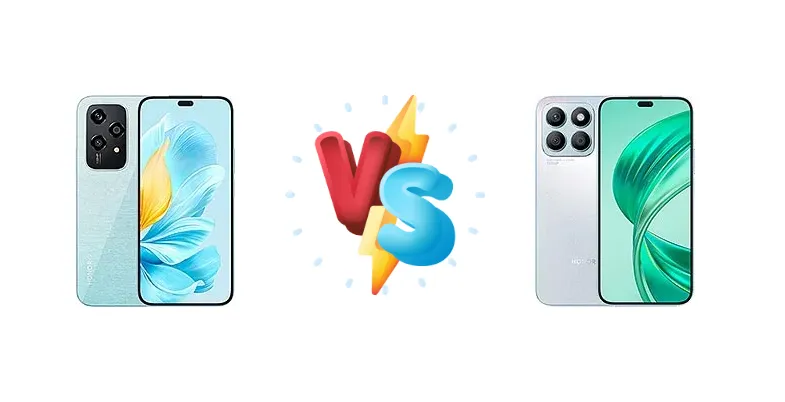
The Honor 200 Lite and X8b represent Honor's continued push into the competitive budget smartphone market. While both devices aim to deliver a compelling experience without breaking the bank, they take different approaches to achieving this goal, primarily through their chipset choices. This comparison will dissect the key differences between the Mediatek Dimensity 6080-powered 200 Lite and the Qualcomm Snapdragon 680-equipped X8b, helping you determine which phone best suits your needs.
🏆 Quick Verdict
For most users, the Honor 200 Lite emerges as the stronger choice. Its Mediatek Dimensity 6080 chipset offers a noticeable performance advantage over the Snapdragon 680 in the X8b, particularly in demanding tasks and gaming. While both phones share a 35W charging rate, the 200 Lite’s more modern processor provides a better future-proofing and overall user experience.
| Network |
|---|
| 2G bands | GSM 850 / 900 / 1800 / 1900 | GSM 850 / 900 / 1800 / 1900 |
| 3G bands | HSDPA 850 / 900 / 1900 / 2100 | HSDPA 850 / 900 / 1900 / 2100 |
| 4G bands | LTE | LTE |
| 5G bands | SA/NSA | - |
| Speed | HSPA, LTE, 5G | HSPA, LTE |
| Technology | GSM / HSPA / LTE / 5G | GSM / HSPA / LTE |
| Launch |
|---|
| Announced | 2024, April 25 | 2023, December 14 |
| Status | Available. Released 2024, May 03 | Available. Released 2023, December 22 |
| Body |
|---|
| Dimensions | 161.1 x 74.6 x 6.8 mm (6.34 x 2.94 x 0.27 in) | 161.1 x 74.6 x 6.8 mm (6.34 x 2.94 x 0.27 in) |
| SIM | Nano-SIM + Nano-SIM | Nano-SIM + Nano-SIM |
| Weight | 166 g (5.86 oz) | 166 g (5.86 oz) |
| Display |
|---|
| Resolution | 1080 x 2412 pixels, 20:9 ratio (~394 ppi density) | 1080 x 2412 pixels, 20:9 ratio (~394 ppi density) |
| Size | 6.7 inches, 108.0 cm2 (~89.9% screen-to-body ratio) | 6.7 inches, 108.0 cm2 (~89.9% screen-to-body ratio) |
| Type | AMOLED, 90Hz, 3240Hz PWM | AMOLED, 90Hz, 1200 nits (HBM), 2000 nits (peak) |
| Platform |
|---|
| CPU | Octa-core (2x2.4 GHz Cortex-A76 & 6x2.0 GHz Cortex-A55) | Octa-core (4x2.4 GHz Kryo 265 Gold & 4x1.9 GHz Kryo 265 Silver) |
| Chipset | Mediatek Dimensity 6080 (6 nm) | Qualcomm SM6225 Snapdragon 680 4G (6 nm) |
| GPU | Mali-G57 MC2 | Adreno 610 |
| OS | Android 14, MagicOS 8 | Android 13, MagicOS 7.2 |
| Memory |
|---|
| Card slot | No | No |
| Internal | 256GB 8GB RAM, 256GB 12GB RAM | 128GB 8GB RAM, 256GB 6GB RAM, 256GB 8GB RAM, 512GB 8GB RAM |
| Main Camera |
|---|
| Features | LED flash, HDR, panorama | LED flash, HDR, panorama |
| Triple | 108 MP, f/1.8, (wide), PDAF
5 MP, f/2.2, (ultrawide)
2 MP (macro) | 108 MP, f/1.8, 24mm (wide), 1/1.67", PDAF
5 MP, f/2.2, (ultrawide)
2 MP (macro) |
| Video | 1080p@30fps | 1080p@30fps |
| Selfie camera |
|---|
| Features | LED flash | LED flash |
| Single | 50 MP, f/2.1, (wide) | 50 MP, f/2.1, (wide) |
| Video | 1080p@30fps | 1080p@30fps |
| Sound |
|---|
| 35mm jack | No | No |
| Loudspeaker | Yes | Yes |
| Comms |
|---|
| Bluetooth | 5.1, A2DP, LE | 5.0, A2DP, LE |
| NFC | Yes (market/region dependent) | No |
| Positioning | GPS, GLONASS, GALILEO, BDS | GPS, GLONASS, GALILEO, BDS |
| Radio | Unspecified | No |
| USB | USB Type-C 2.0, OTG | USB Type-C 2.0, OTG |
| WLAN | Wi-Fi 802.11 a/b/g/n/ac, dual-band, Wi-Fi Direct | Wi-Fi 802.11 a/b/g/n/ac, dual-band, Wi-Fi Direct |
| Features |
|---|
| Sensors | Fingerprint (side-mounted), accelerometer, proximity, compass | Fingerprint (side-mounted), accelerometer, compass |
| Battery |
|---|
| Charging | 35W wired | 35W wired |
| Type | Li-Po 4500 mAh | Li-Po 4500 mAh |
| Misc |
|---|
| Colors | Starry Blue, Cyan Lake, Black | Glamorous Green, Titanium Silver, Midnight Black, Blue |
| Models | LLY-NX1 | LLY-LX1, LLY-LX2, LLY-LX3 |
| Price | $ 169.00 / £ 144.99 / € 164.21 | $ 369.00 / € 219.99 |
| SAR EU | 0.84 W/kg (head) 1.25 W/kg (body) | - |
Honor 200 Lite
- Superior processor performance with the Dimensity 6080
- 5G connectivity for faster data speeds
- More advanced ISP for potentially better camera processing
- Potential for slightly higher power consumption under heavy load
- May be slightly more expensive than the X8b
Honor X8b
- Proven reliability of the Snapdragon 680 chipset
- Good power efficiency for basic tasks
- Potentially lower price point
- Noticeably slower performance compared to the Dimensity 6080
- Limited to 4G connectivity
Display Comparison
Both the Honor 200 Lite and X8b are expected to feature LCD panels, typical for this price segment. While specific details like peak brightness and color accuracy are unavailable, the focus here is on the processing power driving the display. The Dimensity 6080 in the 200 Lite has a more capable ISP (Image Signal Processor) which *could* translate to slightly better image processing for display output, though this is speculative without direct testing. Bezels are likely comparable, and neither phone is expected to feature high refresh rate panels.
Camera Comparison
Without detailed camera specs beyond the chipsets, analysis focuses on ISP capabilities. The Dimensity 6080’s ISP is more advanced, potentially enabling better noise reduction, dynamic range, and image processing algorithms. While both phones likely feature similar primary sensor resolutions (typical for this price point), the 200 Lite’s chipset gives it an edge in computational photography. The presence of a 2MP macro camera on both devices is largely a marketing feature, offering limited practical benefit due to the small sensor size and lack of optical image stabilization (OIS).
Performance
The core difference lies in the chipsets. The Honor 200 Lite’s Mediatek Dimensity 6080 (6nm) utilizes a dual-core Cortex-A76 setup alongside six Cortex-A55 cores, peaking at 2.4 GHz. This contrasts with the Honor X8b’s Qualcomm Snapdragon 680 4G (6nm), which employs a quad-core Kryo 265 Gold and quad-core Kryo 265 Silver configuration, also peaking at 2.4 GHz. While clock speeds are similar, the Cortex-A76 cores in the Dimensity 6080 offer significantly higher single-core performance than the Kryo 265 Gold cores, resulting in snappier app launches and smoother multitasking. The Dimensity 6080 also benefits from a more modern GPU, providing a better gaming experience. The X8b's 4G connectivity is a limitation compared to the 200 Lite's 5G capabilities.
Battery Life
Both devices feature 35W wired charging, suggesting comparable charging speeds – approximately 60-70 minutes for a full charge. Battery capacity is not specified, but given the target market, both are likely in the 5000mAh range. The Dimensity 6080’s 6nm process *could* offer slightly better power efficiency under heavy load, but real-world battery life will depend heavily on usage patterns. The Snapdragon 680 is known for its efficiency in light to moderate tasks, potentially giving the X8b a slight edge in standby time.
Buying Guide
Buy the Honor 200 Lite if you prioritize performance for gaming, multitasking, and future app compatibility. Its Dimensity 6080 chipset delivers a smoother experience for power users. Buy the Honor X8b if you value a proven, reliable chipset and are primarily focused on everyday tasks like calling, texting, and social media. The Snapdragon 680 offers solid efficiency for basic usage scenarios.
Frequently Asked Questions
❓ Will the Snapdragon 680 in the Honor X8b struggle with demanding games like PUBG Mobile?
Yes, the Snapdragon 680 is a capable chip for everyday tasks, but it will likely struggle to deliver a smooth experience in graphically intensive games like PUBG Mobile, even at lower settings. Expect frame drops and potential lag. The Dimensity 6080 in the 200 Lite offers a significantly better gaming experience.
❓ Does the Honor 200 Lite support carrier aggregation for improved 5G speeds?
While the Honor 200 Lite supports 5G, specific details regarding carrier aggregation support are not available. However, given its positioning, it's likely to support at least some level of carrier aggregation, allowing for faster and more stable 5G connections where available. Check with your carrier for compatibility details.
❓ Is the 35W charging on both phones fast enough for quick top-ups throughout the day?
35W charging is reasonably fast for this price segment. Both phones should be able to charge from 0-100% in approximately 60-70 minutes. A 30-minute charge will provide a significant boost, enough for several hours of usage.