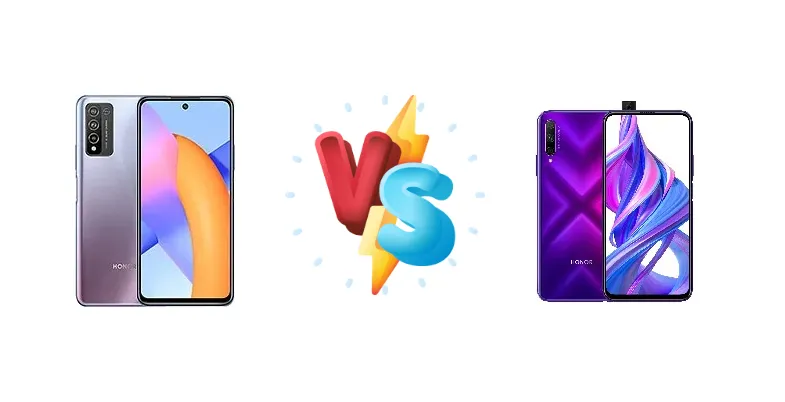
The Honor 10X Lite and 9X Pro represent different approaches to the budget and mid-range smartphone market. The 10X Lite prioritizes extended battery life and affordability, while the 9X Pro aims for a more robust performance experience. This comparison dissects their key specifications to determine which device best suits your needs.
🏆 Quick Verdict
For the average user prioritizing longevity and cost-effectiveness, the Honor 10X Lite emerges as the winner. Its significantly better battery endurance rating of 114 hours, coupled with a reasonable price point, outweighs the 9X Pro’s performance advantage. However, power users will appreciate the 9X Pro’s Kirin 810.
| Network |
|---|
| 2G bands | GSM 900 / 1800 / 1900 | GSM 850 / 900 / 1800 / 1900 |
| 3G bands | HSDPA 850 / 900 / 1900 / 2100 | HSDPA 850 / 900 / 2100 |
| 4G bands | LTE | 1, 3, 7, 8, 20, 38, 40, 41 - International |
| Speed | HSPA, LTE | HSPA 42.2/5.76 Mbps, LTE (2CA) Cat12 600/50 Mbps |
| Technology | GSM / HSPA / LTE | GSM / CDMA / HSPA / EVDO / LTE |
| | - | 1, 3, 5, 8, 38, 39, 40, 41 - China |
| Launch |
|---|
| Announced | 2020, October 29. Released 2020, October 29 | 2019, July 23. Released 2019, August 09 |
| Status | Discontinued | Discontinued |
| Body |
|---|
| Build | - | Glass front, glass back, aluminum frame |
| Dimensions | 165.7 x 76.9 x 9.3 mm (6.52 x 3.03 x 0.37 in) | 163.5 x 77.3 x 8.8 mm (6.44 x 3.04 x 0.35 in) |
| SIM | Nano-SIM + Nano-SIM | Nano-SIM + Nano-SIM |
| Weight | 206 g (7.27 oz) | 202 g (7.13 oz) |
| Display |
|---|
| Resolution | 1080 x 2400 pixels, 20:9 ratio (~395 ppi density) | 1080 x 2340 pixels, 19.5:9 ratio (~391 ppi density) |
| Size | 6.67 inches, 107.4 cm2 (~84.3% screen-to-body ratio) | 6.59 inches, 106.6 cm2 (~84.3% screen-to-body ratio) |
| Type | IPS LCD | IPS LCD |
| Platform |
|---|
| CPU | Octa-core (4x2.0 GHz Cortex-A73 & 4x1.7 GHz Cortex-A53) | Octa-core (2x2.27 GHz Cortex-A76 & 6x1.88 GHz Cortex-A55) |
| Chipset | Kirin 710A (14 nm) | Kirin 810 (7 nm) |
| GPU | Mali-G51 MP4 | Mali-G52 MP6 |
| OS | Android 10, Magic UI 3.1, no Google Play Services | Android 9.0 (Pie), upgradable to Android 10, EMUI 9.1, no Google Play Services |
| Memory |
|---|
| Card slot | microSDXC (dedicated slot) | microSDXC (uses shared SIM slot) |
| Internal | 128GB 4GB RAM | 128GB 8GB RAM, 256GB 6GB RAM, 256GB 8GB RAM |
| Main Camera |
|---|
| Features | LED flash, HDR, panorama | LED flash, HDR, panorama |
| Quad | 48 MP, f/1.8, 26mm (wide), 1/2.0", 0.8µm, PDAF
8 MP, f/2.4, 120˚ (ultrawide), 1/4.0", 1.12µm
2 MP (macro)
Auxiliary lens | - |
| Triple | - | 48 MP, f/1.8, (wide), 1/2.0", 0.8µm, PDAF
8 MP, f/2.4, 120˚ (ultrawide)
Auxiliary lens |
| Video | 1080p@30/60fps | 1080p@30fps, gyro-EIS |
| Selfie camera |
|---|
| Features | HDR | - |
| Single | 8 MP, f/2.0, (wide) | Motorized pop-up 16 MP, f/2.2, 26mm (wide), 1/3.06", 1.0µm |
| Video | 1080p@30fps | 1080p@60fps |
| Sound |
|---|
| 3.5mm jack | Yes | Yes |
| 35mm jack | Yes | Yes |
| Loudspeaker | Yes | Yes |
| Comms |
|---|
| Bluetooth | 5.1, A2DP, LE | 4.2, A2DP, LE (International)5.0, A2DP, LE (China) |
| NFC | Yes | No |
| Positioning | GPS, GLONASS, BDS | GPS, GLONASS, BDS |
| Radio | FM radio, built-in antenna | FM radio |
| USB | USB Type-C 2.0 | USB Type-C 2.0 |
| WLAN | Wi-Fi 802.11 a/b/g/n/ac, dual-band, Wi-Fi Direct | Wi-Fi 802.11 a/b/g/n/ac, dual-band, Wi-Fi Direct |
| Features |
|---|
| Sensors | Fingerprint (side-mounted), accelerometer, proximity | Fingerprint (side-mounted), accelerometer, gyro, proximity, compass |
| Battery |
|---|
| Charging | 22.5W wired, 46% in 30 min | 10W wired |
| Type | Li-Po 5000 mAh | Li-Po 4000 mAh, non-removable |
| Misc |
|---|
| Colors | Icelandic Frost, Midnight Black, Emerald Green | Midnight Black, Phantom Purple |
| Models | DNN-LX9 | HLK-AL10, HLK-TL10, HLK-L41, HLK-L42 |
| Price | About 230 EUR | About 230 EUR |
| Tests |
|---|
| Battery life | Endurance rating 114h |
Endurance rating 104h
|
| Camera |
Photo / Video |
Photo / Video |
| Display |
Contrast ratio: 1260:1 (nominal) |
Contrast ratio: 1319:1 (nominal) |
| Loudspeaker |
-29.4 LUFS (Average) |
-31.1 LUFS (Below average)
|
| Performance |
AnTuTu: 172910 (v8)
GeekBench: 1346 (v5.1)
GFXBench: 7fps (ES 3.1 onscreen) |
AnTuTu: 312668 (v8)
GeekBench: 7836 (v4.4), 1911 (v5.1)
GFXBench: 18fps (ES 3.1 onscreen) |
Honor 10X Lite
- Exceptional battery life (114h endurance)
- Faster 22.5W charging
- More affordable price point
- Less powerful Kirin 710A chipset
- Dimmer display compared to the 9X Pro
Honor 9X Pro
- More powerful Kirin 810 chipset
- Brighter display (517 nits)
- Better performance for gaming and multitasking
- Shorter battery life (104h endurance)
- Slower 10W charging
Display Comparison
The Honor 9X Pro boasts a brighter display, reaching 517 nits compared to the 10X Lite’s 426 nits, making it more usable outdoors in direct sunlight. While both displays offer a similar contrast ratio – 1319:1 for the 9X Pro and 1260:1 for the 10X Lite – the higher brightness of the 9X Pro provides a more vibrant viewing experience. Both phones lack high refresh rate panels, a common omission in this price bracket, but the 9X Pro’s superior brightness is a clear advantage.
Camera Comparison
Both phones are listed as having 'Photo / Video' capabilities, but detailed camera specifications are absent. Given the market positioning, it’s reasonable to assume both feature multi-camera setups, but image quality will likely vary. The 9X Pro’s more powerful chipset could offer better image processing capabilities, potentially leading to sharper images and more stable video recording. Without specific sensor details, it’s difficult to definitively declare a winner, but the 9X Pro’s processing advantage is a likely benefit.
Performance
The Kirin 810 in the Honor 9X Pro represents a significant leap in performance over the Kirin 710A found in the 10X Lite. Built on a 7nm process versus the 14nm process of the 710A, the 810 offers greater efficiency and processing power. The CPU architecture also differs; the 9X Pro utilizes 2x Cortex-A76 cores for peak performance alongside 6x Cortex-A55 cores, while the 10X Lite relies on 4x Cortex-A73 and 4x Cortex-A53 cores. This translates to noticeably faster app loading times, smoother multitasking, and a better gaming experience on the 9X Pro.
Battery Life
The Honor 10X Lite shines in battery endurance, achieving a remarkable 114-hour rating. This is 10 hours better than the 9X Pro’s 104-hour rating. While the 9X Pro’s chipset is more efficient, the 10X Lite’s longer endurance suggests a larger battery capacity or more aggressive power management. Furthermore, the 10X Lite supports 22.5W fast charging, reaching 46% charge in just 30 minutes, while the 9X Pro is limited to a slower 10W charging speed. This faster charging significantly reduces downtime for the 10X Lite.
Buying Guide
Buy the Honor 10X Lite if you need a phone that can reliably last through a full day – and then some – on a single charge, and if your primary use cases are everyday tasks like browsing, social media, and light media consumption. Buy the Honor 9X Pro if you prioritize smoother multitasking, gaming, and a more responsive user experience, and are willing to compromise on battery life and potentially charge more frequently.
Frequently Asked Questions
❓ Is the Kirin 810 in the Honor 9X Pro powerful enough for demanding games like PUBG or Call of Duty?
Yes, the Kirin 810 is capable of running demanding games like PUBG and Call of Duty at medium to high settings. While it won't match the performance of flagship chipsets, it provides a smooth and enjoyable gaming experience, especially considering the phone's price point. However, extended gaming sessions may lead to some thermal throttling.
❓ How much faster is the 22.5W charging on the Honor 10X Lite compared to the 10W charging on the 9X Pro in real-world use?
The 22.5W charging on the 10X Lite is significantly faster. The provided data indicates a 46% charge in 30 minutes. The 9X Pro’s 10W charging will take considerably longer to reach the same charge level, potentially over 2 hours for a full charge. This makes the 10X Lite much more convenient for users who need a quick power boost.
❓ Given the lack of detailed camera specs, should I assume the camera quality is similar between the two phones?
Not necessarily. While detailed specs are missing, the 9X Pro’s more powerful Kirin 810 chipset likely provides superior image processing capabilities. This could result in better dynamic range, noise reduction, and overall image quality, even if the sensors themselves are similar. However, without more information, it’s difficult to make a definitive judgment.