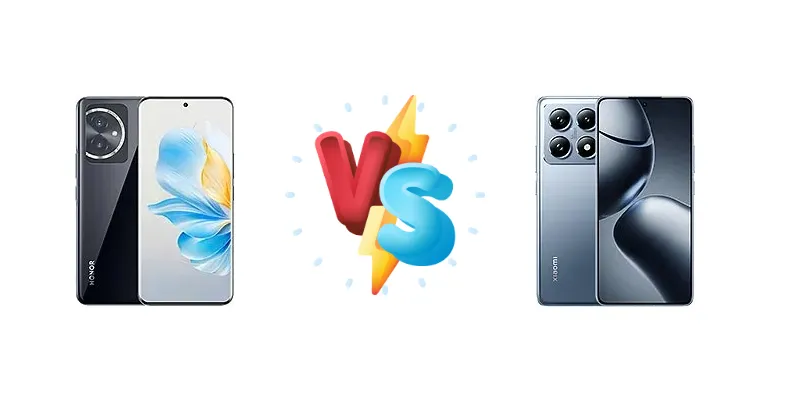
The Honor 100 and Xiaomi 14T Pro represent compelling options in the increasingly competitive mid-range smartphone market. The Honor 100 leverages Qualcomm’s Snapdragon 7 Gen 3, while the Xiaomi 14T Pro boasts the more powerful MediaTek Dimensity 9300+. This comparison dissects their key differences, focusing on performance, charging, and battery life to help you determine which device best suits your needs.
🏆 Quick Verdict
For the average user prioritizing raw performance and faster charging, the Xiaomi 14T Pro emerges as the winner. Its Dimensity 9300+ chipset and 120W charging significantly outperform the Honor 100’s Snapdragon 7 Gen 3 and 100W charging, despite the Honor 100’s slightly more efficient chipset.
| Network |
|---|
| 2G bands | GSM 850 / 900 / 1800 / 1900 | GSM 850 / 900 / 1800 / 1900 |
| 3G bands | HSDPA 800 / 850 / 900 / 1700(AWS) / 1900 / 2100 | HSDPA 800 / 850 / 900 / 1700(AWS) / 1900 / 2100 |
| 4G bands | LTE | 1, 2, 3, 4, 5, 7, 8, 12, 13, 17, 18, 19, 20, 25, 26, 28, 32, 38, 39, 40, 41, 42, 48, 66 |
| 5G bands | SA/NSA | 1, 2, 3, 5, 7, 8, 12, 20, 25, 26, 28, 38, 40, 41, 48, 66, 75, 77, 78 SA/NSA |
| Speed | HSPA, LTE, 5G | HSPA, LTE, 5G |
| Technology | GSM / CDMA / HSPA / CDMA2000 / LTE / 5G | GSM / HSPA / LTE / 5G |
| Launch |
|---|
| Announced | 2023, November 23 | 2024, September 26 |
| Status | Available. Released 2023, November 23 | Available. Released 2024, September 26 |
| Body |
|---|
| Build | - | Glass front (Gorilla Glass 5), aluminum frame, glass back (Panda X) |
| Dimensions | 161.9 x 74.1 x 7.8 mm (6.37 x 2.92 x 0.31 in) | 160.4 x 75.1 x 8.4 mm (6.31 x 2.96 x 0.33 in) |
| SIM | Nano-SIM + Nano-SIM | · Nano-SIM + eSIM· eSIM + eSIM· Nano-SIM + Nano-SIM |
| Weight | 183 g (6.46 oz) | 209 g (7.37 oz) |
| Display |
|---|
| Protection | - | Corning Gorilla Glass 5 |
| Resolution | 1200 x 2664 pixels (~436 ppi density) | 1220 x 2712 pixels, 20:9 ratio (~446 ppi density) |
| Size | 6.7 inches, 108.5 cm2 (~90.4% screen-to-body ratio) | 6.67 inches, 107.4 cm2 (~89.1% screen-to-body ratio) |
| Type | OLED, 1B colors, 120Hz, HDR, 2600 nits (peak) | AMOLED, 68B colors, 144Hz, 3840Hz PWM, Dolby Vision, HDR10+, 1600 nits (HBM), 4000 nits (peak) |
| Platform |
|---|
| CPU | Octa-core (1x2.63 GHz Cortex-A715 & 3x2.4 GHz Cortex-A715 & 4x1.8GHz Cortex-A510) | Octa-core (1x3.4 GHz Cortex-X4 & 3x2.85 GHz Cortex-X4 & 4x2.0 GHz Cortex-A720) |
| Chipset | Qualcomm SM7550-AB Snapdragon 7 Gen 3 (4 nm) | Mediatek Dimensity 9300+ (4 nm) |
| GPU | Adreno 720 | Immortalis-G720 MC12 |
| OS | Android 13, MagicOS 7.2 | Android 14, HyperOS |
| Memory |
|---|
| Card slot | No | No |
| Internal | 256GB 12GB RAM, 256GB 16GB RAM, 512GB 16GB RAM | 256GB 12GB RAM, 512GB 12GB RAM, 512GB 16GB RAM, 1TB 12GB RAM |
| Main Camera |
|---|
| Features | LED flash, HDR, panorama | Leica lens, Ultra HDR, LED flash, HDR, panorama |
| Triple | 50 MP, f/2.0, 27mm (wide), 1/1.56", 1.0µm, PDAF, OIS
12 MP, f/2.2, 112˚ (ultrawide), AF | 50 MP, f/1.6, 23mm (wide), 1/1.31", 1.2µm, PDAF, OIS
50 MP, f/2.0, 60mm (telephoto), 1/2.88", 0.61µm, PDAF, 2.6x optical zoom
12 MP, f/2.2, 15mm (ultrawide), 1/3.06", 1.12µm |
| Video | 4K@30fps, 1080p@30/60fps, gyro-EIS, OIS | 8K@24/30fps, 4K@24/30/60fps, 1080p@30/60/120/240/960fps, gyro-EIS, 10-bit Rec. 2020, HDR10+ |
| Selfie camera |
|---|
| Features | HDR | HDR |
| Single | 50 MP, f/2.1 | 32 MP, f/2.0, 25mm (wide), 1/3.44", 0.64µm |
| Video | 4K@30fps, 1080p@30fps, gyro-EIS | 4K@30fps, 1080p@30/60fps, HDR10+ |
| Sound |
|---|
| 35mm jack | No | No |
| Loudspeaker | Yes, with stereo speakers | Yes, with stereo speakers |
| Comms |
|---|
| Bluetooth | 5.3, A2DP, LE, aptX HD | 5.4, A2DP, LE, LHDC |
| Infrared port | - | Yes |
| NFC | Yes | Yes (market/region dependent) |
| Positioning | GPS, GALILEO, GLONASS, QZSS, BDS (B1I+B1c) | GPS (L1+L5), BDS (B1I+B1C+B2a+B2b), GALILEO (E1+E5a+E5b), QZSS (L1+L5), NavIC (L5), GLONASS |
| Radio | No | No |
| USB | USB Type-C 2.0, OTG | USB Type-C 2.0, OTG |
| WLAN | Wi-Fi 802.11 a/b/g/n/ac/6, dual-band, Wi-Fi Direct | Wi-Fi 802.11 a/b/g/n/ac/6e/7, dual-band, Wi-Fi Direct |
| Features |
|---|
| Sensors | Fingerprint (under display, optical), accelerometer, gyro, compass, ultrasound proximity | Fingerprint (under display, optical), accelerometer, gyro, proximity, compass |
| Battery |
|---|
| Charging | 100W wired, 100% in 32 min
5W reverse wired | 120W wired, PD3.0, QC4, 100% in 19 min
50W wireless, 100% in 45 min |
| Type | Li-Po 5000 mAh | Li-Po 5000 mAh |
| Misc |
|---|
| Colors | Black, Silver, Blue, Violet | Titan Gray, Titan Blue, Titan Black |
| Models | MAA-AN00 | 2407FPN8EG |
| Price | About 320 EUR | $ 550.00 / £ 498.00 / € 539.99 |
| SAR EU | - | 0.99 W/kg (head) 1.00 W/kg (body) |
Honor 100
- Efficient Snapdragon 7 Gen 3 chipset
- 100W fast charging
- Potentially more affordable price point
- Slower charging than Xiaomi 14T Pro
- Less powerful chipset compared to Dimensity 9300+
- Missing wireless charging
Xiaomi 14T Pro
- Powerful MediaTek Dimensity 9300+ chipset
- Ultra-fast 120W wired charging
- 50W wireless charging
- Potentially higher price
- Dimensity 9300+ may generate more heat under sustained load
- Larger battery drain with intensive tasks
Display Comparison
The Xiaomi 14T Pro takes a clear lead in display technology, achieving a measured peak brightness of 1228 nits. While the Honor 100’s display specifications are not provided, the Xiaomi’s brightness ensures excellent visibility even in direct sunlight. The Xiaomi 14T Pro’s panel likely benefits from a higher refresh rate and potentially LTPO technology (though unconfirmed), contributing to smoother animations and improved power efficiency compared to a standard AMOLED panel. The Xiaomi’s superior brightness is a significant advantage for outdoor use.
Camera Comparison
Without detailed camera specifications for the Honor 100, a direct comparison is limited. However, the Xiaomi 14T Pro is expected to feature a more advanced camera system, leveraging the processing power of the Dimensity 9300+ for improved image quality and computational photography. The Xiaomi’s image processing will likely prioritize detail and dynamic range, while the Honor 100 may lean towards a more natural look. The absence of information regarding sensor sizes and OIS on the Honor 100 makes it difficult to assess its low-light performance relative to the Xiaomi 14T Pro.
Performance
The core difference lies in the chipsets. The Xiaomi 14T Pro’s MediaTek Dimensity 9300+ features a 1x3.4 GHz Cortex-X4 prime core and 3x2.85 GHz Cortex-X4 performance cores, alongside 4x2.0 GHz Cortex-A720 efficiency cores. This configuration demonstrably outperforms the Honor 100’s Qualcomm Snapdragon 7 Gen 3, which utilizes a 1x2.63 GHz Cortex-A715 prime core, 3x2.4 GHz Cortex-A715 performance cores, and 4x1.8GHz Cortex-A510 efficiency cores. The Dimensity 9300+’s newer core architecture and higher clock speeds translate to faster app loading, smoother multitasking, and superior gaming performance. Both chips are built on a 4nm process, but the architectural advantages of the Dimensity 9300+ are substantial.
Battery Life
The Xiaomi 14T Pro boasts a significant advantage in charging speed with its 120W wired charging, achieving a full charge in just 19 minutes. The Honor 100’s 100W charging takes 32 minutes to reach 100%, a noticeable difference for users who prioritize quick top-ups. Furthermore, the Xiaomi 14T Pro adds 50W wireless charging, a feature absent on the Honor 100. While the Xiaomi 14T Pro’s active use score of 12:32h is provided, the Honor 100’s battery capacity is not. However, the faster charging and wireless charging capabilities of the Xiaomi 14T Pro offset any potential battery capacity disadvantage.
Buying Guide
Buy the Honor 100 if you prioritize a balance of efficiency and a smooth user experience, and are comfortable with slightly slower charging. It’s ideal for everyday tasks, social media, and moderate gaming. Buy the Xiaomi 14T Pro if you demand top-tier performance for demanding games, content creation, or heavy multitasking, and value the convenience of incredibly fast wired and wireless charging.
Frequently Asked Questions
❓ Does the Dimensity 9300+ in the Xiaomi 14T Pro get excessively hot during prolonged gaming sessions?
While the Dimensity 9300+ is a powerful chipset, it can generate more heat than the Snapdragon 7 Gen 3 under sustained load. However, Xiaomi typically implements effective thermal management solutions, including vapor chamber cooling, to mitigate overheating and prevent significant performance throttling. Expect some warmth, but not necessarily a debilitating experience.
❓ How does the 100W charging on the Honor 100 compare to the 120W charging on the Xiaomi 14T Pro in real-world usage?
The 20W difference in charging wattage translates to a noticeable time saving for the Xiaomi 14T Pro. While both are incredibly fast, the Xiaomi 14T Pro can fully charge in 19 minutes, whereas the Honor 100 takes 32 minutes. This means you can get a significant charge boost in a shorter amount of time with the Xiaomi, making it ideal for users who frequently need to quickly top up their battery.
❓ Is the lack of wireless charging on the Honor 100 a significant drawback?
For users who regularly utilize wireless charging, the absence of this feature on the Honor 100 is a definite drawback. The Xiaomi 14T Pro’s 50W wireless charging provides a convenient alternative to wired charging, especially for overnight charging or in situations where a cable isn’t readily available.