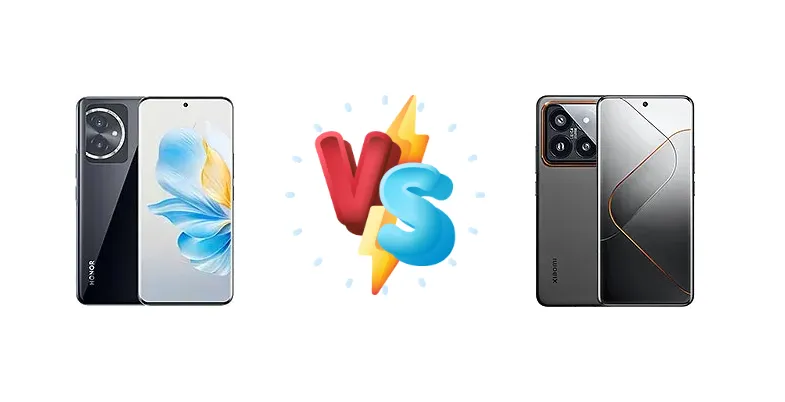
The Honor 100 and Xiaomi 14 Pro represent distinct approaches to the modern smartphone. The Honor 100 aims for a compelling balance of features and price, leveraging the Snapdragon 7 Gen 3. The Xiaomi 14 Pro, however, is a full-fledged flagship, equipped with the latest Snapdragon 8 Gen 3 and a suite of premium features. This comparison dissects their key differences to help you choose the right device.
🏆 Quick Verdict
For the average user prioritizing raw performance and the fastest charging, the Xiaomi 14 Pro is the clear winner. Its Snapdragon 8 Gen 3 delivers significantly higher processing power. However, the Honor 100 offers a strong value proposition for those seeking a capable device without the flagship price tag.
| Network |
|---|
| 2G bands | GSM 850 / 900 / 1800 / 1900 | GSM 850 / 900 / 1800 / 1900 |
| 3G bands | HSDPA 800 / 850 / 900 / 1700(AWS) / 1900 / 2100 | HSDPA 800 / 850 / 900 / 1700(AWS) / 1900 / 2100 |
| 4G bands | LTE | 1, 3, 4, 5, 7, 8, 18, 19, 26, 28, 34, 38, 39, 40, 41, 42, 48, 66 |
| 5G bands | SA/NSA | 1, 3, 5, 7, 8, 28, 38, 40, 41, 48, 66, 77, 78, 79 SA/NSA |
| Speed | HSPA, LTE, 5G | HSPA, LTE, 5G |
| Technology | GSM / CDMA / HSPA / CDMA2000 / LTE / 5G | GSM / CDMA / HSPA / CDMA2000 / LTE / 5G |
| Launch |
|---|
| Announced | 2023, November 23 | 2023, October 26 |
| Status | Available. Released 2023, November 23 | Available. Released 2023, November 01 |
| Body |
|---|
| Build | - | Glass front, aluminum frame or titanium frame, glass back |
| Dimensions | 161.9 x 74.1 x 7.8 mm (6.37 x 2.92 x 0.31 in) | 161.4 x 75.3 x 8.5 mm |
| SIM | Nano-SIM + Nano-SIM | Nano-SIM + Nano-SIM |
| Weight | 183 g (6.46 oz) | 223 g or 230 g (7.87 oz) |
| Display |
|---|
| Protection | - | Shatterproof glass |
| Resolution | 1200 x 2664 pixels (~436 ppi density) | 1440 x 3200 pixels, 20:9 ratio (~522 ppi density) |
| Size | 6.7 inches, 108.5 cm2 (~90.4% screen-to-body ratio) | 6.73 inches, 108.9 cm2 (~89.6% screen-to-body ratio) |
| Type | OLED, 1B colors, 120Hz, HDR, 2600 nits (peak) | LTPO AMOLED, 68B colors, 120Hz, Dolby Vision, HDR10+, 3000 nits (peak) |
| Platform |
|---|
| CPU | Octa-core (1x2.63 GHz Cortex-A715 & 3x2.4 GHz Cortex-A715 & 4x1.8GHz Cortex-A510) | Octa-core (1x3.3 GHz Cortex-X4 & 3x3.2 GHz Cortex-A720 & 2x3.0 GHz Cortex-A720 & 2x2.3 GHz Cortex-A520) |
| Chipset | Qualcomm SM7550-AB Snapdragon 7 Gen 3 (4 nm) | Qualcomm SM8650-AB Snapdragon 8 Gen 3 (4 nm) |
| GPU | Adreno 720 | Adreno 750 |
| OS | Android 13, MagicOS 7.2 | Android 14, HyperOS |
| Memory |
|---|
| Card slot | No | No |
| Internal | 256GB 12GB RAM, 256GB 16GB RAM, 512GB 16GB RAM | 256GB 12GB RAM, 512GB 16GB RAM, 1TB 16GB RAM |
| Main Camera |
|---|
| Features | LED flash, HDR, panorama | Laser AF, color spectrum sensor, Leica lens, Dual-LED dual-tone flash, HDR, panorama |
| Triple | 50 MP, f/2.0, 27mm (wide), 1/1.56", 1.0µm, PDAF, OIS
12 MP, f/2.2, 112˚ (ultrawide), AF | 50 MP, f/1.4-f/4.0, 23mm (wide), 1/1.31", 1.2µm, dual pixel PDAF, OIS
50 MP, f/2.0, 75mm (telephoto), PDAF (10cm - ∞), OIS, 3.2x optical zoom
50 MP, f/2.2, 14mm, 115˚ (ultrawide), AF |
| Video | 4K@30fps, 1080p@30/60fps, gyro-EIS, OIS | 8K@24fps (HDR), 4K@24/30/60fps (HDR10+, 10-bit Dolby Vision HDR, 10-bit LOG), 1080p@30/60/120/240/960fps, 720p@1920fps, gyro-EIS |
| Selfie camera |
|---|
| Features | HDR | HDR, panorama |
| Single | 50 MP, f/2.1 | 32 MP, f/2.0, 22mm (wide), 0.7µm |
| Video | 4K@30fps, 1080p@30fps, gyro-EIS | 4K@30/60fps, 1080p@30/60fps, gyro-EIS |
| Sound |
|---|
| 35mm jack | No | No |
| Loudspeaker | Yes, with stereo speakers | Yes, with stereo speakers |
| Comms |
|---|
| Bluetooth | 5.3, A2DP, LE, aptX HD | 5.4, A2DP, LE, aptX HD, aptX Adaptive |
| Infrared port | - | Yes |
| NFC | Yes | Yes |
| Positioning | GPS, GALILEO, GLONASS, QZSS, BDS (B1I+B1c) | GPS (L1+L5), GLONASS (G1), BDS (B1I+B1c+B2a), GALILEO (E1+E5a), QZSS (L1+L5), NavIC (L5) |
| Radio | No | No |
| USB | USB Type-C 2.0, OTG | USB Type-C 3.2 Gen 2, OTG |
| WLAN | Wi-Fi 802.11 a/b/g/n/ac/6, dual-band, Wi-Fi Direct | Wi-Fi 802.11 a/b/g/n/ac/6e/7, dual-band, Wi-Fi Direct |
| Features |
|---|
| Sensors | Fingerprint (under display, optical), accelerometer, gyro, compass, ultrasound proximity | Fingerprint (under display, optical), accelerometer, proximity, gyro, compass, barometer |
| Battery |
|---|
| Charging | 100W wired, 100% in 32 min
5W reverse wired | 120W wired, PD3.0, QC4, 100% in 18 min
50W wireless, 100% in 40 min
10W reverse wireless |
| Type | Li-Po 5000 mAh | Li-Po 4880 mAh |
| Misc |
|---|
| Colors | Black, Silver, Blue, Violet | Black, Silver, Titanium, Green |
| Models | MAA-AN00 | 23116PN5BC |
| Price | About 320 EUR | About 650 EUR |
Honor 100
- More affordable price point
- Stylish design
- Fast 100W wired charging
- Less powerful Snapdragon 7 Gen 3 chipset
- No wireless charging
Xiaomi 14 Pro
- Flagship Snapdragon 8 Gen 3 performance
- Ultra-fast 120W wired and 50W wireless charging
- Likely superior camera system
- Higher price tag
- Potentially more heat generation under sustained load
Display Comparison
While both devices likely feature high-quality OLED panels (data not provided), the core difference lies in the processing power driving them. The Xiaomi 14 Pro, with its superior chipset, will likely benefit from smoother animations and faster response times, especially in graphically intensive applications. The Honor 100’s display performance will be more than adequate for most users, but won’t reach the same peak responsiveness. We expect both to have similar color accuracy, but the Xiaomi 14 Pro may have a higher peak brightness.
Camera Comparison
Without detailed camera specs, it’s difficult to make a definitive comparison. However, Xiaomi’s Pro models typically prioritize camera performance, often featuring larger sensors and more advanced image processing. The Xiaomi 14 Pro is likely to offer superior low-light performance and dynamic range. The Honor 100 will likely deliver good image quality, but may not match the Xiaomi 14 Pro’s level of detail and clarity. We can assume both will have capable main sensors, but the Xiaomi 14 Pro will likely have a more sophisticated optical image stabilization (OIS) system.
Performance
The performance gap is the most significant differentiator. The Xiaomi 14 Pro’s Snapdragon 8 Gen 3 (4nm) boasts a prime Cortex-X4 core clocked at 3.3 GHz, compared to the Honor 100’s Snapdragon 7 Gen 3 (4nm) with its 2.63 GHz Cortex-A715 core. This translates to a substantial advantage for the Xiaomi 14 Pro in CPU-intensive tasks like video editing and complex calculations. The Xiaomi 14 Pro’s GPU will also deliver significantly higher frame rates in demanding games. The Snapdragon 7 Gen 3 is still a capable chip, but it’s a step below the flagship tier. The Xiaomi 14 Pro’s LPDDR5x RAM will also contribute to faster data access and overall system responsiveness.
Battery Life
The Xiaomi 14 Pro’s 120W wired charging is a game-changer, achieving a full charge in just 18 minutes. The Honor 100’s 100W charging is also fast, but takes 32 minutes to reach 100%. The addition of 50W wireless charging on the Xiaomi 14 Pro provides further convenience, while the Honor 100 lacks wireless charging. While battery capacity isn’t specified, the faster charging speeds of the Xiaomi 14 Pro mitigate the impact of a potentially smaller battery, offering more usable uptime throughout the day.
Buying Guide
Buy the Honor 100 if you need a stylish, capable smartphone for everyday tasks, social media, and light gaming, and want to stay within a more reasonable budget. Buy the Xiaomi 14 Pro if you demand the absolute best performance for demanding games, professional content creation, and appreciate the convenience of ultra-fast wired and wireless charging.
Frequently Asked Questions
❓ Will the Snapdragon 7 Gen 3 in the Honor 100 struggle with demanding games like Genshin Impact?
While the Snapdragon 7 Gen 3 is capable, Genshin Impact and similar titles will likely require reduced graphics settings to maintain a stable frame rate on the Honor 100. The Xiaomi 14 Pro’s Snapdragon 8 Gen 3 will handle these games at maximum settings with ease.
❓ How much faster is the 120W charging on the Xiaomi 14 Pro compared to the 100W charging on the Honor 100 in real-world use?
The Xiaomi 14 Pro’s 120W charging can add a significant amount of charge in just a few minutes – roughly 20% in 5 minutes. The Honor 100’s 100W charging is still fast, but the Xiaomi 14 Pro offers a noticeably quicker top-up, especially useful for users who frequently need to recharge quickly.
❓ Does the Xiaomi 14 Pro get noticeably hotter than the Honor 100 during extended gaming sessions?
The Snapdragon 8 Gen 3 is a powerful chip and generates more heat than the Snapdragon 7 Gen 3. While Xiaomi likely employs advanced cooling solutions, the 14 Pro may get warmer during prolonged gaming. The Honor 100 will likely remain cooler, but at the cost of performance.