
Honor 100 vs Magic6 RSR Porsche Design: A Deep Dive into Honor's Flagship Lineup
| Phones Images | |||||
|---|---|---|---|---|---|
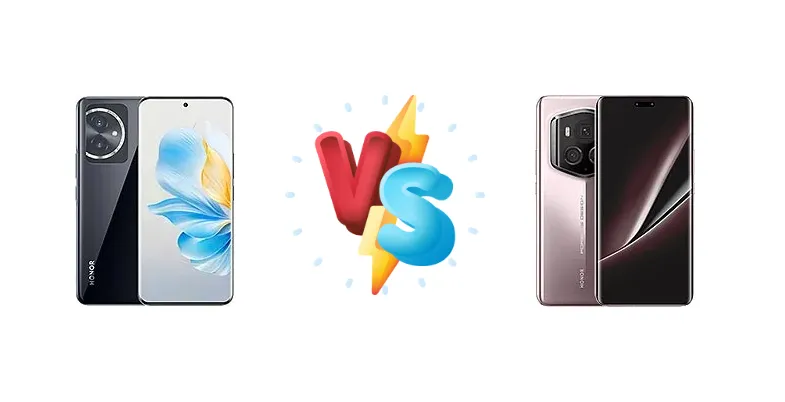
|
🏆 Quick Verdict
For most users, the Honor Magic6 RSR Porsche Design is the superior choice, offering significantly faster performance with the Snapdragon 8 Gen 3 and a brighter, more vibrant display. However, the Honor 100 remains a strong contender for budget-conscious buyers who prioritize fast 100W charging and a sleek design without the premium price tag.
| PHONES | ||
|---|---|---|
| Phone Names | Honor 100 | Honor Magic6 RSR Porsche Design |
| Network | ||
|---|---|---|
| 2G bands | GSM 850 / 900 / 1800 / 1900 | GSM 850 / 900 / 1800 / 1900 |
| 3G bands | HSDPA 800 / 850 / 900 / 1700(AWS) / 1900 / 2100 | HSDPA 800 / 850 / 900 / 1700(AWS) / 1900 / 2100 |
| 4G bands | LTE | LTE |
| 5G bands | SA/NSA | SA/NSA |
| Speed | HSPA, LTE, 5G | HSPA, LTE, 5G |
| Technology | GSM / CDMA / HSPA / CDMA2000 / LTE / 5G | GSM / CDMA / HSPA / CDMA2000 / LTE / 5G |
| Launch | ||
|---|---|---|
| Announced | 2023, November 23 | 2024, March 18 |
| Status | Available. Released 2023, November 23 | Available. Released 2024, March 22 |
| Body | ||
|---|---|---|
| Build | - | Glass front (NanoCrystal Shield), glass back (NanoCrystal Shield), titanium frame |
| Dimensions | 161.9 x 74.1 x 7.8 mm (6.37 x 2.92 x 0.31 in) | 162.5 x 75.8 x 8.9 mm (6.40 x 2.98 x 0.35 in) |
| SIM | Nano-SIM + Nano-SIM | · Nano-SIM + eSIM· Nano-SIM + Nano-SIM |
| Weight | 183 g (6.46 oz) | 237 g (8.36 oz) |
| Display | ||
|---|---|---|
| Protection | - | NanoCrystal Shield |
| Resolution | 1200 x 2664 pixels (~436 ppi density) | 1280 x 2800 pixels, 19.5:9 ratio (~453 ppi density) |
| Size | 6.7 inches, 108.5 cm2 (~90.4% screen-to-body ratio) | 6.8 inches, 112.8 cm2 (~91.6% screen-to-body ratio) |
| Type | OLED, 1B colors, 120Hz, HDR, 2600 nits (peak) | LTPO OLED, 1B colors, 120Hz, Dolby Vision, HDR, 1800 nits (HBM), 5000 nits (peak) |
| Platform | ||
|---|---|---|
| CPU | Octa-core (1x2.63 GHz Cortex-A715 & 3x2.4 GHz Cortex-A715 & 4x1.8GHz Cortex-A510) | Octa-core (1x3.3 GHz Cortex-X4 & 3x3.2 GHz Cortex-A720 & 2x3.0 GHz Cortex-A720 & 2x2.3 GHz Cortex-A520) |
| Chipset | Qualcomm SM7550-AB Snapdragon 7 Gen 3 (4 nm) | Qualcomm SM8650-AB Snapdragon 8 Gen 3 (4 nm) |
| GPU | Adreno 720 | Adreno 750 |
| OS | Android 13, MagicOS 7.2 | Android 14, MagicOS 8 |
| Memory | ||
|---|---|---|
| Card slot | No | No |
| Internal | 256GB 12GB RAM, 256GB 16GB RAM, 512GB 16GB RAM | 1TB 24GB RAM |
| Main Camera | ||
|---|---|---|
| Features | LED flash, HDR, panorama | Color spectrum sensor, LED flash, HDR, panorama |
| Triple | 50 MP, f/2.0, 27mm (wide), 1/1.56", 1.0µm, PDAF, OIS 12 MP, f/2.2, 112˚ (ultrawide), AF | 50 MP, f/1.4-2.0, 23mm (wide), 1/1.3", LiDAR AF, PDAF, OIS 180 MP, f/2.6, (periscope telephoto), 1/1.49", 0.56µm, PDAF, OIS, 2.5x optical zoom 50 MP, f/2.0, 13mm, 122˚ (ultrawide), 1/2.88", AF |
| Video | 4K@30fps, 1080p@30/60fps, gyro-EIS, OIS | 4K@24/30/60fps, 1080p@30/60/120/240fps, gyro-EIS, OIS, HDR, 10-bit video |
| Selfie camera | ||
|---|---|---|
| Features | HDR | - |
| Single | 50 MP, f/2.1 | 50 MP, f/2.0, 22mm (wide), 1/2.93", AF TOF 3D, (depth/biometrics sensor) |
| Video | 4K@30fps, 1080p@30fps, gyro-EIS | 4K@30fps, 1080p@30/60fps, gyro-EIS |
| Sound | ||
|---|---|---|
| 35mm jack | No | No |
| Loudspeaker | Yes, with stereo speakers | Yes, with stereo speakers |
| Comms | ||
|---|---|---|
| Bluetooth | 5.3, A2DP, LE, aptX HD | 5.3, A2DP, LE, aptX HD |
| Infrared port | - | Yes |
| NFC | Yes | Yes |
| Positioning | GPS, GALILEO, GLONASS, QZSS, BDS (B1I+B1c) | GPS (L1+L5), GLONASS, BDS (B1I+B1c+B2a), GALILEO (E1+E5a) |
| Radio | No | No |
| USB | USB Type-C 2.0, OTG | USB Type-C 3.2, DisplayPort 1.2, OTG |
| WLAN | Wi-Fi 802.11 a/b/g/n/ac/6, dual-band, Wi-Fi Direct | Wi-Fi 802.11 a/b/g/n/ac/6/7, dual-band, Wi-Fi Direct |
| Features | ||
|---|---|---|
| Sensors | Fingerprint (under display, optical), accelerometer, gyro, compass, ultrasound proximity | Fingerprint (under display, optical), Face ID, accelerometer, gyro, proximity, compass |
| Battery | ||
|---|---|---|
| Charging | 100W wired, 100% in 32 min 5W reverse wired | 80W wired 66W wireless Reverse wireless 5W reverse wired |
| Type | Li-Po 5000 mAh | Si/C Li-Ion 5600 mAh |
| Misc | ||
|---|---|---|
| Colors | Black, Silver, Blue, Violet | Agate Grey, Frozen Berry |
| Models | MAA-AN00 | BVL-N59, BVL-AN20 |
| Price | About 320 EUR | About 3020 EUR |
Honor 100
- Incredibly fast 100W wired charging
- More affordable price point
- Sleek and stylish design
- Less powerful Snapdragon 7 Gen 3 chipset
- Display brightness likely lower than Magic6 RSR
- Limited camera details available
Honor Magic6 RSR Porsche Design
- Flagship Snapdragon 8 Gen 3 performance
- Significantly brighter and likely more accurate display
- Longer battery life and 66W wireless charging
- Higher price tag
- 80W wired charging is slower than Honor 100's 100W
- Porsche Design aesthetic may not appeal to everyone
Display Comparison
The Honor Magic6 RSR Porsche Design boasts a significantly brighter display, reaching a measured 1731 nits, compared to the Honor 100 (brightness data unavailable). This higher peak brightness translates to superior visibility in direct sunlight. While both likely utilize OLED panels, the Magic6 RSR’s brightness advantage suggests a more advanced panel technology, potentially with higher efficiency. The Honor 100’s display specs are less detailed, making a direct comparison of color accuracy and refresh rate difficult, but the RSR’s flagship status implies a more refined visual experience.
Camera Comparison
Detailed camera specs for the Honor 100 are unavailable, making a precise comparison challenging. However, the Magic6 RSR Porsche Design’s focus on flagship features suggests a more sophisticated camera system. While both likely feature multi-camera setups, the RSR’s premium positioning implies a larger main sensor, potentially with a wider aperture for improved low-light performance. The inclusion of Optical Image Stabilization (OIS) is highly probable on the RSR, further enhancing image quality. The Honor 100 may rely on software processing to compensate for potentially less capable hardware.
Performance
The core difference lies in the chipsets: the Honor 100 utilizes the Qualcomm SM7550-AB Snapdragon 7 Gen 3 (4nm), while the Magic6 RSR Porsche Design is powered by the Snapdragon 8 Gen 3 (4nm). The 8 Gen 3 features a more advanced CPU architecture – Cortex-X4 prime core at 3.3GHz versus the A715 in the 7 Gen 3 at 2.63GHz – resulting in a substantial performance uplift in CPU-intensive tasks. The GPU difference is equally significant, offering a far superior gaming experience on the Magic6 RSR. The 4nm process node in both chips ensures good efficiency, but the 8 Gen 3’s architectural improvements provide a clear advantage. The Magic6 RSR also benefits from potentially faster RAM (LPDDR5x is expected, but not confirmed) compared to the Honor 100.
Battery Life
The Honor Magic6 RSR Porsche Design demonstrates superior battery endurance with an active use score of 14:14h, indicating a larger battery capacity and/or more efficient power management. While the Honor 100 offers incredibly fast 100W wired charging (fully charging in 32 minutes), the Magic6 RSR counters with 80W wired charging *and* 66W wireless charging, offering greater versatility. Both phones support 5W reverse wired charging. The RSR’s longer battery life, combined with its wireless charging capabilities, provides a more convenient and flexible charging experience.
Buying Guide
Buy the Honor 100 if you need a stylish smartphone with incredibly fast 100W charging and are willing to compromise on peak performance for a more affordable price. It’s ideal for everyday users, social media enthusiasts, and those who value quick top-ups. Buy the Honor Magic6 RSR Porsche Design if you demand the absolute best in performance, display quality, and battery endurance, and are willing to pay a premium for a flagship experience with a distinctive Porsche Design aesthetic. This phone is geared towards power users, gamers, and photography enthusiasts.