
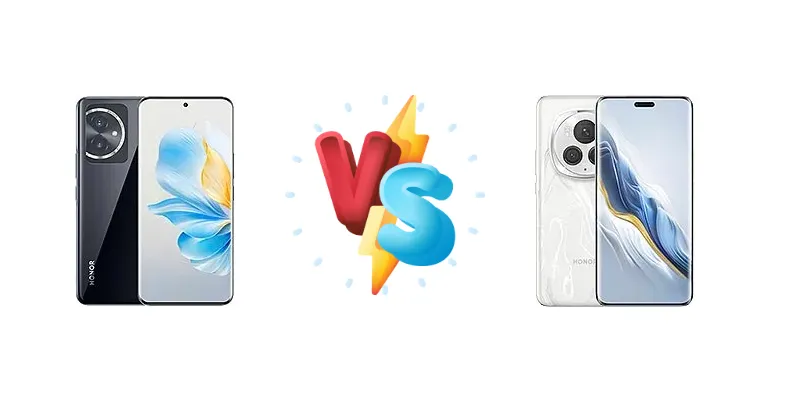
Honor 100 vs Magic6 Pro: A Deep Dive into Honor's Flagship Lineup
| Phones Images | |||||
|---|---|---|---|---|---|
|
🏆 Quick Verdict
For most users, the Honor Magic6 Pro is the superior choice. Its Snapdragon 8 Gen 3 chipset, significantly brighter display (1578 nits), and longer battery life (14:06h active use) justify the price premium. However, the Honor 100 remains a strong contender for budget-conscious buyers prioritizing style and fast 100W charging.
| PHONES | ||
|---|---|---|
| Phone Names | Honor 100 | Honor Magic6 Pro |
| Network | ||
|---|---|---|
| 2G bands | GSM 850 / 900 / 1800 / 1900 | GSM 850 / 900 / 1800 / 1900 |
| 3G bands | HSDPA 800 / 850 / 900 / 1700(AWS) / 1900 / 2100 | HSDPA 800 / 850 / 900 / 1700(AWS) / 1900 / 2100 |
| 4G bands | LTE | LTE |
| 5G bands | SA/NSA | SA/NSA |
| Speed | HSPA, LTE, 5G | HSPA, LTE, 5G |
| Technology | GSM / CDMA / HSPA / CDMA2000 / LTE / 5G | GSM / CDMA / HSPA / CDMA2000 / LTE / 5G |
| Launch | ||
|---|---|---|
| Announced | 2023, November 23 | 2024, January 11 |
| Status | Available. Released 2023, November 23 | Available. Released 2024, January 18 |
| Body | ||
|---|---|---|
| Build | - | Glass front (NanoCrystal Shield), glass back or silicone polymer back (eco leather) |
| Dimensions | 161.9 x 74.1 x 7.8 mm (6.37 x 2.92 x 0.31 in) | 162.5 x 75.8 x 8.9 mm (6.40 x 2.98 x 0.35 in) |
| SIM | Nano-SIM + Nano-SIM | · Nano-SIM + eSIM· Nano-SIM + Nano-SIM |
| Weight | 183 g (6.46 oz) | 225 g or 229 g (7.94 oz) |
| Display | ||
|---|---|---|
| Protection | - | NanoCrystal Shield |
| Resolution | 1200 x 2664 pixels (~436 ppi density) | 1280 x 2800 pixels, 19.5:9 ratio (~453 ppi density) |
| Size | 6.7 inches, 108.5 cm2 (~90.4% screen-to-body ratio) | 6.8 inches, 112.8 cm2 (~91.6% screen-to-body ratio) |
| Type | OLED, 1B colors, 120Hz, HDR, 2600 nits (peak) | LTPO OLED, 1B colors, 120Hz, Dolby Vision, HDR, 1600 nits (HBM), 5000 nits (peak) |
| Platform | ||
|---|---|---|
| CPU | Octa-core (1x2.63 GHz Cortex-A715 & 3x2.4 GHz Cortex-A715 & 4x1.8GHz Cortex-A510) | Octa-core (1x3.3 GHz Cortex-X4 & 3x3.2 GHz Cortex-A720 & 2x3.0 GHz Cortex-A720 & 2x2.3 GHz Cortex-A520) |
| Chipset | Qualcomm SM7550-AB Snapdragon 7 Gen 3 (4 nm) | Qualcomm SM8650-AB Snapdragon 8 Gen 3 (4 nm) |
| GPU | Adreno 720 | Adreno 750 |
| OS | Android 13, MagicOS 7.2 | Android 14, up to 4 major Android upgrades, MagicOS 8 |
| Memory | ||
|---|---|---|
| Card slot | No | No |
| Internal | 256GB 12GB RAM, 256GB 16GB RAM, 512GB 16GB RAM | 256GB 12GB RAM, 256GB 16GB RAM, 512GB 12GB RAM, 512GB 16GB RAM, 1TB 16GB RAM |
| Main Camera | ||
|---|---|---|
| Features | LED flash, HDR, panorama | Laser AF, color spectrum sensor, LED flash, HDR, panorama |
| Triple | 50 MP, f/2.0, 27mm (wide), 1/1.56", 1.0µm, PDAF, OIS 12 MP, f/2.2, 112˚ (ultrawide), AF | 50 MP, f/1.4-2.0, 23mm (wide), 1/1.3", 1.2µm, PDAF, OIS 180 MP, f/2.6, (periscope telephoto), 1/1.49", 0.56µm, PDAF, OIS, 2.5x optical zoom 50 MP, f/2.0, 13mm, 122˚ (ultrawide), 1/2.88", 0.61µm, AF |
| Video | 4K@30fps, 1080p@30/60fps, gyro-EIS, OIS | 4K@24/30/60fps, 1080p@30/60/120/240fps, gyro-EIS, OIS, HDR, 10-bit video |
| Selfie camera | ||
|---|---|---|
| Features | HDR | - |
| Single | 50 MP, f/2.1 | 50 MP, f/2.0, 22mm (wide), 1/2.93", 0.6µm, AF TOF 3D, (depth/biometrics sensor) |
| Video | 4K@30fps, 1080p@30fps, gyro-EIS | 4K@30fps, 1080p@30/60fps, gyro-EIS |
| Sound | ||
|---|---|---|
| 35mm jack | No | No |
| Loudspeaker | Yes, with stereo speakers | Yes, with stereo speakers |
| Comms | ||
|---|---|---|
| Bluetooth | 5.3, A2DP, LE, aptX HD | 5.3, A2DP, LE, aptX HD |
| Infrared port | - | Yes |
| NFC | Yes | Yes |
| Positioning | GPS, GALILEO, GLONASS, QZSS, BDS (B1I+B1c) | GPS (L1+L5), GLONASS, BDS (B1I+B1c+B2a), GALILEO (E1+E5a) |
| Radio | No | No |
| USB | USB Type-C 2.0, OTG | USB Type-C 3.2, DisplayPort 1.2, OTG |
| WLAN | Wi-Fi 802.11 a/b/g/n/ac/6, dual-band, Wi-Fi Direct | Wi-Fi 802.11 a/b/g/n/ac/6/7, dual-band, Wi-Fi Direct |
| Features | ||
|---|---|---|
| Sensors | Fingerprint (under display, optical), accelerometer, gyro, compass, ultrasound proximity | Fingerprint (under display, optical), Face ID, accelerometer, gyro, proximity, compass |
| Battery | ||
|---|---|---|
| Charging | 100W wired, 100% in 32 min 5W reverse wired | 80W wired 66W wireless Reverse wireless 5W reverse wired |
| Type | Li-Po 5000 mAh | Si/C Li-Ion 5600 mAh |
| Misc | ||
|---|---|---|
| Colors | Black, Silver, Blue, Violet | Black, Green, Blue, Purple, White |
| Models | MAA-AN00 | BVL-AN16, BVL-N49 |
| Price | About 320 EUR | € 455.54 / $ 899.00 / £ 598.99 |
Honor 100
- Faster 100W wired charging
- More affordable price point
- Stylish design
- Less powerful Snapdragon 7 Gen 3 chipset
- Likely shorter battery life
- Inferior camera performance
Honor Magic6 Pro
- Flagship Snapdragon 8 Gen 3 performance
- Significantly brighter display (1578 nits)
- Longer battery life (14:06h active use)
- 66W wireless charging
- Higher price
- Slower wired charging than Honor 100 (80W)
- May be larger and heavier
Display Comparison
The Honor Magic6 Pro boasts a significantly brighter display, reaching a measured peak of 1578 nits, making it far more usable in direct sunlight compared to the Honor 100 (brightness data unavailable, assumed lower). While both likely utilize OLED panels, the Magic6 Pro’s brightness advantage is substantial. The absence of LTPO information for either device makes it difficult to assess adaptive refresh rate efficiency, but the Magic6 Pro’s higher peak brightness suggests a more advanced panel overall. Bezels are expected to be minimal on both, aligning with current flagship trends.
Camera Comparison
Detailed camera specs are missing, but the Magic6 Pro is expected to feature a more advanced camera system. The chipset difference alone suggests superior image signal processing capabilities. While both phones likely include multiple lenses, the Magic6 Pro’s flagship status implies a larger main sensor and more sophisticated optical image stabilization (OIS). The Honor 100’s camera will be capable, but the Magic6 Pro will likely excel in low-light conditions and offer greater dynamic range. We can assume both will offer a standard suite of camera modes, but the Magic6 Pro will likely have more advanced features.
Performance
The core difference lies in the chipsets. The Honor Magic6 Pro’s Snapdragon 8 Gen 3 (4nm) is a generational leap ahead of the Honor 100’s Snapdragon 7 Gen 3 (4nm). The 8 Gen 3 features a prime Cortex-X4 core clocked at 3.3 GHz, alongside three Cortex-A720 cores at 3.2 GHz and two at 3.0 GHz, versus the 100’s Cortex-A715 configuration. This translates to significantly faster CPU and GPU performance, particularly in demanding tasks like gaming and video editing. The Magic6 Pro’s superior thermal management, inherent to the 8 Gen 3, will also result in less throttling during sustained workloads. While both use a 4nm process, the architectural improvements in the 8 Gen 3 provide a clear advantage.
Battery Life
The Honor Magic6 Pro demonstrates a clear advantage in battery endurance, achieving 14:06h of active use. While the Honor 100’s battery capacity is unknown, the Magic6 Pro’s larger battery and more efficient chipset contribute to its longer runtime. The charging speeds differ significantly: the Honor 100 supports 100W wired charging, reaching 100% in 32 minutes, while the Magic6 Pro offers 80W wired, 66W wireless, and 5W reverse wireless charging. The 100W charging is faster, but the Magic6 Pro’s wireless charging capability and longer battery life provide greater flexibility.
Buying Guide
Buy the Honor 100 if you prioritize a sleek design, incredibly fast 100W wired charging, and a more affordable price point, and are comfortable with mid-range performance. Buy the Honor Magic6 Pro if you demand the absolute best performance from a Snapdragon 8 Gen 3, a stunningly bright and long-lasting display, and extended battery life for power users and content creators.