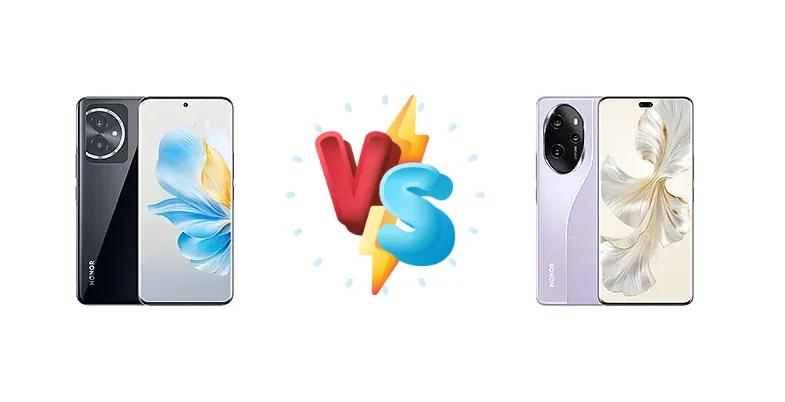
Honor has positioned the 100 and 100 Pro as compelling mid-range options, but the 'Pro' moniker signifies more than just marketing. The core difference lies in the chipset – a Snapdragon 7 Gen 3 in the 100 versus the flagship-tier Snapdragon 8 Gen 2 in the 100 Pro. This comparison dissects these differences, alongside charging capabilities and other key features, to determine which device best suits your needs.
🏆 Quick Verdict
For most users, the Honor 100 Pro is the superior choice. The Snapdragon 8 Gen 2 provides a substantial performance uplift, ensuring smoother multitasking, faster app loading, and a more enjoyable gaming experience. While the Honor 100 offers excellent value, the Pro’s faster charging and more powerful processor justify the price premium.
| Network |
|---|
| 2G bands | GSM 850 / 900 / 1800 / 1900 | GSM 850 / 900 / 1800 / 1900 |
| 3G bands | HSDPA 800 / 850 / 900 / 1700(AWS) / 1900 / 2100 | HSDPA 800 / 850 / 900 / 1700(AWS) / 1900 / 2100 |
| 4G bands | LTE | LTE |
| 5G bands | SA/NSA | SA/NSA |
| Speed | HSPA, LTE, 5G | HSPA, LTE, 5G |
| Technology | GSM / CDMA / HSPA / CDMA2000 / LTE / 5G | GSM / CDMA / HSPA / CDMA2000 / LTE / 5G |
| Launch |
|---|
| Announced | 2023, November 23 | 2023, November 23 |
| Status | Available. Released 2023, November 23 | Available. Released 2023, November 23 |
| Body |
|---|
| Dimensions | 161.9 x 74.1 x 7.8 mm (6.37 x 2.92 x 0.31 in) | 163.7 x 74.7 x 8.2 mm or 8.5 mm |
| SIM | Nano-SIM + Nano-SIM | Nano-SIM + Nano-SIM |
| Weight | 183 g (6.46 oz) | 195 g (6.88 oz) |
| Display |
|---|
| Resolution | 1200 x 2664 pixels (~436 ppi density) | 1224 x 2700 pixels (~437 ppi density) |
| Size | 6.7 inches, 108.5 cm2 (~90.4% screen-to-body ratio) | 6.78 inches, 111.5 cm2 (~91.2% screen-to-body ratio) |
| Type | OLED, 1B colors, 120Hz, HDR, 2600 nits (peak) | OLED, 1B colors, 120Hz, HDR, 2600 nits (peak) |
| Platform |
|---|
| CPU | Octa-core (1x2.63 GHz Cortex-A715 & 3x2.4 GHz Cortex-A715 & 4x1.8GHz Cortex-A510) | Octa-core (1x3.2 GHz Cortex-X3 & 2x2.8 GHz Cortex-A715 & 2x2.8 GHz Cortex-A710 & 3x2.0 GHz Cortex-A510) |
| Chipset | Qualcomm SM7550-AB Snapdragon 7 Gen 3 (4 nm) | Qualcomm SM8550-AB Snapdragon 8 Gen 2 (4 nm) |
| GPU | Adreno 720 | Adreno 740 |
| OS | Android 13, MagicOS 7.2 | Android 13, MagicOS 7.2 |
| Memory |
|---|
| Card slot | No | No |
| Internal | 256GB 12GB RAM, 256GB 16GB RAM, 512GB 16GB RAM | 256GB 12GB RAM, 256GB 16GB RAM, 512GB 16GB RAM, 1TB 16GB RAM |
| Main Camera |
|---|
| Features | LED flash, HDR, panorama | LED flash, HDR, panorama |
| Triple | 50 MP, f/2.0, 27mm (wide), 1/1.56", 1.0µm, PDAF, OIS
12 MP, f/2.2, 112˚ (ultrawide), AF | 50 MP, f/2.0, 27mm (wide), 1/1.56", 1.0µm, PDAF, OIS
32 MP, f/2.4, (telephoto), PDAF, OIS, 2.5x optical zoom
12 MP, f/2.2, 112˚ (ultrawide), AF |
| Video | 4K@30fps, 1080p@30/60fps, gyro-EIS, OIS | 4K@30fps, 1080p@30/60fps, gyro-EIS, OIS |
| Selfie camera |
|---|
| Dual | - | 50 MP, f/2.0
2 MP, f/2.4, (depth) |
| Features | HDR | HDR |
| Single | 50 MP, f/2.1 | - |
| Video | 4K@30fps, 1080p@30fps, gyro-EIS | 4K@30fps, 1080p@30fps, gyro-EIS |
| Sound |
|---|
| 35mm jack | No | No |
| Loudspeaker | Yes, with stereo speakers | Yes, with stereo speakers |
| Comms |
|---|
| Bluetooth | 5.3, A2DP, LE, aptX HD | 5.3, A2DP, LE, aptX HD |
| NFC | Yes | Yes |
| Positioning | GPS, GALILEO, GLONASS, QZSS, BDS (B1I+B1c) | GPS, GALILEO, GLONASS, BDS, QZSS |
| Radio | No | No |
| USB | USB Type-C 2.0, OTG | USB Type-C 2.0, OTG |
| WLAN | Wi-Fi 802.11 a/b/g/n/ac/6, dual-band, Wi-Fi Direct | Wi-Fi 802.11 a/b/g/n/ac/6, dual-band, Wi-Fi Direct |
| Features |
|---|
| Sensors | Fingerprint (under display, optical), accelerometer, gyro, compass, ultrasound proximity | Fingerprint (under display, optical), accelerometer, gyro, compass, ultrasound proximity |
| Battery |
|---|
| Charging | 100W wired, 100% in 32 min
5W reverse wired | 100W wired, 50% in 10 min
66W wireless, 100% in 42 min
5W reverse wired
Reverse wireless |
| Type | Li-Po 5000 mAh | Li-Po 5000 mAh |
| Misc |
|---|
| Colors | Black, Silver, Blue, Violet | Black, Silver, Blue, Violet |
| Models | MAA-AN00 | MAA-AN10 |
| Price | About 320 EUR | About 440 EUR |
Honor 100
- More affordable price point
- Excellent 100W wired charging
- Capable Snapdragon 7 Gen 3 processor
- Less powerful processor than the Pro
- Lacks wireless charging capabilities
Honor 100 Pro
- Flagship-level Snapdragon 8 Gen 2 performance
- 66W wireless charging with fast 42-minute full charge
- Reverse wireless charging for added convenience
- Higher price tag
- Potentially higher power consumption
Display Comparison
While both phones likely feature OLED panels (data not provided), the core distinction isn't display quality, but the processing power driving it. The Snapdragon 8 Gen 2 in the Pro will handle graphically intensive content more smoothly. The 100’s Snapdragon 7 Gen 3 is still capable, but will show its limitations in demanding scenarios. We anticipate both will offer vibrant colors and good viewing angles, but the Pro’s chipset will ensure a consistently fluid experience.
Camera Comparison
Without specific camera sensor details, it’s difficult to make a definitive judgment. However, the processing power of the Snapdragon 8 Gen 2 in the Pro will likely enable more sophisticated image processing algorithms, resulting in better dynamic range and noise reduction. The Pro’s chipset will also handle 4K video recording and post-processing more efficiently. While the 100 will take good photos, the Pro has the potential for superior image quality, especially in challenging lighting conditions.
Performance
The Snapdragon 8 Gen 2 (SM8550-AB) in the Honor 100 Pro is a significant leap over the Snapdragon 7 Gen 3 (SM7550-AB) found in the standard 100. The 8 Gen 2’s Cortex-X3 prime core, clocked at 3.2 GHz, offers substantially higher peak performance compared to the 100’s Cortex-A715. The 8 Gen 2’s architecture also includes more powerful Cortex-A710 cores, further widening the gap. This translates to faster app launches, smoother multitasking, and a more responsive user experience. The 4nm process node used by both chips contributes to efficiency, but the 8 Gen 2’s superior architecture provides a clear advantage in sustained performance.
Battery Life
Both phones feature 100W wired charging, capable of fully charging the device in 32 minutes for the Honor 100. However, the Honor 100 Pro adds 66W wireless charging, reaching 100% in 42 minutes, a significant convenience factor. The Pro also boasts reverse wireless charging, allowing it to charge other devices. While battery capacity isn’t specified, the more powerful chipset in the Pro will likely consume more power, but the faster charging speeds and wireless charging options mitigate this concern.
Buying Guide
Buy the Honor 100 if you prioritize affordability and still need a capable daily driver for social media, browsing, and light gaming. Its 100W charging is still incredibly fast. Buy the Honor 100 Pro if you demand flagship-level performance, enjoy demanding mobile games, or frequently utilize power-intensive applications, and value the convenience of wireless charging.
Frequently Asked Questions
❓ Will the Snapdragon 7 Gen 3 in the Honor 100 struggle with graphically demanding games like Genshin Impact?
While the Snapdragon 7 Gen 3 is a capable chip, Genshin Impact and similar titles will likely require reduced graphics settings for a consistently smooth experience. The Honor 100 Pro’s Snapdragon 8 Gen 2 will handle these games at higher settings with less performance throttling.
❓ How much faster is the 66W wireless charging on the Honor 100 Pro compared to a standard wireless charger?
66W wireless charging is significantly faster than most standard wireless chargers, which typically offer 15W or 25W. The Honor 100 Pro can reach a full charge in approximately 42 minutes wirelessly, while a standard charger could take over two hours.
❓ Does the Honor 100 Pro get noticeably hotter during extended gaming sessions compared to the Honor 100?
The Snapdragon 8 Gen 2 is more powerful and therefore generates more heat under load. However, the 4nm process node and Honor’s thermal management system should prevent excessive overheating. The Pro may get warmer, but it’s unlikely to reach uncomfortable temperatures.
❓ Is the reverse wireless charging feature on the Honor 100 Pro useful for everyday use?
Reverse wireless charging is a convenient feature for topping up accessories like earbuds or smartwatches. While it’s not a replacement for a dedicated charger, it can be a lifesaver in a pinch, especially when traveling.