
HMD XR21 vs. Ulefone Armor 17 Pro: Which Rugged Phone Reigns Supreme?
| Phones Images | |||||
|---|---|---|---|---|---|
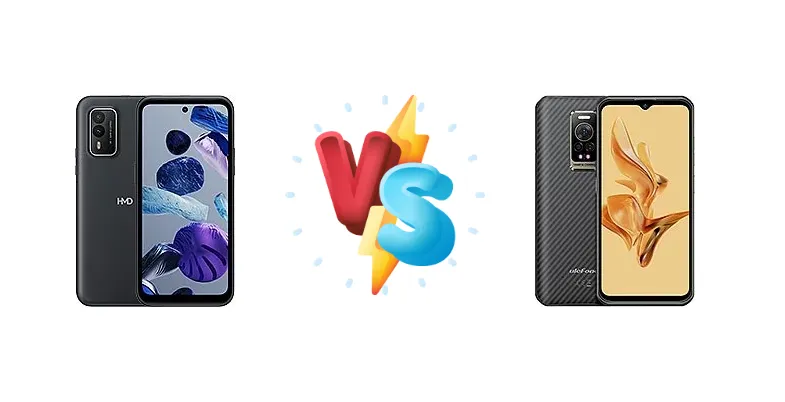
|
🏆 Quick Verdict
For the average user prioritizing rapid replenishment and convenience, the Ulefone Armor 17 Pro takes the lead. Its 66W charging, capable of a 53% charge in just 15 minutes, significantly outperforms the HMD XR21's 33W offering. However, the XR21's 5G connectivity provides future-proofing.
| PHONES | ||
|---|---|---|
| Phone Names | HMD XR21 | Ulefone Armor 17 Pro |
| Network | ||
|---|---|---|
| 2G bands | GSM 850 / 900 / 1800 / 1900 | GSM 850 / 900 / 1800 / 1900 |
| 3G bands | HSDPA 850 / 900 / 1700(AWS) / 1900 / 2100 | HSDPA 800 / 850 / 900 / 1700(AWS) / 1900 / 2100 |
| 4G bands | 1, 2, 3, 4, 5, 7, 8, 12, 13, 17, 20, 25, 26, 28, 32, 38, 39, 40, 41, 42, 43, 48, 66, 71 | 1, 2, 3, 4, 5, 7, 8, 12, 13, 17, 18, 19, 20, 25, 26, 28, 34, 38, 39, 40, 41, 66 |
| 5G bands | 1, 2, 3, 5, 7, 8, 20, 25, 28, 38, 40, 41, 48, 66, 71, 77, 78, 79 SA/NSA | - |
| Speed | HSPA, LTE, 5G | HSPA, LTE |
| Technology | GSM / HSPA / LTE / 5G | GSM / HSPA / LTE |
| Launch | ||
|---|---|---|
| Announced | 2024, May 14 | 2022, October 31 |
| Status | Available. Released 2024, May | Available. Released 2022, October 31 |
| Body | ||
|---|---|---|
| Build | Glass front (Gorilla Glass Victus), plastic back, plastic frame | - |
| Dimensions | 168 x 78.6 x 10.5 mm (6.61 x 3.09 x 0.41 in) | 172.7 x 80.4 x 12.5 mm (6.80 x 3.17 x 0.49 in) |
| SIM | Nano-SIM + Nano-SIM + eSIM (max 2 at a time) | Nano-SIM + Nano-SIM |
| Weight | 231 g (8.15 oz) | 290 g (10.23 oz) |
| - | IP68/IP69K dust/water resistant (up to 1.5m for 30 min) Drop-to-concrete resistance from up to 1.5m MIL-STD-810G compliant | |
| Display | ||
|---|---|---|
| Protection | Corning Gorilla Glass Victus | Corning Gorilla Glass 5 |
| Resolution | 1080 x 2400 pixels, 20:9 ratio (~406 ppi density) | 1080 x 2408 pixels, 20:9 ratio (~401 ppi density) |
| Size | 6.49 inches, 101.7 cm2 (~77.0% screen-to-body ratio) | 6.58 inches, 104.3 cm2 (~75.1% screen-to-body ratio) |
| Type | IPS LCD, 120Hz, 450 nits (typ), 550 nits (HBM) | IPS LCD, 120Hz |
| Platform | ||
|---|---|---|
| CPU | Octa-core (2x2.2 GHz Kryo 660 Gold & 6x1.7 GHz Kryo 660 Silver) | Octa-core (2x2.2 GHz Cortex-A76 & 6x2.0 GHz Cortex-A55) |
| Chipset | Qualcomm SM6375 Snapdragon 695 5G (6 nm) | Mediatek Helio G99 (6 nm) |
| GPU | Adreno 619 | Mali-G57 MC2 |
| OS | Android 12 | Android 12 |
| Memory | ||
|---|---|---|
| Card slot | No | microSDXC (dedicated slot) |
| Internal | 128GB 6GB RAM | 256GB 8GB RAM |
| Main Camera | ||
|---|---|---|
| Dual | 64 MP, f/1.8, (wide), 1/2.0", PDAF 8 MP, f/2.2, (ultrawide), 1/4.0", 1.12µm | - |
| Features | Dual-LED dual-tone flash, second LED flash, HDR, panorama | Triple-LED flash, HDR, panorama |
| Single | - | 16 MP, f/2.2, (wide), 1.0µm |
| Triple | - | 108 MP, f/1.9, (wide), 1/1.52”, 0.7µm, PDAF 8 MP, f/2.2, 119˚, (ultrawide), 1/4.0", 1.12µm 8 MP, (night vision), 2 infrared night vision lights |
| Video | 1080p@30fps | 1440p@30fps, 1080p@30fps |
| Selfie camera | ||
|---|---|---|
| Single | 16 MP, f/2.4 (wide) | 16 MP, f/2.2, (wide), 1.0µm |
| Video | 1080p@30fps | 1080p@30fps |
| Sound | ||
|---|---|---|
| 3.5mm jack | - | Yes |
| 35mm jack | Yes | Yes |
| Loudspeaker | Yes, with stereo speakers | Yes |
| Comms | ||
|---|---|---|
| Bluetooth | 5.1, A2DP, LE, aptX Adaptive | 5.2, A2DP, LE |
| NFC | Yes | Yes |
| Positioning | GPS (L1+L5), GLONASS (G1), BDS (B1I+B1c+B2a), GALILEO (E1+E5a), QZSS (L1+L5), NavIC (L5) | GPS, GLONASS, GALILEO, BDS |
| Radio | Unspecified | Wireless FM radio, RDS, recording |
| USB | USB Type-C 2.0, OTG | USB Type-C 2.0, OTG |
| WLAN | Wi-Fi 802.11 a/b/g/n/ac/6, dual-band | Wi-Fi 802.11 a/b/g/n/ac, dual-band |
| Features | ||
|---|---|---|
| Sensors | Fingerprint (side-mounted), accelerometer, gyro, proximity, compass, barometer | Fingerprint (side-mounted), accelerometer, gyro, proximity, compass |
| - | MagSafe compatible accessories | |
| Battery | ||
|---|---|---|
| Charging | 33W wired, PD2.0, QC3 | 66W wired, 53% in 15 min 15W wireless Wireless reversed |
| Type | Li-Po 4800 mAh | Li-Po 5380 mAh |
| Misc | ||
|---|---|---|
| Colors | Midnight Black | Black |
| Price | About 600 EUR | About 260 EUR |
HMD XR21
- 5G Connectivity for faster data speeds
- Potentially cleaner software experience (HMD's Android approach)
- Qualcomm chipset known for modem efficiency
- Slower charging speed (33W)
- Likely less emphasis on sustained GPU performance
- No wireless charging
Ulefone Armor 17 Pro
- Extremely fast 66W wired charging
- Wireless charging and reverse wireless charging
- Helio G99 potentially better for gaming
- Lacks 5G connectivity
- Rugged design may add bulk
- Ulefone's software can be more heavily customized
Display Comparison
Neither device's display specifications are provided, so a direct comparison is limited. However, given the price points, we can expect both to utilize IPS LCD panels. The Ulefone Armor 17 Pro, being a rugged device, likely prioritizes durability over display finesse, potentially resulting in thicker bezels. The HMD XR21, as a more mainstream offering, might offer slightly more refined display characteristics, but without specific data, this remains speculative.
Camera Comparison
Without detailed camera specifications, a comprehensive comparison is impossible. However, the market segment suggests both devices will feature multi-camera setups geared towards versatility rather than flagship-level image quality. We can assume both will include a primary sensor, an ultrawide, and potentially a macro lens. The absence of information regarding sensor size and aperture makes it difficult to assess low-light performance. Image processing will likely differ, with Ulefone often leaning towards more saturated colors and HMD aiming for a more natural look.
Performance
The Ulefone Armor 17 Pro's Mediatek Helio G99 (6nm) and the HMD XR21's Qualcomm Snapdragon 695 5G (6nm) represent different approaches to mobile processing. While both are built on a 6nm process for efficiency, the Snapdragon 695 prioritizes 5G connectivity alongside its octa-core CPU (2x2.2 GHz Kryo 660 Gold & 6x1.7 GHz Kryo 660 Silver). The Helio G99, with its Cortex-A76 cores (2x2.2 GHz) and Cortex-A55 cores (6x2.0 GHz), focuses more on sustained CPU and GPU performance. This suggests the Armor 17 Pro may offer a smoother experience in graphically intensive tasks, while the XR21 excels in network-dependent applications. The Snapdragon's integrated 5G modem is a key advantage for users in areas with 5G coverage.
Battery Life
The Ulefone Armor 17 Pro’s 66W wired charging is a significant advantage, promising a 53% charge in just 15 minutes. This drastically reduces downtime compared to the HMD XR21’s 33W charging, which will take considerably longer to reach full capacity. The Armor 17 Pro also includes 15W wireless charging and wireless reverse charging, adding convenience. While battery capacity isn't specified for either device, the faster charging of the Armor 17 Pro effectively mitigates the impact of a potentially smaller battery, making it ideal for users who frequently need to top up their device.
Buying Guide
Buy the HMD XR21 if you need reliable 5G connectivity for streaming, remote work, or frequent travel, and value a cleaner software experience. Buy the Ulefone Armor 17 Pro if you prioritize battery life and incredibly fast charging, especially if you're often away from power outlets and need a rugged device for demanding physical work. The Armor 17 Pro also appeals to those who value wireless charging and reverse wireless charging capabilities.