
HMD XR21 vs. Doogee S98 Pro: A Deep Dive into Rugged Smartphone Performance
| Phones Images | |||||
|---|---|---|---|---|---|
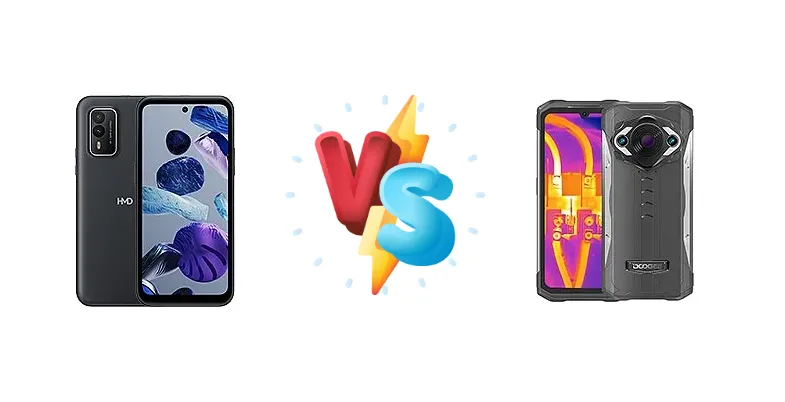
|
🏆 Quick Verdict
For the average user prioritizing 5G connectivity and a more efficient processor, the HMD XR21 emerges as the better choice. Its Snapdragon 695 offers a more modern architecture and better power management than the Doogee S98 Pro’s Helio G96, despite the latter’s slightly higher clock speeds. However, the Doogee S98 Pro’s wireless charging is a significant advantage for some.
| PHONES | ||
|---|---|---|
| Phone Names | HMD XR21 | Doogee S98 Pro |
| Network | ||
|---|---|---|
| 2G bands | GSM 850 / 900 / 1800 / 1900 | GSM 850 / 900 / 1800 / 1900 |
| 3G bands | HSDPA 850 / 900 / 1700(AWS) / 1900 / 2100 | HSDPA 800 / 850 / 900 / 1700(AWS) / 1900 / 2100 |
| 4G bands | 1, 2, 3, 4, 5, 7, 8, 12, 13, 17, 20, 25, 26, 28, 32, 38, 39, 40, 41, 42, 43, 48, 66, 71 | 1, 2, 3, 4, 5, 7, 8, 12, 13, 17, 18, 19, 20, 25, 26, 28, 34, 38, 39, 40, 41, 66 |
| 5G bands | 1, 2, 3, 5, 7, 8, 20, 25, 28, 38, 40, 41, 48, 66, 71, 77, 78, 79 SA/NSA | - |
| Speed | HSPA, LTE, 5G | HSPA, LTE |
| Technology | GSM / HSPA / LTE / 5G | GSM / CDMA / HSPA / LTE |
| Launch | ||
|---|---|---|
| Announced | 2024, May 14 | 2022, May 27 |
| Status | Available. Released 2024, May | Available. Released 2022, June 06 |
| Body | ||
|---|---|---|
| Build | Glass front (Gorilla Glass Victus), plastic back, plastic frame | - |
| Dimensions | 168 x 78.6 x 10.5 mm (6.61 x 3.09 x 0.41 in) | 172 x 82 x 15.5 mm (6.77 x 3.23 x 0.61 in) |
| SIM | Nano-SIM + Nano-SIM + eSIM (max 2 at a time) | Nano-SIM + Nano-SIM |
| Weight | 231 g (8.15 oz) | 320 g (11.29 oz) |
| Display | ||
|---|---|---|
| Protection | Corning Gorilla Glass Victus | Corning Gorilla Glass |
| Resolution | 1080 x 2400 pixels, 20:9 ratio (~406 ppi density) | 1080 x 2340 pixels, 19.5:9 ratio (~409 ppi density) |
| Size | 6.49 inches, 101.7 cm2 (~77.0% screen-to-body ratio) | 6.3 inches, 97.4 cm2 (~69.1% screen-to-body ratio) |
| Type | IPS LCD, 120Hz, 450 nits (typ), 550 nits (HBM) | IPS LCD, 500 nits (peak) |
| Platform | ||
|---|---|---|
| CPU | Octa-core (2x2.2 GHz Kryo 660 Gold & 6x1.7 GHz Kryo 660 Silver) | Octa-core (2x2.05 GHz Cortex-A76 & 6x2.0 GHz Cortex-A55) |
| Chipset | Qualcomm SM6375 Snapdragon 695 5G (6 nm) | Mediatek MT6781 Helio G96 (12 nm) |
| GPU | Adreno 619 | Mali-G57 MC2 |
| OS | Android 12 | Android 12 |
| Memory | ||
|---|---|---|
| Card slot | No | microSDXC (dedicated slot) |
| Internal | 128GB 6GB RAM | 256GB 8GB RAM |
| Main Camera | ||
|---|---|---|
| Dual | 64 MP, f/1.8, (wide), 1/2.0", PDAF 8 MP, f/2.2, (ultrawide), 1/4.0", 1.12µm | - |
| Features | Dual-LED dual-tone flash, second LED flash, HDR, panorama | Dual-LED flash, HDR, panorama |
| Triple | - | 48 MP, f/1.8, (wide), PDAF 20 MP, f/1.8, (night vision), 2 infrared night vision lights Thermal imaging camera |
| Video | 1080p@30fps | 1440p, 1080p |
| Selfie camera | ||
|---|---|---|
| Single | 16 MP, f/2.4 (wide) | 16 MP, f/2.0, (wide) |
| Video | 1080p@30fps | 1080p |
| Sound | ||
|---|---|---|
| 35mm jack | Yes | Unspecified |
| Loudspeaker | Yes, with stereo speakers | Yes |
| Comms | ||
|---|---|---|
| Bluetooth | 5.1, A2DP, LE, aptX Adaptive | 5.1, A2DP, LE |
| NFC | Yes | Yes |
| Positioning | GPS (L1+L5), GLONASS (G1), BDS (B1I+B1c+B2a), GALILEO (E1+E5a), QZSS (L1+L5), NavIC (L5) | GPS, GLONASS, BDS, GALILEO |
| Radio | Unspecified | FM radio |
| USB | USB Type-C 2.0, OTG | USB Type-C 2.0, OTG |
| WLAN | Wi-Fi 802.11 a/b/g/n/ac/6, dual-band | Wi-Fi 802.11 a/b/g/n/ac, dual-band |
| Features | ||
|---|---|---|
| Sensors | Fingerprint (side-mounted), accelerometer, gyro, proximity, compass, barometer | Fingerprint (side-mounted), accelerometer, gyro, proximity, compass |
| Battery | ||
|---|---|---|
| Charging | 33W wired, PD2.0, QC3 | 33W wired 15W wireless |
| Type | Li-Po 4800 mAh | 6000 mAh |
| Misc | ||
|---|---|---|
| Colors | Midnight Black | Black |
| Price | About 600 EUR | About 470 EUR |
HMD XR21
- More efficient Snapdragon 695 processor
- Modern 5G modem for faster connectivity
- Potentially better image processing with Qualcomm ISP
- Lacks wireless charging
- May have a less rugged design compared to Doogee
Doogee S98 Pro
- Convenient 15W wireless charging
- Potentially more ruggedized build quality
- Slightly higher CPU clock speeds (on paper)
- Less efficient Helio G96 processor
- Older 12nm fabrication process
- Potentially slower 5G speeds
Display Comparison
Neither device boasts a standout display. Both likely utilize IPS LCD panels, common in this price bracket. The focus here isn't on visual fidelity, but durability. We can infer both will prioritize scratch resistance and visibility in direct sunlight. Without specific brightness data, it's difficult to declare a winner, but the XR21's potential for software optimization with Qualcomm's image processing could yield slightly better color accuracy.
Camera Comparison
Without detailed camera specs beyond the chipsets, a direct comparison is limited. Both phones likely feature multi-camera setups geared towards versatility rather than high-end photography. The image signal processor (ISP) within the Snapdragon 695 generally offers superior image processing capabilities, potentially resulting in better dynamic range and noise reduction in the HMD XR21. We can assume both will include standard features like HDR and portrait modes, but the XR21’s ISP is likely to deliver more refined results.
Performance
The core difference lies in the chipsets. The HMD XR21’s Qualcomm Snapdragon 695 (6nm) utilizes Kryo 660 cores, offering a balance of performance and efficiency. The Doogee S98 Pro’s MediaTek Helio G96 (12nm) relies on Cortex-A76 and A55 cores. While the G96’s cores have slightly higher peak clock speeds, the 6nm fabrication process of the Snapdragon 695 provides a significant advantage in thermal efficiency. This translates to less throttling under sustained load, meaning the XR21 will likely maintain higher performance for longer periods during gaming or demanding applications. The Snapdragon 695 also integrates a more modern 5G modem, offering potentially faster and more reliable connectivity.
Battery Life
Both devices offer 33W wired charging, providing reasonably fast replenishment. However, the Doogee S98 Pro adds 15W wireless charging, a convenience feature the XR21 lacks. While battery capacity isn't specified, the Snapdragon 695’s superior power efficiency suggests the HMD XR21 will likely achieve longer battery life on a single charge, even with a potentially smaller battery capacity. The 6nm process minimizes power draw during both active use and standby.
Buying Guide
Buy the HMD XR21 if you need a reliable 5G connection for work or travel, and value a processor built on a more efficient 6nm process for extended battery life. Buy the Doogee S98 Pro if you prioritize wireless charging convenience and are less concerned about the latest 5G technology or maximizing battery runtime during intensive tasks.