
HMD XR21 vs Blackview BV9200: A Deep Dive into Rugged Smartphone Performance
| Phones Images | |||||
|---|---|---|---|---|---|
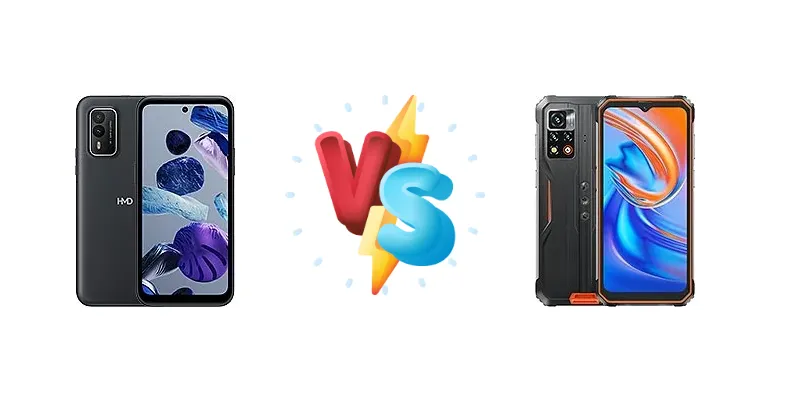
|
🏆 Quick Verdict
For the average user prioritizing 5G connectivity and a more modern chipset, the HMD XR21 is the better choice. While the Blackview BV9200 boasts faster charging and a brighter display, the XR21’s Snapdragon 695 offers a more efficient and future-proofed platform.
| PHONES | ||
|---|---|---|
| Phone Names | HMD XR21 | Blackview BV9200 |
| Network | ||
|---|---|---|
| 2G bands | GSM 850 / 900 / 1800 / 1900 | GSM 850 / 900 / 1800 / 1900 |
| 3G bands | HSDPA 850 / 900 / 1700(AWS) / 1900 / 2100 | HSDPA 850 / 900 / 1700(AWS) / 1900 / 2100 |
| 4G bands | 1, 2, 3, 4, 5, 7, 8, 12, 13, 17, 20, 25, 26, 28, 32, 38, 39, 40, 41, 42, 43, 48, 66, 71 | 1, 2, 3, 4, 5, 7, 8, 12, 13, 17, 18, 19, 20, 25, 26, 28, 34, 38, 39, 40, 41, 66 |
| 5G bands | 1, 2, 3, 5, 7, 8, 20, 25, 28, 38, 40, 41, 48, 66, 71, 77, 78, 79 SA/NSA | - |
| Speed | HSPA, LTE, 5G | HSPA, LTE |
| Technology | GSM / HSPA / LTE / 5G | GSM / CDMA / HSPA / LTE |
| - | CDMA 800 / 1900 | |
| Launch | ||
|---|---|---|
| Announced | 2024, May 14 | 2022, December 28 |
| Status | Available. Released 2024, May | Available. Released 2023, January 09 |
| Body | ||
|---|---|---|
| Build | Glass front (Gorilla Glass Victus), plastic back, plastic frame | - |
| Dimensions | 168 x 78.6 x 10.5 mm (6.61 x 3.09 x 0.41 in) | 174.5 x 81.8 x 13.6 mm (6.87 x 3.22 x 0.54 in) |
| SIM | Nano-SIM + Nano-SIM + eSIM (max 2 at a time) | Nano-SIM + Nano-SIM |
| Weight | 231 g (8.15 oz) | 310 g (10.93 oz) |
| - | IP68/IP69K dust/water resistant (up to 1.5m for 30 min) Drop-to-concrete resistance from up to 1.8m MIL-STD-810H compliant | |
| Display | ||
|---|---|---|
| Protection | Corning Gorilla Glass Victus | Corning Gorilla Glass 5 |
| Resolution | 1080 x 2400 pixels, 20:9 ratio (~406 ppi density) | 1080 x 2408 pixels, 20:9 ratio (~400 ppi density) |
| Size | 6.49 inches, 101.7 cm2 (~77.0% screen-to-body ratio) | 6.6 inches, 104.9 cm2 (~73.5% screen-to-body ratio) |
| Type | IPS LCD, 120Hz, 450 nits (typ), 550 nits (HBM) | IPS LCD, 120Hz |
| Platform | ||
|---|---|---|
| CPU | Octa-core (2x2.2 GHz Kryo 660 Gold & 6x1.7 GHz Kryo 660 Silver) | Octa-core (2x2.05 GHz Cortex-A76 & 6x2.0 GHz Cortex-A55) |
| Chipset | Qualcomm SM6375 Snapdragon 695 5G (6 nm) | Mediatek MT6781 Helio G96 (12 nm) |
| GPU | Adreno 619 | Mali-G52 MC2 |
| OS | Android 12 | Android 12, Doke-OS 3.1 |
| Memory | ||
|---|---|---|
| Card slot | No | microSDXC (dedicated slot) |
| Internal | 128GB 6GB RAM | 256GB 8GB RAM |
| - | UFS 2.1 | |
| Main Camera | ||
|---|---|---|
| Dual | 64 MP, f/1.8, (wide), 1/2.0", PDAF 8 MP, f/2.2, (ultrawide), 1/4.0", 1.12µm | - |
| Features | Dual-LED dual-tone flash, second LED flash, HDR, panorama | LED flash, HDR, panorama |
| Single | - | 16 MP, (wide), 1/3", 1.0µm |
| Triple | - | 50 MP, f/1.8, (wide), 1/2.76", 0.64µm, PDAF 8 MP, f/1.8, 120˚, (ultrawide), AF Auxiliary lens |
| Video | 1080p@30fps | 1440p@30fps, 1080p@30fps |
| Selfie camera | ||
|---|---|---|
| Single | 16 MP, f/2.4 (wide) | 16 MP, f/2.0, (wide), 1/3", 1.0µm |
| Video | 1080p@30fps | 1080p |
| Sound | ||
|---|---|---|
| 3.5mm jack | - | No |
| 35mm jack | Yes | No |
| Loudspeaker | Yes, with stereo speakers | Yes, with dual speakers |
| Comms | ||
|---|---|---|
| Bluetooth | 5.1, A2DP, LE, aptX Adaptive | 5.2, A2DP, LE |
| NFC | Yes | Yes |
| Positioning | GPS (L1+L5), GLONASS (G1), BDS (B1I+B1c+B2a), GALILEO (E1+E5a), QZSS (L1+L5), NavIC (L5) | GPS, GLONASS, GALILEO, BDS |
| Radio | Unspecified | FM radio |
| USB | USB Type-C 2.0, OTG | USB Type-C, OTG |
| WLAN | Wi-Fi 802.11 a/b/g/n/ac/6, dual-band | Wi-Fi 802.11 a/b/g/n/ac, dual-band |
| Features | ||
|---|---|---|
| Sensors | Fingerprint (side-mounted), accelerometer, gyro, proximity, compass, barometer | Fingerprint (side-mounted), accelerometer, gyro, proximity, compass, barometer |
| Battery | ||
|---|---|---|
| Charging | 33W wired, PD2.0, QC3 | 66W wired 30W wireless |
| Type | Li-Po 4800 mAh | 5000 mAh |
| Misc | ||
|---|---|---|
| Colors | Midnight Black | Black, Orange, Green |
| Price | About 600 EUR | About 200 EUR |
HMD XR21
- 5G Connectivity for faster data speeds
- More efficient Snapdragon 695 chipset
- Potentially better software support from HMD Global
- Slower charging speeds (33W)
- Display brightness likely lower than BV9200
- Camera specs are unknown
Blackview BV9200
- Fast 66W wired and 30W wireless charging
- Bright 481 nits display for outdoor use
- High contrast ratio (1423:1)
- Less efficient MediaTek Helio G96 chipset
- Older 12nm process node
- Limited 5G support
Display Comparison
The Blackview BV9200 immediately stands out with its measured 481 nits of peak brightness, a significant advantage for outdoor visibility compared to the XR21 (brightness data unavailable, but likely lower given the chipset focus). The BV9200 also boasts a 1423:1 contrast ratio, suggesting deeper blacks and more vibrant colors. However, the XR21’s display characteristics are unknown, and a higher refresh rate (not specified for either) could improve perceived smoothness. The BV9200’s brightness is a clear win for users frequently exposed to direct sunlight.
Camera Comparison
Camera specifications are limited for both devices. Without detailed sensor information, it’s difficult to make a definitive judgment. However, the absence of any mention of OIS or large sensors on either device suggests a focus on practicality rather than high-end photography. The BV9200’s inclusion of a 2MP macro camera is likely a marketing feature with limited real-world utility. Image processing will likely be the differentiating factor, and without sample images, it’s impossible to assess which device produces more pleasing results.
Performance
The HMD XR21’s Qualcomm Snapdragon 695 5G (6nm) offers a more modern architecture than the Blackview BV9200’s MediaTek Helio G96 (12nm). The 6nm process node translates to improved power efficiency and potentially lower thermal throttling during sustained workloads. While the G96’s Cortex-A76 cores clock slightly higher (2.05 GHz vs 2.2 GHz on the XR21’s Kryo 660 Gold), the Snapdragon’s overall architecture and 5G modem integration provide a more balanced and future-proof experience. The XR21 is better suited for demanding tasks and 5G applications.
Battery Life
The Blackview BV9200 dominates in charging speed, offering 66W wired and 30W wireless charging, significantly faster than the XR21’s 33W wired charging with PD2.0 and QC3 support. While battery capacity isn’t specified for either device, the BV9200’s charging capabilities will drastically reduce downtime. The XR21’s Snapdragon 695, being more power-efficient, may offset the charging disadvantage to some extent, but the BV9200 provides a clear convenience advantage for users who frequently need to top up their battery.
Buying Guide
Buy the HMD XR21 if you need reliable 5G connectivity for remote work or streaming, and value a chipset designed for sustained performance. Buy the Blackview BV9200 if you prioritize maximum battery convenience with 66W wired and 30W wireless charging, and need a display that remains visible in direct sunlight, even if it comes at the cost of processing efficiency.