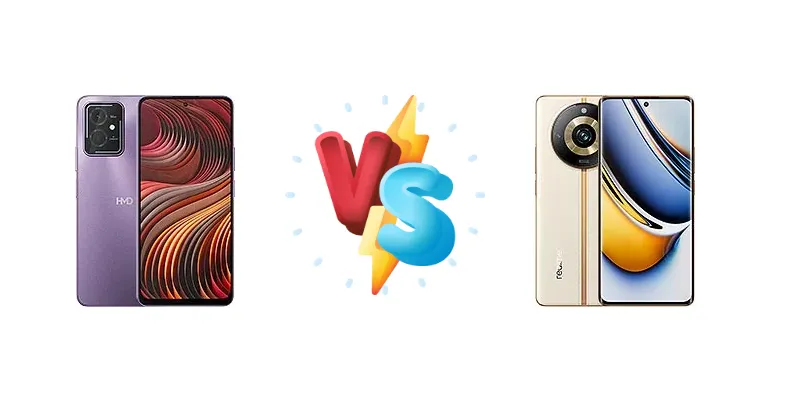
The HMD Vibe and Realme 11 Pro+ represent distinct approaches to the mid-range smartphone market. The HMD Vibe aims for a balance of affordability and functionality, while the Realme 11 Pro+ prioritizes fast charging and a brighter display. This comparison dissects their key differences to determine which device best suits your needs.
🏆 Quick Verdict
For the average user prioritizing speed and convenience, the Realme 11 Pro+ is the clear winner. Its Dimensity 7050 chipset and 100W charging significantly outperform the HMD Vibe’s Unisoc T760 and 18W charging. However, the HMD Vibe offers a compelling value proposition for those on a tighter budget.
| Network |
|---|
| 2G bands | GSM 850 / 900 / 1800 / 1900 | GSM 850 / 900 / 1800 / 1900 |
| 3G bands | HSDPA 850 / 900 / 2100 | HSDPA 850 / 900 / 2100 |
| 4G bands | 1, 3, 5, 8, 28, 40, 41 | 1, 3, 5, 8, 28, 38, 40, 41 - India |
| 5G bands | 1, 3, 5, 8, 28, 40, 41, 77, 78 SA/NSA | 1, 3, 5, 8, 28, 40, 41, 77, 78 SA/NSA - International |
| Speed | HSPA, LTE | HSPA, LTE, 5G |
| Technology | GSM / HSPA / LTE / 5G | GSM / CDMA / HSPA / CDMA2000 / LTE / 5G |
| | - | CDMA2000 1x |
| Launch |
|---|
| Announced | 2025, September 11 | 2023, May 10 |
| Status | Available. Released 2025, September 11 | Available. Released 2023, May 15 |
| Body |
|---|
| Build | Glass front, plastic frame, plastic back | Glass front, leather or plastic back, plastic frame |
| Dimensions | 165 x 75.8 x 8.7 mm (6.50 x 2.98 x 0.34 in) | 161.6 x 73.9 x 8.2 mm or 8.7 mm |
| SIM | Nano-SIM + Nano-SIM | Nano-SIM + Nano-SIM |
| Weight | 190 g (6.70 oz) | 183 g or 189 g (6.46 oz) |
| Display |
|---|
| Resolution | 720 x 1604 pixels, 20:9 ratio (~264 ppi density) | 1080 x 2412 pixels, 20:9 ratio (~394 ppi density) |
| Size | 6.67 inches, 107.2 cm2 (~85.7% screen-to-body ratio) | 6.7 inches, 108.0 cm2 (~90.5% screen-to-body ratio) |
| Type | IPS LCD, 90Hz | AMOLED, 1B colors, HDR10+, 120Hz, 950 nits (peak) |
| Platform |
|---|
| CPU | Octa-core (1x2.2 GHz Cortex-A76 & 3x Cortex-A76 & 4x Cortex-A55) | Octa-core (2x2.6 GHz Cortex-A78 & 6x2.0 GHz Cortex-A55) |
| Chipset | Unisoc T760 (6 nm) | Mediatek Dimensity 7050 (6 nm) |
| GPU | Mali-G57 | Mali-G68 MC4 |
| OS | Android 15 | Android 13, up to 2 major Android upgrades, Realme UI 5.0 |
| Memory |
|---|
| Card slot | microSDXC | No |
| Internal | 128GB 4GB RAM | 256GB 8GB RAM, 256GB 12GB RAM, 512GB 12GB RAM, 1TB 12GB RAM |
| Main Camera |
|---|
| Dual | 50 MP, (wide)
Auxiliary lens | - |
| Features | LED flash, HDR | LED flash, HDR, panorama |
| Triple | - | 200 MP, f/1.7, 23mm (wide), 1/1.4", 0.56µm, PDAF, OIS
8 MP, f/2.2, 16mm, 112˚ (ultrawide)
2 MP (macro) |
| Video | 1080p@30fps | 4K@30fps, 1080p@30/60/120/480fps, 720p@960fps, gyro-EIS |
| Selfie camera |
|---|
| Features | - | Panorama |
| Single | 8 MP | 32 MP, f/2.5, 22mm (wide) |
| Video | Yes | 1080p@30fps |
| Sound |
|---|
| 3.5mm jack | - | No |
| 35mm jack | Yes | No |
| Loudspeaker | Yes, with dual speakers | Yes, with stereo speakers |
| | - | 24-bit/192kHz audio |
| Comms |
|---|
| Bluetooth | 5.2, A2DP, LE | 5.2, A2DP, LE, aptX HD |
| NFC | No | Yes |
| Positioning | GPS, GLONASS | GPS, GLONASS, GALILEO, BDS, QZSS, NavIC |
| Radio | Unspecified | No |
| USB | USB Type-C 2.0 | USB Type-C 2.0 |
| WLAN | Wi-Fi 802.11 a/b/g/n | Wi-Fi 802.11 a/b/g/n/ac/6, dual-band |
| Features |
|---|
| Sensors | Fingerprint (side-mounted), accelerometer, proximity | Fingerprint (under display, optical), accelerometer, gyro, proximity, compass |
| Battery |
|---|
| Charging | 18W wired | 100W wired |
| Type | 5000 mAh | 5000 mAh |
| Misc |
|---|
| Colors | Black, Purple | Astral Black, Sunrise Beige, Oasis Green |
| Models | - | RMX3740, RMX3741 |
| Price | About 90 EUR | € 399.90 / ₹ 27,990 |
HMD Vibe
- Potentially lower price point
- Unisoc T760 offers decent multi-core performance
- Functional and reliable for basic tasks
- Slow 18W charging
- Inferior chipset compared to Dimensity 7050
- Likely lower display brightness and quality
Realme 11 Pro+
- 100W SuperVOOC charging
- Powerful Mediatek Dimensity 7050 chipset
- Bright 793 nit display for excellent visibility
- Potentially higher price
- Faster charging may impact long-term battery health
- Software bloatware (typical of Realme)
Display Comparison
The Realme 11 Pro+ boasts a significantly brighter display, reaching a measured 793 nits. This is crucial for outdoor visibility, a clear advantage over the HMD Vibe, whose peak brightness is not specified but is likely lower given its market positioning. While both utilize 6nm chipsets, the Realme’s brighter screen will draw more power. We expect the Realme to have a more vibrant viewing experience, particularly with HDR content, though the HMD Vibe’s panel technology is unknown. Bezels are likely comparable, given both target similar price brackets.
Camera Comparison
The Realme 11 Pro+’s camera system is likely to be more versatile, though specific details are missing. The presence of 'Photo / Video' suggests a focus on both aspects, and Realme typically equips its Pro+ models with capable sensors. The HMD Vibe’s camera specifications are unknown, but given its price point, it’s unlikely to compete with the Realme in image quality or features. We can assume the Realme will have better low-light performance and more advanced image processing capabilities. The HMD Vibe may include a 2MP macro lens, which are generally of limited utility.
Performance
The Realme 11 Pro+’s Mediatek Dimensity 7050, with its 2x2.6 GHz Cortex-A78 cores, offers a substantial performance uplift over the HMD Vibe’s Unisoc T760. The A78 cores in the Dimensity 7050 are architecturally superior to the Cortex-A76 cores found in the HMD Vibe, resulting in faster single-core performance. The Unisoc T760’s configuration of 1x A76, 3x A76, and 4x A55 is unusual and suggests a focus on multi-core performance, but it won’t match the overall speed of the Dimensity 7050. The Realme’s chipset will translate to snappier app launches and smoother multitasking. The HMD Vibe will be adequate for basic tasks, but will struggle with demanding games.
Battery Life
The Realme 11 Pro+’s 100W wired charging is a game-changer. While the HMD Vibe offers a modest 18W charging speed, the Realme can likely charge from 0-100% in under 30 minutes. The Realme 11 Pro+ has an endurance rating of 112h, suggesting good battery optimization. The HMD Vibe’s battery capacity is unknown, but even with a larger battery, the slower charging speed will be a significant drawback for users who need to quickly top up their device.
Buying Guide
Buy the HMD Vibe if you need a functional, reliable smartphone for everyday tasks and prioritize value over raw performance. It’s ideal for users who don’t heavily game or rely on fast charging. Buy the Realme 11 Pro+ if you prefer a smoother experience with demanding apps, faster charging speeds, and a brighter, more vibrant display – especially if you frequently consume media or play mobile games.
Frequently Asked Questions
❓ Is the Unisoc T760 in the HMD Vibe capable of running demanding games like Genshin Impact?
While the Unisoc T760 can *launch* Genshin Impact, expect significant compromises in graphics settings and frame rates. The chipset lacks the raw GPU power of the Dimensity 7050, leading to a less enjoyable gaming experience. You'll likely need to play on the lowest settings to maintain playable frame rates.
❓ How long does it realistically take to fully charge the Realme 11 Pro+ with the 100W charger?
Realme claims the 11 Pro+ can charge from 0-100% in around 25-30 minutes with the included 100W charger. However, this time can vary slightly depending on ambient temperature and background app activity. It's significantly faster than the HMD Vibe's 18W charging, which would likely take over 2 hours for a full charge.
❓ Does the Realme 11 Pro+ suffer from significant thermal throttling during extended gaming sessions?
The Dimensity 7050 is generally efficient, but prolonged gaming can still generate heat. Realme typically incorporates cooling solutions in its Pro+ models, but throttling may occur after 30-60 minutes of intensive gameplay. The extent of throttling will depend on ambient temperature and the game's graphics settings.