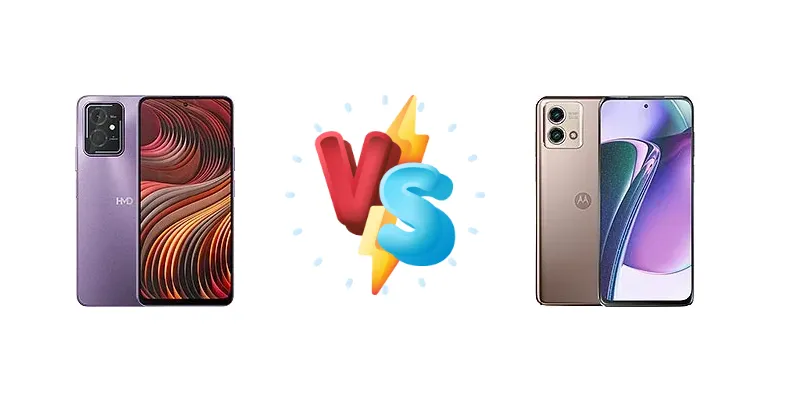
The sub-$300 5G smartphone market is fiercely competitive. The HMD Vibe, powered by a Unisoc T760, aims to deliver value, while the Motorola Moto G Stylus 5G (2023) leverages Qualcomm’s Snapdragon 6 Gen 1. This comparison dissects the core differences between these two devices, focusing on performance, efficiency, and real-world usability.
🏆 Quick Verdict
For the average user prioritizing sustained performance and efficiency, the Motorola Moto G Stylus 5G (2023) is the better choice. Its Snapdragon 6 Gen 1, built on a 4nm process, offers a noticeable advantage in thermal management and overall responsiveness compared to the HMD Vibe’s 6nm Unisoc T760.
| Network |
|---|
| 2G bands | GSM 850 / 900 / 1800 / 1900 | GSM 850 / 900 / 1800 / 1900 |
| 3G bands | HSDPA 850 / 900 / 2100 | HSDPA 850 / 900 / 1700(AWS) / 1900 / 2100 |
| 4G bands | 1, 3, 5, 8, 28, 40, 41 | 1, 2, 3, 4, 5, 7, 8, 12, 13, 14, 17, 18, 19, 20, 25, 26, 29, 30, 38, 39, 40, 41, 48, 66, 71 |
| 5G bands | 1, 3, 5, 8, 28, 40, 41, 77, 78 SA/NSA | 1, 2, 3, 5, 7, 12, 13, 14, 25, 26, 29, 30, 38, 41, 48, 66, 70, 71, 77, 78 SA/NSA |
| Speed | HSPA, LTE | HSPA, LTE, 5G |
| Technology | GSM / HSPA / LTE / 5G | GSM / HSPA / LTE / 5G |
| Launch |
|---|
| Announced | 2025, September 11 | 2023, May 30 |
| Status | Available. Released 2025, September 11 | Available. Released 2023, June 02 |
| Body |
|---|
| Build | Glass front, plastic frame, plastic back | Glass front, plastic frame, plastic back |
| Dimensions | 165 x 75.8 x 8.7 mm (6.50 x 2.98 x 0.34 in) | 162.8 x 73.8 x 9.2 mm (6.41 x 2.91 x 0.36 in) |
| SIM | Nano-SIM + Nano-SIM | Nano-SIM |
| Weight | 190 g (6.70 oz) | 202 g (7.13 oz) |
| Display |
|---|
| Resolution | 720 x 1604 pixels, 20:9 ratio (~264 ppi density) | 1080 x 2400 pixels, 20:9 ratio (~399 ppi density) |
| Size | 6.67 inches, 107.2 cm2 (~85.7% screen-to-body ratio) | 6.6 inches, 105.2 cm2 (~87.5% screen-to-body ratio) |
| Type | IPS LCD, 90Hz | IPS LCD, 120Hz |
| Platform |
|---|
| CPU | Octa-core (1x2.2 GHz Cortex-A76 & 3x Cortex-A76 & 4x Cortex-A55) | Octa-core (4x2.2 GHz Cortex-A78 & 4x1.8 GHz Cortex-A55) |
| Chipset | Unisoc T760 (6 nm) | Qualcomm SM6450 Snapdragon 6 Gen 1 (4 nm) |
| GPU | Mali-G57 | Adreno 710 |
| OS | Android 15 | Android 13, planned upgrade to Android 14 |
| Memory |
|---|
| Card slot | microSDXC | microSDXC (dedicated slot) |
| Internal | 128GB 4GB RAM | 64GB 4GB RAM, 128GB 4GB RAM, 128GB 6GB RAM, 256GB 6GB RAM |
| Main Camera |
|---|
| Dual | 50 MP, (wide)
Auxiliary lens | 50 MP, f/1.9, (wide), 1.0µm, PDAF
8 MP, f/2.2, (ultrawide), 1/4.0", 1.12µm, AF |
| Features | LED flash, HDR | LED flash, HDR, panorama |
| Video | 1080p@30fps | 4K@30fps, 1080p@30/60fps |
| Selfie camera |
|---|
| Features | - | HDR |
| Single | 8 MP | 16 MP, f/2.5, (wide), 1.0µm |
| Video | Yes | 1080p@30fps |
| Sound |
|---|
| 35mm jack | Yes | Yes |
| Loudspeaker | Yes, with dual speakers | Yes, with stereo speakers |
| Comms |
|---|
| Bluetooth | 5.2, A2DP, LE | 5.1, A2DP, LE |
| NFC | No | Yes |
| Positioning | GPS, GLONASS | GPS (L1+L5), GALILEO |
| Radio | Unspecified | FM radio |
| USB | USB Type-C 2.0 | USB Type-C 2.0 |
| WLAN | Wi-Fi 802.11 a/b/g/n | Wi-Fi 802.11 a/b/g/n/ac, dual-band |
| Features |
|---|
| Sensors | Fingerprint (side-mounted), accelerometer, proximity | Fingerprint (side-mounted), accelerometer, gyro, proximity, compass, barometer |
| Battery |
|---|
| Charging | 18W wired | 20W wired |
| Type | 5000 mAh | Li-Po 5000 mAh |
| Misc |
|---|
| Colors | Black, Purple | Cosmic Black, Rose Champagne |
| Models | - | XT2315-1, XT2315-4 |
| Price | About 90 EUR | $ 93.43 |
HMD Vibe
- Potentially lower price point
- Unisoc chipset offers 5G connectivity
- May offer unique software features from HMD
- Less efficient Unisoc T760 chipset
- Likely lower sustained performance
- Image processing may be less refined
Motorola Moto G Stylus 5G (2023)
- More efficient Snapdragon 6 Gen 1 (4nm)
- Superior CPU architecture (Cortex-A78)
- Better thermal management for sustained performance
- Potentially higher price
- Motorola’s software can include bloatware
- Stylus may not be useful for all users
Display Comparison
Neither device boasts a flagship-level display. While specific panel details (brightness nits, color gamut coverage) are absent, the focus here is on the underlying processors impacting UI smoothness. The display quality is likely similar, making the chipset the more significant differentiator. Bezels are expected to be comparable given the price point, and color accuracy will likely be tuned for vibrant, rather than accurate, reproduction.
Camera Comparison
Without detailed camera specs beyond the presence of a stylus on the Motorola, a direct comparison is limited. However, the Motorola’s brand reputation suggests a more refined image processing pipeline. The HMD Vibe, being a newer entrant, may lack the software optimization found in Motorola’s devices. We can assume both will feature a primary camera, but the Snapdragon’s ISP (Image Signal Processor) is generally more capable, potentially leading to better dynamic range and low-light performance. The presence of a 2MP macro camera on either device is largely a marketing feature with limited practical benefit.
Performance
The core battleground is the chipset. The Motorola’s Snapdragon 6 Gen 1 (4nm) utilizes four Cortex-A78 cores clocked at 2.2 GHz, offering a significant architectural advantage over the HMD Vibe’s Unisoc T760. The T760 employs a mix of Cortex-A76 and A55 cores, with the A76 being an older generation. The 4nm fabrication process of the Snapdragon is crucial; it translates to lower power consumption and reduced heat generation under load, minimizing throttling during extended gaming or demanding tasks. This means the Moto G Stylus 5G will likely maintain higher sustained performance. While both have octa-core CPUs, the Snapdragon’s core design is more modern and efficient.
Battery Life
The HMD Vibe charges at 18W, while the Motorola supports 20W wired charging. While a 2W difference isn’t massive, the Snapdragon 6 Gen 1’s superior efficiency means the Motorola will likely achieve a longer overall battery life despite potentially having a similar capacity battery. The 4nm process reduces power draw during all tasks, extending usage between charges. Expect both phones to fully charge in around 1.5-2 hours, but the Motorola will likely offer more screen-on time.
Buying Guide
Buy the HMD Vibe if you prioritize a potentially lower upfront cost and are primarily focused on basic smartphone tasks like calling, texting, and light social media use. Buy the Motorola Moto G Stylus 5G (2023) if you value smoother multitasking, more consistent gaming performance, and a more efficient chipset that will likely hold up better over time, especially given the stylus functionality for productivity.
Frequently Asked Questions
❓ Will the Unisoc T760 in the HMD Vibe struggle with graphically demanding games like Genshin Impact?
Yes, the Unisoc T760 will likely exhibit noticeable frame drops and throttling in demanding games like Genshin Impact. The older Cortex-A76 cores and 6nm process aren't optimized for sustained high performance like the Snapdragon 6 Gen 1.
❓ Does the Motorola Moto G Stylus 5G (2023) support active pen features beyond basic note-taking?
The Motorola Moto G Stylus 5G (2023) supports basic active pen features like quick notes and screenshot annotations. However, it doesn't offer the advanced pressure sensitivity or software integration found in higher-end stylus-equipped devices like the Samsung Galaxy S23 Ultra.
❓ How much bloatware is pre-installed on the Motorola Moto G Stylus 5G (2023)?
Motorola is known for including some pre-installed apps, often referred to as bloatware. While the amount has decreased in recent years, users can expect to find a few third-party apps pre-installed, some of which can be uninstalled.
❓ Is the 18W charging on the HMD Vibe significantly slower than the 20W on the Motorola?
The 2W difference in charging wattage isn't massive, but combined with the Snapdragon's efficiency, the Motorola will likely charge slightly faster and maintain battery life better overall. The real-world difference in 0-100% charge time will likely be around 15-20 minutes.